 Reviewed by
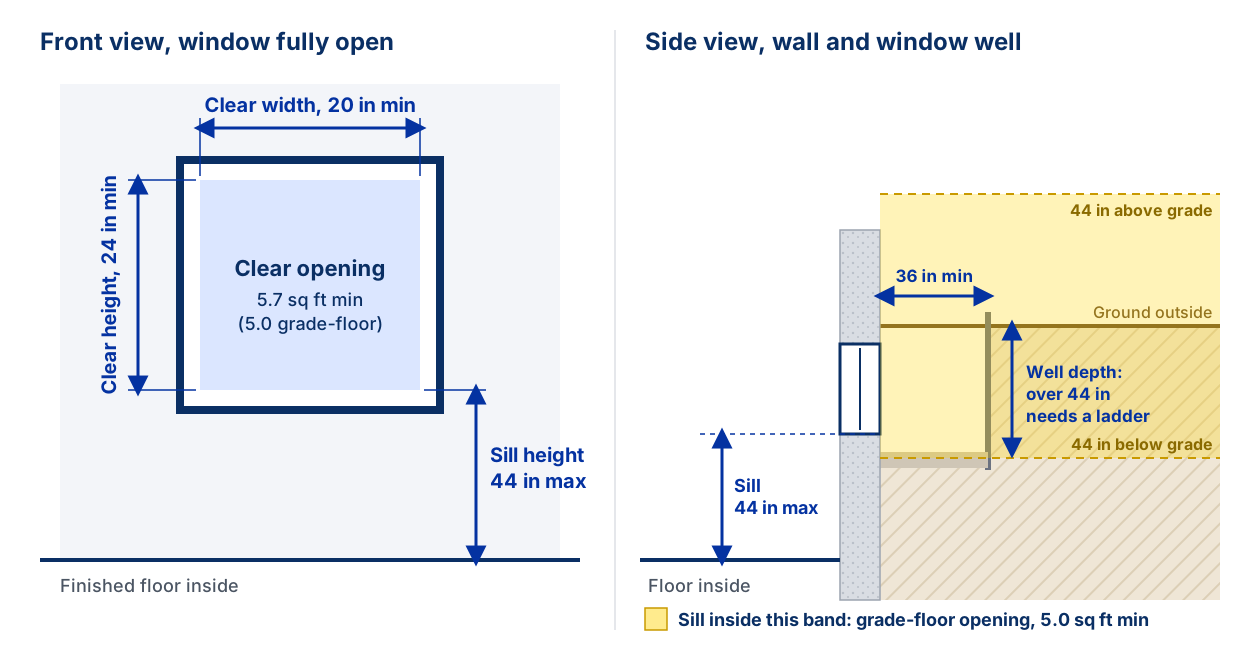
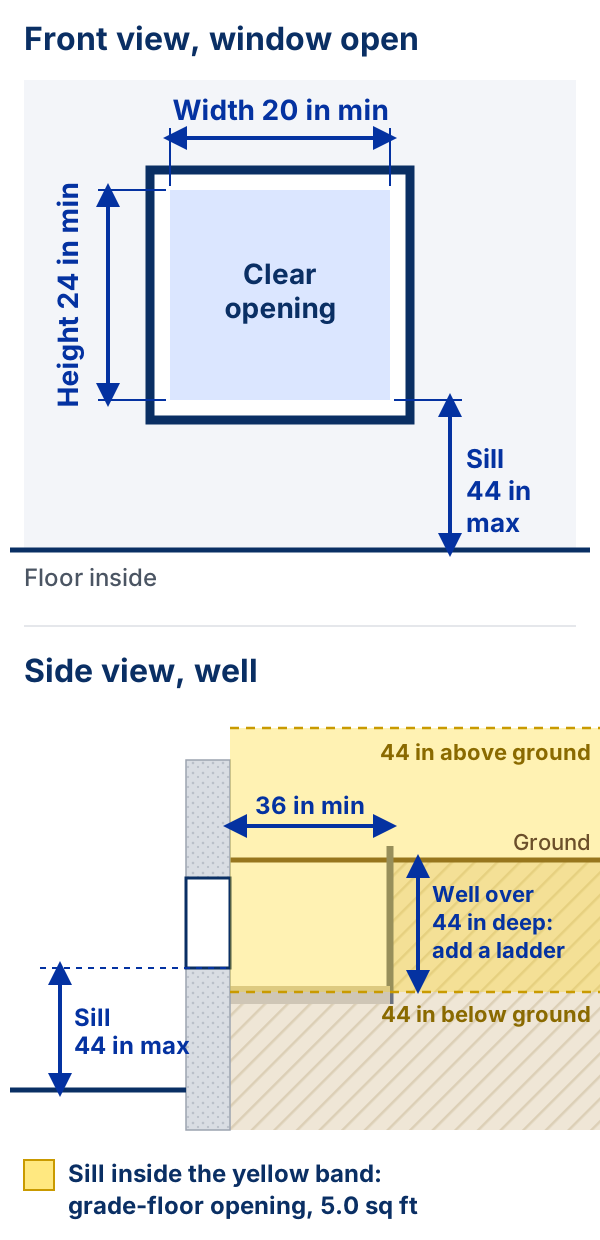
A basement egress window is an emergency escape opening sized for you to climb out and a firefighter to climb in. The model residential code sets four limits: 5.7 square feet of clear opening, 20 inches of clear width, 24 inches of clear height, and a sill no more than 44 inches above the floor.
If you’re finishing a basement or adding a bedroom below ground level, there’s one feature you can’t overlook: a basement egress window. These windows aren’t just nice to have — they’re required by law for any habitable space below grade. Egress windows provide a safe exit in the event of a fire or emergency, and installing them correctly is critical for meeting local building codes and ensuring your family’s safety. In this guide, we’ll cover everything you need to know about basement egress windows: from code requirements and window types to installation tips and common mistakes to avoid.
Key Takeaways
- Code minimum: 5.7 sq ft opening (5.0 for a grade-floor opening), 20″ wide × 24″ tall, sill ≤44″ from floor — required in every basement sleeping room.
- Window well rules: 9 sq ft floor area, 36″ horizontal projection, ladder if deeper than 44″.
- Best style for tight rough openings: casement (a 36″×48″ unit clears the minimums because the whole sash swings open).
- Code violation = insurance + safety risk: non-compliant basement bedrooms can void coverage and fail inspections.
- Cost: adding egress while you finish the basement costs less than a retrofit later, when concrete cutting and a new well come on top of finished walls.
What Is an Egress Window (and Why It’s Required)
An egress window is an operable window that meets the size and sill limits the International Residential Code sets for an emergency escape and rescue opening in Section R310. The rule exists because a basement often has a single stairway, and if smoke fills it, the window becomes your second way out and the rescuers’ way in.
These windows are especially important in older homes being updated or converted into rentals. Adding a finished basement with bedrooms in Columbus, for example, requires at least one egress-compliant window per bedroom under the local code.
When a Basement Legally Needs an Egress Window
A basement needs an egress window when the house is new construction or when a sleeping room is created below grade. Section R310.1 of the model code requires at least one emergency escape opening in basements, habitable attics and every sleeping room. The exceptions are narrow: storm shelters and basements used only for mechanical equipment with no more than 200 square feet of floor area.
Remodeling an existing basement follows a different rule. Section R310.6 of the 2018 International Residential Code covers that case, and 2018 is the edition Ohio’s residential code is built on. Altering or repairing an existing basement does not by itself require a new escape opening. A new sleeping room does: each bedroom you add down there needs its own opening that meets R310.
Here is how that plays out in a typical project. You finish an older basement into a family room and a home office, and no egress window is required for that work. Two years later the office becomes a guest bedroom, and now that room needs an opening that passes all four limits below.
Building Code Requirements for Egress Windows
- Minimum net clear opening: 5.7 square feet (or 820 square inches); 5.0 square feet for a grade-floor opening
- Minimum opening height: 24 inches
- Minimum opening width: 20 inches
- Maximum sill height from floor: 44 inches
- Window must open without tools or keys
- If below grade: A window well is required with proper size and clearance
If the egress window is installed below ground level, the window well must allow for easy exit, with at least 9 square feet of clear floor area and dimensions of at least 36 inches in width and projection. A permanent ladder or steps is required if the well depth exceeds 44 inches.

Why Some Basement Windows Only Need 5.0 Square Feet
A basement window can use the smaller 5.0-square-foot minimum when it counts as a grade-floor opening. That term means the sill sits within 44 inches of the finished ground outside, above it or below it. A window set deeper than that needs the standard 5.7 square feet.
Many guides describe 5.0 as a rule for ground-floor windows only. The code definition measures from the ground outside, not from the floor inside, so it also covers a lot of basement windows. Delaware County Building Safety spells this out in its January 2024 egress handout, which cites Section 310 of the 2019 Residential Code of Ohio. The handout lists 5.7 square feet, or 5.0 when the sill is within 44 inches of the adjacent finished grade.
Take two windows in the same house. One has its sill 30 inches below the outside ground, so it qualifies as a grade-floor opening and 720 square inches of clear opening can be enough. The other sits in a deep well with the sill 50 inches below grade, so it needs the full 820.8 square inches.
The model code text reaches a little further. The 2018 IRC exception reads “grade floor openings or below-grade openings,” which can be read as 5.0 for any basement window. The Ohio county handout we checked states only the grade-floor version. Treat 5.0 as available when the sill is within 44 inches of grade, and ask your building department before relying on it for a deeper window.
Check Your Window Against the Code Before You Order
The fastest way to know whether a window passes is to measure its clear opening with the sash fully open and test each limit on its own. A window can clear the area rule and still fail on width, height or sill height, and the checker below flags each one separately.
Egress window checker
Open the window fully and measure the clear opening in inches. Every field updates the result.
Enter the clear width, clear height and sill height to see the result.
Checks the limits in IRC Section R310 as used by the 2019 Residential Code of Ohio. Your building department makes the final call, so confirm before you order a window or cut an opening.
How to measure the clear opening
Measure the way an inspector does, with the window opened as far as its normal hardware allows:
- Open the sash fully by its normal operation from inside, without removing it or forcing the hinges.
- Measure the clear width at the narrowest point, including anything that sticks into the opening, such as the open sash or the operator arm.
- Measure the clear height the same way, from the lowest to the highest point of the open space.
- Measure the sill height from the finished floor to the bottom of the clear opening, not to the top of the trim.
- Multiply clear width by clear height in inches and divide by 144 to get square feet.
The size printed on a quote is usually the frame size. Mixing it up with the clear opening is how people order a window that looks big enough and still fails. A 36 × 48 inch casement and a 36 × 48 inch double-hung share the same label, yet the double-hung opens less than half its height because the two sashes overlap.
Types of Basement Egress Windows
Casement Egress Windows
- Hinged on one side and open outward like a door
- Ideal for narrow wall openings, as they offer a wide clear opening
- Often the most space-efficient choice
Sliding Egress Windows
- One sash slides horizontally over the other
- Require a wider window opening to meet the minimum clear opening size
- Popular in more modern basements with long window wells
Single-Hung Egress Windows
- Lower sash slides vertically
- Can meet egress requirements, but often require large window openings
- Less common due to their vertical clearance needs
Window Type Comparison Table
| Window Type | Meets Code? | Opening Style | Best For | Limitations |
| Casement | ✔ | Outward swing | Narrow basement walls | Needs exterior clearance |
| Sliding | ✔ | Horizontal slide | Wide basement wall openings | Larger frame required |
| Single-Hung | ✔ (if sized) | Vertical slide | Traditional designs | Heavy and harder to meet dimensions |
| Awning / Hopper | ✘ | Top/bottom hinge | Not suitable for egress | Opening is too small or inward |
What Size Casement or Double-Hung Window Passes Egress
The two minimum dimensions never pass on their own: a 20 by 24 inch opening is only 3.3 square feet. To reach 5.7 square feet, a 24-inch-tall opening has to be at least 34¼ inches wide. At the minimum width of 20 inches, it has to be about 41 inches tall.
That math explains why casements are the easiest style to make pass. A casement swings its whole sash out of the way, so the open space stays close to the frame size. A double-hung or single-hung window opens one sash at a time, so its clear height stays under half the frame height. A slider has the same limit across its width.
Clear width you need for each clear height
Find your clear height in the first column and read the minimum clear width, rounded up to the next quarter inch:
| Clear height | Clear width for 5.7 sq ft | Clear width for 5.0 sq ft (grade-floor) |
|---|---|---|
| 24 in | 34¼ in | 30 in |
| 26 in | 31¾ in | 27¾ in |
| 28 in | 29½ in | 25¾ in |
| 30 in | 27½ in | 24 in |
| 32 in | 25¾ in | 22½ in |
| 34 in | 24¼ in | 21¼ in |
| 36 in | 23 in | 20 in |
| 38 in | 21¾ in | 20 in |
| 40 in | 20¾ in | 20 in |
| 42 in | 20 in | 20 in |
Use the 5.0 column only for a window that qualifies as a grade-floor opening. Many manufacturers publish the clear opening for each unit size in their spec sheets, and that figure is the one to compare with the table, not the rough opening. If your existing opening already has the clear dimensions, the job is a standard window replacement in the same opening rather than foundation work.
Window Wells: Requirements and Practical Tips
- At least 36 inches wide and out from the wall
- Have a floor area of 9 square feet or more
- Include a permanent ladder or steps if deeper than 44 inches
- Drained properly to prevent flooding or ice buildup
In colder climates like Minneapolis or Madison, it’s crucial to install proper drainage and consider a clear cover to keep out snow, leaves, and water. A flooded well can freeze over and become unusable in an emergency.

Covers and grates can go over the well as long as they open from below without a key or tool and with no more effort than the window itself (IRC Section R310.4). That rules out padlocks and screwed-down grates. Test a heavy cover from inside after the first snow: a panel that lifts easily in July can stay pinned under a snow load in January.
Permits for Egress Work in Columbus and Its Suburbs
Egress work in Columbus needs a building permit, and cutting a new opening needs plans as well. The City of Columbus Building and Zoning Services publishes a list of typical residential projects. It marks window replacement as permit only, while creating a new window opening or finishing a basement needs both a permit and plan review.
The property address decides which office reviews the work. A Columbus mailing address does not always mean the City of Columbus. Parts of the metro with that address belong to townships or neighboring cities that run their own building departments. Delaware County, north of the city, publishes the egress handout quoted above for the areas it covers.
Historic districts add a step. The city notes that projects in German Village and other historic districts may need extra approvals before work begins. Window changes are part of the exterior work those commissions review. Our guide to replacing windows in historic Ohio homes covers how that review works.
For the application, keep the manufacturer’s spec sheet with the clear opening dimensions at hand. Those are the numbers the plan reviewer and the final inspection compare with the code minimums.
Tips for Installing or Upgrading to Egress
- Consult your local code office first — requirements can vary slightly by city or state
- Hire an experienced contractor — especially for cutting through foundation walls
- Choose window size based on function — casement for narrow walls, sliders for wide layouts
- Ensure proper drainage in the window well — add gravel, drain tile, or tie into sump system
- Schedule a final inspection to confirm compliance and avoid future resale issues
In many Midwest cities, improperly installed egress windows are one of the top reasons basement bedrooms fail inspection. Taking shortcuts here can lead to major code violations and safety risks.
Conclusion
If you’re unsure about your current windows, it’s worth getting a professional assessment. Especially for families with children or homeowners planning to rent out basement space, egress compliance is critical — not just legally, but ethically.
FAQ: Common Questions About Egress Windows
Quick answers to common reader questions, drawn directly from real search intents.
An egress window must have a minimum opening of 5.7 sq. ft. (5.0 for a grade-floor opening), be no more than 44 inches off the floor, and open fully without tools or keys. If it’s below grade, a window well is also required.
Under the 2019 Residential Code of Ohio, which is based on the 2018 IRC, every basement that contains a sleeping room must have at least one egress window meeting four criteria: minimum opening of 5.7 sq ft (5.0 sq ft for grade-floor windows), minimum width 20 inches, minimum height 24 inches, and sill no higher than 44 inches above the finished floor. Window wells must be at least 9 sq ft with a horizontal projection of 36 inches and include a permanently affixed ladder or steps if the well is deeper than 44 inches.
You need one egress window per sleeping room in the basement. A finished basement with no sleeping rooms typically requires zero egress windows under most local codes, though the model code still asks for one opening in the basement of a new house. If you plan to add a bedroom later, install the egress window during initial finishing, because a retrofit means cutting through finished walls.
Yes, but only if the basement contains a sleeping room. A basement bedroom without a code-compliant egress window is an active code violation that can void homeowners insurance, fail home inspections, and create life-safety risk in fire scenarios. Existing basements used only for storage or laundry do not need one when you remodel them. If you are buying a home with a finished basement bedroom, confirm the egress window meets current IRC dimensions before closing.
For basement bedrooms, plan on a minimum 5.7 sq ft net clear opening (5.0 if the sill is within 44 inches of the outside ground) with 20″ minimum width and 24″ minimum height. The most common code-compliant egress window is a casement style at 36″ wide × 48″ tall — its outward-swinging operation gives the largest opening for the smallest rough opening. Sliders and double-hungs work but require larger frames to hit the same clear opening because half the area is always blocked.
Yes — any egress window with a sill below the surrounding grade requires a window well. The well must extend a minimum 36 inches horizontally from the foundation, provide 9 sq ft of floor area, and include a permanently attached ladder if the well is deeper than 44 inches. Ohio code also requires the well cover (if any) to be openable from inside without tools or special knowledge. Pre-fab galvanized steel and stone-faced composite wells are the two most common installs.
Yes, a cover, grate or set of bars can sit over an escape window or its well if it opens from inside without a key, a tool or special knowledge. IRC Section R310.4 adds two conditions: it must take no more force than opening the window itself, and the opening behind it must still meet the size minimums.
A basement window is non-egress if it misses even one of the four limits on area, width, height or sill height. Hopper and awning windows fail by design, because the tilted sash blocks the opening. A short slider fails when its clear height is under 24 inches. Swapping the unit only helps when the rough opening is big enough for a compliant window.