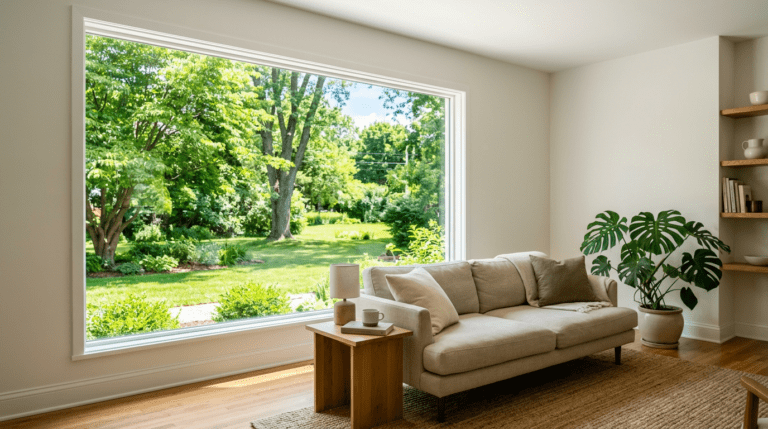
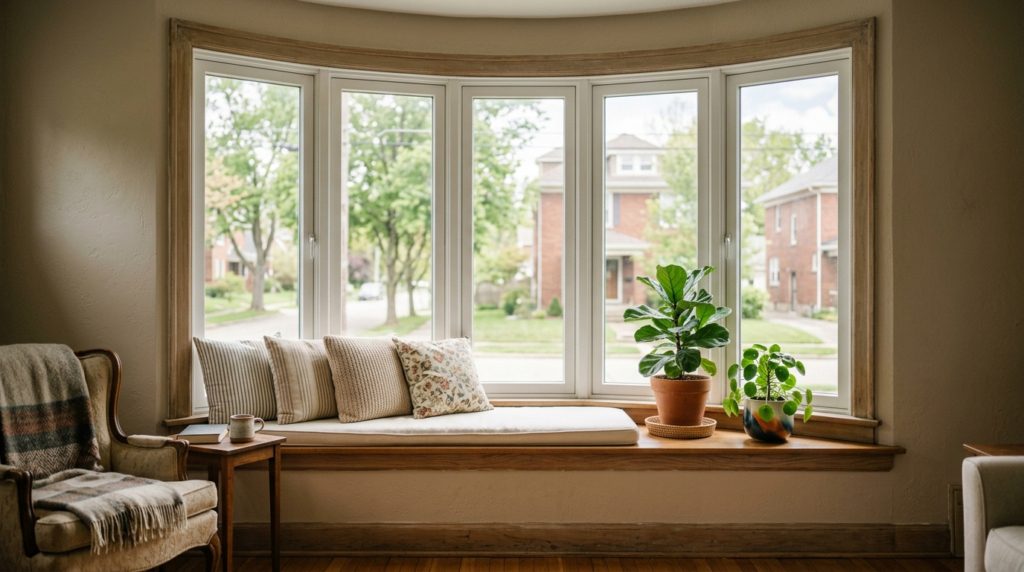
A bow window curves gently out from the wall in four, five, or six equal panes, turning a flat opening into a softly rounded projection that pulls in light from several angles at once. Where a bay window juts out at sharp angles, a bow flows in a smooth arc, and that curve is the whole appeal. It also hands you a shelf of new interior space, which is why so many bows end up holding a window seat, a row of plants, or a reading chair.
This guide covers what a bow window actually is, how it differs from a bay, the real pros and cons, what drives the cost, and the design ideas that make the curve work in a room. Because a bow projects past the house and adds several new seams, it is as much a structural decision as a style one, so it pays to plan it alongside the rest of your window installation.
Quick answer: A bow window is a curved projection made of four to six equal windows joined at slight angles. Its strengths are wide views, more daylight, and bonus interior space; its trade-offs are higher cost, the need for a wide wall, and more seams to seal. It suits living rooms, dining rooms, and bedrooms with room to spare.
What Is a Bow Window?
A bow window is a single window unit built from several individual sashes set side by side at shallow angles, so the run of glass forms a curve instead of a straight line. Most bows use four, five, or six panes of roughly equal width, and the more panes there are, the rounder and more sweeping the curve looks from inside and out. Viewed from above, the window traces a gentle arc that reaches a foot or two beyond the wall.
That equal-width construction is the signature of a bow. Each section is usually the same size, which gives the unit its even, symmetrical look and sets it apart from other projecting windows. The whole assembly sits on a projecting base and is capped by a small head board or roof, since it extends past the siding and needs its own weather protection top and bottom.
Because the curve is made of flat panes meeting at angles rather than truly bent glass, a bow can mix fixed and operable sections. The middle panes are often fixed picture units for an unbroken view, while the end panes open to let air through. That layout is worth deciding early, because it shapes both the price and how the room actually feels to live in.
Bow Windows vs. Bay Windows
Buyers shop for these two together because both project from the wall, but they are built differently and suit different walls. A bay window is angular: one large picture window in the center with two flanking sashes set at sharp angles, usually somewhere around thirty to forty-five degrees. It projects deep and needs less width, so it fits a narrower opening.
A bow is the curved cousin. It uses more sashes of equal size set at gentler angles, so it spreads wider across the wall and reaches out less far. The result is a softer, rounded profile and a broader, more panoramic span of glass. As a rule of thumb, a bay makes a bold, deep nook on a smaller wall, while a bow makes a wide, even sweep on a larger one.
The practical differences follow from the shape. A bow’s many equal panes gather light from more directions and give a wider seat, but the extra sections cost more and demand more wall. A bay’s big center pane offers one clear, dramatic view and tends to cost less. Neither is better outright; the right pick depends on your wall width and the look you are after.
The Pros of Bow Windows
The reason homeowners pay more for a bow comes down to what the curve gives back. More glass set at more angles means daylight enters the room from early morning to late afternoon, not just when the sun faces a single flat pane. Rooms that felt boxed in often read as open and bright once a bow replaces an ordinary window.
The projection also creates usable space that did not exist before. The sill of a bow is deep enough for a window seat, a bench, a run of potted herbs, or a reading chair tucked into the curve. On the outside, the rounded bump adds dimension and curb appeal to an otherwise flat facade, and a bow can even wrap a corner to frame a yard or garden.
- Wider, panoramic views across the broad arc of glass, with fewer thick frames breaking the sightline.
- More natural light pulled in from several directions at once.
- Bonus interior space on the deep sill for seating, storage, or display.
- Stronger curb appeal from a three-dimensional feature on the exterior.
- Flexible ventilation when the end sections open as casement or double-hung sashes.
The Cons to Weigh Before You Buy
A bow window asks for more than a standard replacement, and knowing the trade-offs up front saves disappointment later. The first is cost. More sashes, more glass, and a more involved install make a bow one of the pricier window choices, often well above a comparable bay. It is a feature window, not a budget swap.
The second is space and structure. A bow needs a wide, fairly flat wall to sit on, so it does not fit every room. Because it hangs out past the siding, the projecting box needs proper support below and a small roof above, and that framing is part of the job, not an extra. The added panes also mean more joints where two sections meet, and every joint is a seam that has to be sealed and maintained.
On replacement jobs around Columbus, the bow itself is rarely what we get called back for. It is the box underneath and the little roof on top, where flashing got rushed, that lets water in. The glass is the easy part; weatherproofing a projection is where the skill shows.
- Higher cost than a flat window or even a bay, from the added units and labor.
- Needs a wide wall, which rules out narrow or broken-up elevations.
- More seams to seal, so drafts and leaks are likelier if the install is sloppy.
- Structural support required below, with a flashed roof cap above the projection.
- Custom treatments and furniture, since the curve rarely fits off-the-shelf pieces.
What Drives the Cost of a Bow Window
There is no single price for a bow window, because the same curved shape can be built a dozen ways. The biggest lever is the number and size of the sashes. A wide six-pane bow costs far more than a compact four-pane one, simply because it is more window. After that, the frame material sets the baseline, with vinyl at the affordable end and wood or fiberglass-clad units costing more for their look and longevity.
Glass choice matters next. Insulated units with a low-emissivity coating and an argon fill cost more than basic glass, but they pay it back in comfort across a wall of this much glazing. The parts you do not see add up too. Structural support for the projection, a built and flashed roof cap, interior trim, and the labor to weave it all into the wall are a real share of the total. Failed or foggy seals down the road are their own expense, which is why quality glass matters, and why we treat any sealed-glass repair as a fix to the seal, not just the pane.
Because every wall and every bow is different, the only honest number comes from measuring the opening in person. A good quote spells out the units, the glass package, and the structural work, so you can see what you are paying for instead of one lump figure.
Energy Efficiency in an Ohio Climate
A bow window is a lot of glass pushed out into the weather, so in a climate like Ohio’s it deserves a closer look than a single flat pane. The good news is that a well-built bow with insulated, low-E glass and tight seals performs on par with any quality window. The catch is that there is more of it to get right, and the weak points are the parts that are not glass.
The floor of the projection, the seat board, and the knee wall below it are the spots that turn cold in a Columbus winter. If that box is not insulated and air-sealed as carefully as the glass, you get a chilly draft pooling at the sill and condensation on the deep inside ledge during a freeze-thaw swing. The small roof above the bow has to shed snow and shed it away from the seams, because standing meltwater and ice are what work a seal loose over a few seasons.
None of this is a reason to avoid a bow. It is a reason to insist the install treats the whole assembly as a system: good glass, yes, but also an insulated base, a flashed cap, and continuous air sealing. Done right, a bow handles a humid Ohio summer and a hard winter as well as the wall around it.
Design Ideas for the Curve
The deep sill is the part everyone wants to decorate, and the curve rewards a little planning. The classic move is a window seat: a built-in bench across the base, topped with a cushion and pillows, with drawers or cabinets underneath for storage you would not otherwise have. In a living room it becomes a reading nook; in a bedroom, a daybed alcove; in a kitchen or dining area, a banquette for a small table.
Greenery is the low-effort option, since the multi-angle light is ideal for plants, and a row of pots along the ledge softens all that glass. Keep furniture in scale. A standard straight sofa fights the arc, so a curved bench or a pair of chairs angled to the curve sits better, and built-in bookshelves flanking the opening frame it as a feature.
Window treatments need a moment of thought, because the curve will not take a single straight rod. The usual solutions are individual shades or blinds fitted to each pane, a flexible or hinged curved track for drapery, or cafe-style shutters on the lower sashes for privacy without losing the top light. Layering a sheer with a heavier panel gives you control over glare through the day.
- Window seat with storage built into the base of the curve.
- Reading nook or daybed tucked into the projection.
- Plant ledge that puts the multi-angle daylight to work.
- Per-pane shades or a curved track for treatments that follow the arc.
- Flanking bookshelves to frame the window as a focal point.
Operable Units and Where a Bow Fits Best
A bow does not have to be a fixed wall of glass. Most are built with the center panes as fixed picture units, which keep the view clean, and the end panes as operating sashes for air. Those working sections are usually casements that crank outward or double-hung sashes that slide, and the choice affects both ventilation and the way the window reads.
Match the operable style to the room. Casement ends scoop a breeze and seal tight against Ohio wind, which suits a living or dining room. Double-hung ends feel more traditional and are easy to work over a seat or counter. If a bedroom bow needs to double as a fire egress, at least one section must open wide enough to climb through, so confirm that before you finalize the layout. Our guides to the casement and double-hung styles cover how each one operates.
As for placement, a bow wants a wide, sunny wall with room to breathe. Living rooms and dining rooms are the natural homes, where the seat and the view earn their keep, and primary bedrooms or breakfast nooks work well too. The one thing a bow demands is width, so a cramped or chopped-up wall is better served by a bay or a single large picture window.
Thinking About a Bow Window?
A bow window is one of the bigger window decisions you can make, because it changes the wall, the light, and the room all at once. The difference between a bow that feels like a showpiece and one that drafts or leaks is almost always in the measuring, the structural work, and the weatherproofing, not the glass itself.
If you are weighing a bow for a Columbus or Cincinnati home, get a clear, no-pressure assessment first. Book a free quote and our in-house team will measure the wall, talk through the units and glass, and tell you straight whether a bow, a bay, or a different window is the right call.
FAQ: Bow Windows

Ready to fix your windows? Get a free quote in 30 seconds.
Family-owned, licensed & insured. Free, no-obligation quotes.