The bathroom is the one room where you want bright daylight and complete privacy at the same time, which is what makes its window harder to get right than any other in the house. Pick wrong and you end up taping a towel over the glass or living in a dim, mildew-prone room. Pick well and you get a window that glows with light, hides what it should, and shrugs off years of steam.
This guide walks through how to weigh privacy, light, ventilation, and the moisture that quietly wrecks bathroom windows in a climate like Ohio’s. You will see which window types and obscure glass options work best, why the insulating glass matters more than the pattern, and what to check before a new window installation.
Quick answer: Choose an operable window, such as an awning or casement, placed high or to the side of fixtures, fitted with obscure or frosted glass for privacy. Use insulated, tempered double-pane glass to handle moisture and safety, and a moisture-proof frame like vinyl or fiberglass.
What Makes a Bathroom Window Different
Most rooms ask one thing of a window: let in light and a view. A bathroom asks for the opposite of a view, plenty of light anyway, a way to vent steam, and glass that is safe to stand next to wet and undressed. Balancing those competing demands is what makes the choice tricky.
Privacy is the obvious one, but it is not the demand that decides how long the window lasts. That title goes to moisture. A hot shower fills the room with humid air, and in winter that warm, wet air hits cold glass and turns straight back into water. The condensation runs down the pane, collects on the sill, and sits there. Over a few Ohio winters, that standing water is what rots the sill, feeds mildew in the corners, and works its way into a failing seal.
So a good bathroom window has to do four jobs at once: block the sightline, still pass daylight, open to clear the steam, and resist the water it lives in. Get the privacy glass right but ignore the moisture, and you have a private window that fogs, drips, and rots. Keep all four in mind and the rest of the decisions fall into place.
How to Choose the Right Bathroom Window, Step by Step
Choosing a bathroom window is less about picking a favorite style and more about working through the room’s constraints in the right order. Start with the problem you most need to solve, which in almost every bathroom is the sightline, then layer the practical requirements on top so nothing important gets traded away.
Work through the steps below before you fall in love with a particular look. The order matters: privacy and ventilation are non-negotiable, while the frame color and glass pattern are the fun choices you make last.
- Map the privacy problem. Stand where a neighbor or passerby would and note exactly what they can see, then plan the window to break that one sightline.
- Make ventilation non-negotiable. Pick a style that opens, so you can push humid air out after a shower instead of trapping it against the glass.
- Match the type to the spot. An awning suits a tub or shower wall, a casement reaches over a vanity, and a double-hung fits a standard wall opening.
- Choose the privacy glass level. Match the obscurity of the glass to how exposed the window is, from lightly textured to fully frosted.
- Spec the insulating and safety glass. Ask for double-pane, Low-E glass to fight condensation, and tempered glass wherever it sits near the tub or shower.
- Match the frame to a wet room. Choose a moisture-proof material such as vinyl, fiberglass, or clad wood that will not swell or rot.
- Confirm size and placement. Set the window high enough for built-in privacy and large enough to move real air.
Window Types That Work in a Bathroom
Not every window style belongs in a bathroom, and the best one depends on where it sits and how much it has to open. The styles that handle steam and privacy best are the ones that open wide for ventilation and sit high enough to break the sightline on their own.
In a wet, often small room, an operable window almost always beats a fixed one, because moving air is what keeps mildew and condensation down. Here are the types worth considering, roughly from the most bathroom-friendly to the most situational.
- Awning windows hinge at the top and open outward, so they shed rain even when cracked open and sit comfortably high on a wall. That makes the awning style a favorite over a tub or shower where privacy and ventilation both matter.
- Casement windows swing open on a side hinge with a crank, clearing the whole opening for airflow and reaching easily over a vanity or counter. A casement window seals tightly when closed, which helps in winter.
- Double-hung windows slide up and down and let you open the top sash for venting while the bottom stays shut for privacy. You can order a double-hung window with obscure glass in just the lower sash.
- Sliding windows glide sideways and need no swing room, which suits a tight layout or a wider, lower opening.
- Picture windows are fixed and flood a large bathroom with light, but they do not open, so they only work paired with an operable window or strong ventilation elsewhere.
- Transom and clerestory windows sit high on the wall, above eye level, letting in daylight that bounces off the ceiling while staying completely private.
Glass Options for Privacy Without Losing Light
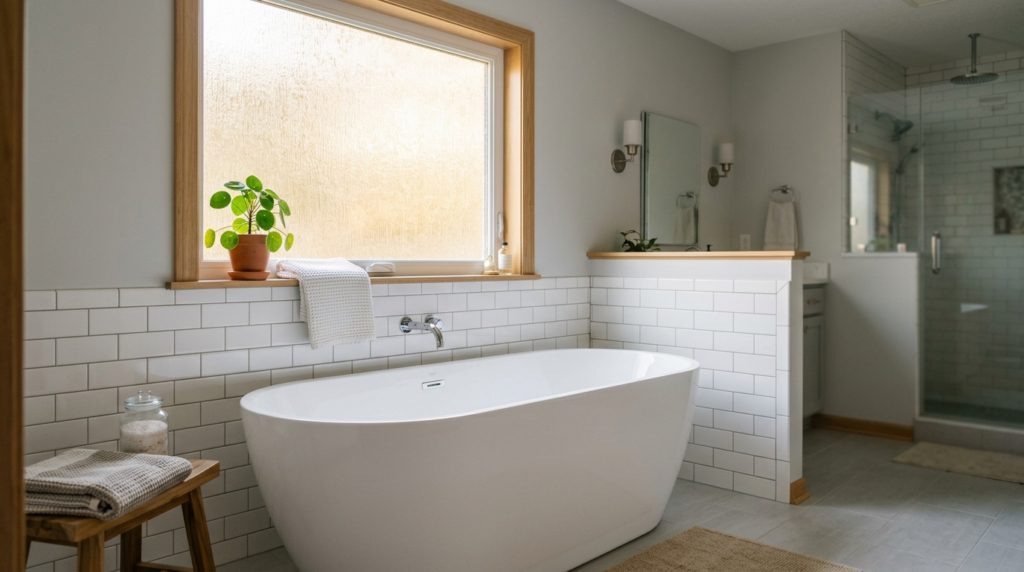
The glass is what does the privacy work, and the good news is that you no longer have to choose between privacy and daylight. Obscure glass scatters light so shapes blur on the other side while the pane still glows, which is exactly what a bathroom wants. The level of obscurity ranges from a faint texture to a solid frosted finish, so you can dial in only as much as the window’s exposure calls for.
If you like your current window and only the glass is the problem, you do not always need a whole new unit. Swapping the pane for an obscure one during a glass repair is often enough. The common options break down like this.
- Frosted glass is acid-etched or sandblasted to a smooth, matte finish that blurs shapes completely while passing soft light. It is the default choice for a window facing a neighbor.
- Obscure and patterned glass comes in textures like reed, rain, and satin etch that obscure the view to different degrees while adding a bit of style.
- Tinted glass in gray, bronze, or green cuts daytime visibility and glare, which helps on a sunny, south-facing bathroom.
- Switchable smart glass turns from clear to opaque at the flick of a switch, useful in a bathroom used day and night, though it costs more than any other option.
- Privacy film sticks to existing clear glass and is the cheapest fix, but it can peel over time in a steamy room.
Whatever pattern you pick, the pane itself should be tempered safety glass anywhere it sits close to the tub or shower floor. Building codes call for safety glazing in those wet, slip-prone spots, and tempered glass breaks into blunt pebbles instead of sharp shards if it ever fails.
Why the Insulated Glass Matters More Than the Pattern
Here is the part most buyers miss while they are choosing between reed and frosted glass: the obscure pattern is cosmetic, but the insulating glass behind it decides whether the window sweats all winter. A bathroom pours warm, wet air at the glass every time someone showers. When the outside is below freezing, a single thin pane gets cold enough that the moisture condenses on the inside and runs down.
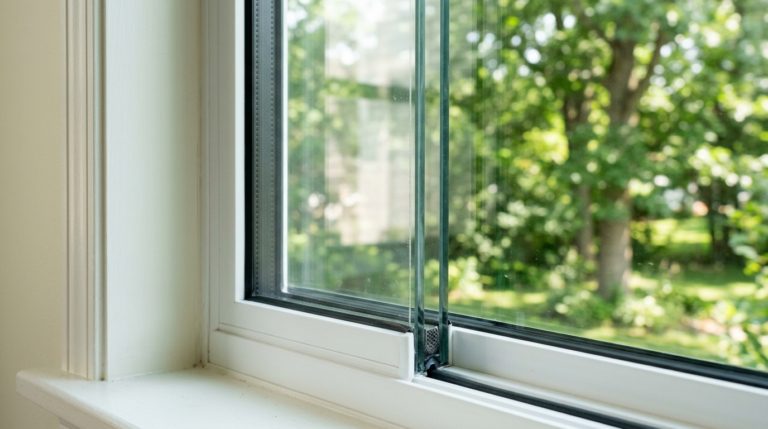
A modern double-pane unit fixes that by keeping the inner pane warmer. Look for two panes of glass with a Low-E coating, an argon fill, and a warm-edge spacer around the rim. The warmer the interior surface stays, the less it drips, which means less water on the sill and far less mildew in the corners.
On bathroom calls around Columbus, the window that is running with water every morning is almost never a privacy problem. It is a cheap or failed sealed unit letting the inside pane go cold, and a warmer double-pane swap usually stops the sweating for good.
If your bathroom window already shows a permanent haze or droplets trapped between the panes, the seal has failed and the insulating gas has leaked out. That fogged unit will not wipe clean and will keep sweating, but it often only needs an insulated glass replacement rather than a whole new window.
Where to Place the Window for Built-In Privacy
Sometimes the simplest privacy fix is not the glass at all, but where the window goes. A window set high on the wall, above standing eye level, lets in plenty of daylight while making it impossible for anyone outside to see in. That is why a high transom or a clerestory window works so well in a bathroom: the light bounces off the ceiling and spreads through the room, and there is nothing to screen.
Placement also helps around fixtures. Putting a window to the side of the toilet or vanity, rather than directly in front of it, breaks the most awkward sightline without giving up the opening. Over a tub, a window placed high keeps the bather out of view from the yard or a neighbor’s upper floor.
Small bathrooms benefit most from clever placement, since there is rarely room for a large window or heavy treatments. A narrow awning high on the wall, a row of glass block, or a slim frosted casement can light a cramped room without exposing it. In tight spaces, going up the wall is almost always better than going wider.
Frame Materials That Hold Up in a Wet Room
A bathroom is the toughest room on a window frame, so the material matters more here than in a dry bedroom. Constant humidity, splashes, and condensation will find any material that absorbs water, and once water gets in, the freeze-thaw swings of an Ohio winter pry the joints apart. The goal is a frame that simply does not care how wet the room gets.
That points toward nonporous materials and away from bare wood. The practical ranking for a bathroom looks like this.
- Vinyl resists moisture completely, never needs painting, and wipes clean, which makes it the most popular bathroom choice.
- Fiberglass shrugs off humidity and holds its shape through temperature swings, and it can be painted if you want a specific color.
- Composite and clad wood wrap a stable core in a weatherproof skin, giving the warmth of wood without the rot risk.
- Bare or painted wood looks great in a period home but needs a perfect finish and regular upkeep, or moisture gets in behind the paint.
Whatever the frame, the sill takes the worst of it, because that is where condensation and splash collect. A soft, dark, or spongy sill is a sign water has been sitting there, and a fresh window dropped onto rotted wood will not seal. It is worth probing the sill first and handling any sill repair before the new window goes in.
Keeping Steam and Condensation Under Control
Even the best window will struggle if the room cannot clear its own moisture, so ventilation deserves its own thought. An operable window is the simplest tool you have: cracking it during and after a shower lets the humid air escape before it can settle on the glass and walls. A fixed picture window may look striking, but on its own it traps exactly the moisture you are trying to remove.
The window works best alongside an exhaust fan, not instead of one. Run the fan during every shower and leave it on for a while afterward, and open the window when the weather allows to flush the room out. The two together keep the humidity low enough that condensation never gets a foothold.
Watch for the early warning signs that moisture is winning: black specks in the corners of the frame, peeling paint on the sill, or a window that beads up every winter morning. Catching those early, and pairing good airflow with a warm, well-sealed window, is what keeps a bathroom window out of the repair queue for the long run.
Need the Right Window for Your Bathroom?
If your bathroom window fogs, sticks, leaks, or simply does not give you the privacy and light you want, the fix is usually more straightforward than replacing the whole thing. A quick look tells you whether it is a glass swap, a seal, or a full replacement.
Book a free, no-pressure window assessment with our Columbus-area team and get a straight answer on the right bathroom window for your space, your light, and your privacy.
FAQ: Choosing Bathroom Windows

Ready to fix your windows? Get a free quote in 30 seconds.
Family-owned, licensed & insured. Free, no-obligation quotes.