A spilled candle leaves a hard, cloudy film on glass that looks impossible to shift, but wax almost never bonds to glass the way it bonds to fabric. It sits on the surface, so the trick is to harden it, lift the bulk, and clean the thin film that is left. Most spills come off a window or a glass tabletop in about ten minutes with a hairdryer, an ice pack, and a plastic scraper.
This guide covers three safe methods for getting wax off glass, the order that makes each one fast, how to clear the oily shadow that dyed candles leave behind, and the one winter shortcut that cracks a windowpane. If a razor has already scratched the glass or a pane has cracked, that is a job for professional glass repair rather than another round of scrubbing.
Quick answer: To remove wax from glass, let it harden, then lift the thick pieces with a plastic scraper. Warm any thin residue with a hairdryer and wipe it off, or chill a stubborn lump with an ice pack and pop it free. Finish with dish soap or rubbing alcohol to cut the oily film, then polish the glass clear.
Why Wax Lifts Off Glass If You Harden It First
Glass is smooth and non-porous, so candle wax cannot soak in the way it does on cloth or wood. The wax cools, shrinks slightly, and grips the surface mechanically rather than chemically. That single fact is what makes glass the easiest material to clean wax off, as long as you work with the wax instead of against it.
The mistake almost everyone makes is attacking a fresh, soft spill with a paper towel. Warm wax just smears into a wider, greasier film and pushes into any seams around the pane. Wait for it to set, or speed that up with an ice pack, and the same wax turns brittle and pops off in flakes.
From there, two levers do all the work: temperature and a flat edge. Heat softens a thin film so a cloth can lift it; cold makes a thick lump brittle so a scraper can shear it off at the base. Knowing which lever to pull for which spill is the whole job, and the three methods below are just different combinations of the two.
What You Need to Remove Wax from Glass
None of this calls for a special kit, and most of it is already in a kitchen or bathroom drawer. The cleaners are mild on purpose, because the goal is to lift wax without etching or scratching the glass underneath. Gather the short list below before you start so you are not hunting for a scraper with greasy hands.
The two tools that matter most are a plastic edge and a gentle heat source. A rigid plastic scraper, an old gift card, or a plastic putty knife shears wax off without the scratch risk of metal. A hairdryer gives you controlled heat you can stop the instant the wax goes glossy.
- A plastic scraper, old card, or plastic putty knife to lift hardened wax without scratching.
- A hairdryer for gentle, controllable heat (skip the heat gun, which runs too hot).
- An ice pack or a bag of ice to harden thick blobs before you scrape.
- Paper towels and a microfiber cloth to blot softened wax and polish the glass.
- Dish soap, white vinegar, or rubbing alcohol to cut the oily, dyed film left behind.
- Glass cleaner for the final streak-free wipe.
Method 1: Heat It and Wipe It Away
The heat method is the gentlest of the three and the best choice for a window, where you cannot get behind the glass and a scraper feels risky. It works by softening the wax just enough that a cloth can absorb it, with no blade touching the surface at all. For a thin smear or a light drip, this is usually all you need.
Set a hairdryer to low or medium and hold it three to four inches from the wax, moving it in small circles so you do not overheat one spot. As the wax turns glossy and slumps, press a folded paper towel or an old cloth onto it and lift. The warm wax wicks into the towel; swap to a clean section and repeat until the glass is clear.
Keep the heat low and the dryer moving. A heat gun, or a dryer held in one place, can warm a cold pane unevenly, and that is exactly the kind of stress an older or already-chipped pane does not need. Slow and gentle beats hot and fast every time on glass.
Method 2: Chill It and Pop It Off
For a thick blob, a puddle that has pooled in a corner, or wax on a glass tabletop, cold works better than heat. Chilling makes wax brittle and shrinks it away from the surface, so it cracks loose instead of smearing. On a fixed windowpane you cannot use the freezer trick the candle blogs describe, but an ice pack does the same thing in place.
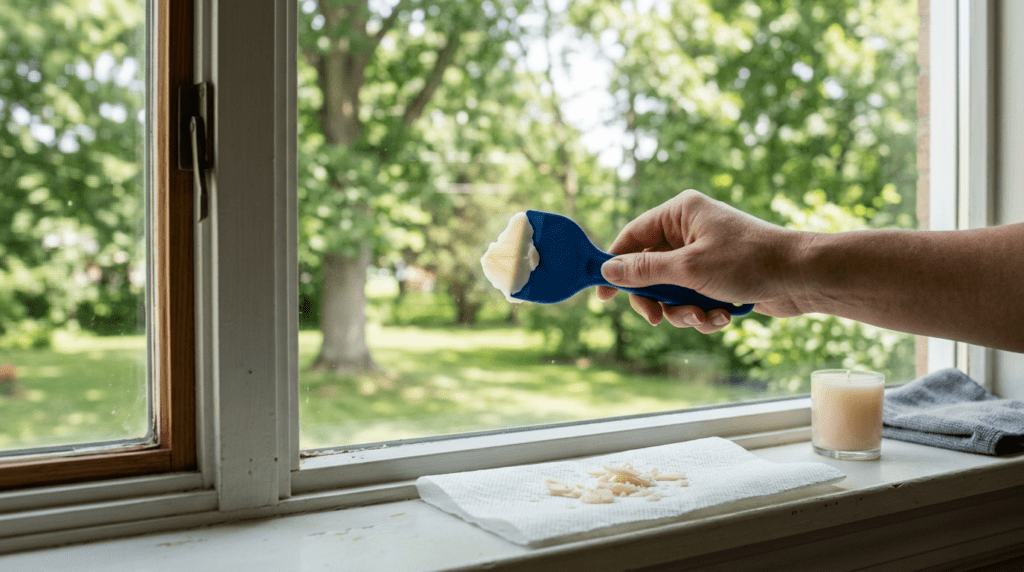
Seal a few ice cubes in a sandwich bag, or grab a gel ice pack, and press it against the wax for a minute or two. When the lump has gone hard and dull, slide a plastic scraper or an old card flat against the glass and shear the wax off at its base. It should come away in solid flakes rather than a smear.
Catch the flakes on a paper towel as they release so they do not fall into the track or onto the sill, where they soften again and stick. Any thin haze the cold method leaves behind comes off with the heat-and-wipe trick from Method 1, or with the solvent pass described next.
Method 3: Scrape and Clean the Flat Pane
On a flat, uncoated surface like a glass tabletop, a mirror, or a plain single-pane window, careful scraping is the fastest route. The key word is careful: the blade has to stay almost flat to the glass and the wax has to be softened first, or you trade a wax problem for a scratch problem.
Wet the glass with warm, soapy water so the scraper glides rather than chatters. Hold a plastic scraper, or a fresh razor blade in a holder, at a low ten to fifteen degree angle and push under the edge of the wax in one smooth stroke. Let the tool do the work; pressing harder is what gouges glass. Re-wet the surface whenever it starts to drag.
Save the razor for glass you are certain is plain and uncoated. Tinted, frosted, low-E, or filmed glass has a delicate surface layer that a blade will scratch, and that damage does not buff out. When in doubt, stay with the plastic edge and the heat method, and you will never have to find out the hard way.
How to Remove Wax from Glass, Step by Step
If you want one reliable sequence that handles most spills, this is it. It blends all three methods in the order that wastes the least effort: harden first, lift the bulk, then clean the film. Work on cool glass, never a hot pane fresh from the sun, and keep a dry cloth handy.
The step people rush is the last one, clearing the oily shadow, and it is the difference between clean glass and a cloudy patch you notice every time the light hits it.
- Let the wax harden. Give a fresh spill a few minutes to cool, or speed it up with an ice pack. Never smear hot wax.
- Lift the thick pieces. Slide a plastic scraper or old card flat under the wax and shear off the raised blobs.
- Warm the thin residue. Hold a hairdryer on low a few inches away until the leftover film turns glossy.
- Blot while warm. Press a paper towel onto the softened wax to wick it up, then swap to a clean section and repeat.
- Chill any stubborn spots. Press an ice pack on a clinging lump, then pop it free with the plastic edge.
- Cut the oily film. Wipe the area with a little dish soap or rubbing alcohol to remove the greasy, dyed shadow.
- Polish it clear. Finish with glass cleaner and a microfiber cloth for a streak-free pane.
Getting Rid of the Oily, Colored Shadow
Plenty of people get the wax off and assume they are done, then notice a faint greasy ring or a tint of color where the spill was. That shadow is the candle’s oils and dye, which spread thinner than the wax and stay behind after the solid part lifts. It is not ground into the glass; it just needs a degreaser the plain scraper cannot provide.
A few drops of dish soap in warm water, white vinegar, or rubbing alcohol on a cloth all cut the oily film. Work in small circles, then rinse with clean water so you do not leave a soap haze of your own. Dyed and heavily scented candles leave the most stubborn shadows, so expect a second pass with red, green, or navy wax.
Finish every method with this step, even the gentle heat-and-wipe. A clear, oil-free pane catches the light the way clean glass should, and it stops the spot from collecting dust and looking grimy a week later. The same logic applies to a full streak-free window cleaning once the wax is gone.
Mistakes That Crack or Scratch the Glass
Getting wax off glass is low-risk, but two shortcuts cause damage that costs far more than the candle ever did, and both are common in winter. The first is heat shock, and the second is an impatient blade. Both are easy to avoid once you know what they do.
The water trick that works on a candle jar is dangerous on a window. Pouring hot or boiling water on cold winter glass creates a sudden temperature gap across the pane, and that stress can crack it, especially a large pane or one with a chipped edge.
On winter calls around Columbus, the cracked pane behind a wax spill is almost never the candle. It is the mug of hot water someone poured on cold glass to melt the drip, and now the whole pane has to come out.
Run through these before you reach for a faster method, because each one trades a few saved minutes for a problem you do not want.
- Pouring hot water on a cold pane, which can thermal-shock the glass into a crack.
- Scraping dry or with a metal blade on coated glass, which scratches low-E, tinted, or frosted surfaces for good.
- Using a heat gun instead of a hairdryer, which can overheat one spot and stress the glass or warp a vinyl frame.
- Letting wax flakes drop into the track or onto the sill, where they soften and stick and start the job over.
- Reaching for harsh solvents like acetone near frames and seals, which can cloud finishes and dry out weatherstripping.
When Wax Cleanup Turns Into a Glass Repair
Sometimes the wax is the easy part, and the cleanup reveals a problem that was already there, or one a blade just created. A scratch from a razor, a chip that catches your nail, or a hairline crack from heat shock will not buff out with any cleaner, and they tend to spread or collect grime over time.
A scratched or cracked pane is a straightforward fix for a pro, and on a sealed double-pane unit a single damaged pane can often be replaced without swapping the whole window. If the spill ran down and softened a wooden sill, or you find soft, dark wood while cleaning, that points to a separate window sill repair rather than a glass issue.
It is worth a quick look before the spot turns into a bigger job. A cracked pane lets air and moisture into the gap and can fog from the inside, which is its own repair. Our team handles both glass repair and fogged, sealed-unit replacement across the Columbus and Cincinnati area.
Scratched or Cracked the Glass Cleaning Up?
If a wax spill left a scratch, a chip, or a crack you cannot wipe away, the glass itself needs attention, and a quick look tells you whether it is a simple reglaze or a sealed-unit swap. There is no sense living with a flaw you see every time the sun hits the window.
Book a free, no-pressure glass assessment with our Columbus-area team and get a straight answer on whether it is a small fix or a full pane replacement.
FAQ: Removing Wax from Glass

Ready to fix your windows? Get a free quote in 30 seconds.
Family-owned, licensed & insured. Free, no-obligation quotes.