Some windows need to let the morning in without letting the whole street look back. That is the job privacy glass does. It scatters or blocks the view while keeping the daylight, so a bathroom, a front door, or a ground-floor bedroom stays bright but not exposed. The catch is that privacy glass covers a dozen different products, from a molded rain texture to a thin frosted film, and they do not all behave the same way.
This guide sorts the options out: what obscure and patterned glass actually is, how each type is made, the named patterns you will see in a showroom, how privacy levels are rated, and where each one belongs in a house. If you only need to add privacy to a sound window, swapping or treating the glass alone is often all it takes, and we will cover when that works.
Quick answer: Privacy glass, also called obscure or patterned glass, is textured, frosted, or filmed so daylight still passes through while the view is blurred or blocked. Frosted and rain patterns are the most popular, and obscurity is rated from light to fully opaque. It works best in bathrooms, entry doors, and any street-facing window.
What Privacy and Patterned Glass Actually Is
Privacy glass is any glazing treated so you cannot see a clear image through it, while it still lets light pass. You will hear it called obscure glass, patterned glass, textured glass, or decorative glass, and the terms overlap more than they differ. The common thread is that the surface or the body of the glass scatters light instead of transmitting a sharp picture.
That distinction matters when you compare it with a shade or a curtain. A blind blocks the view and the light together, and you have to open it to brighten the room. Obscure glass keeps the room lit all day and holds the privacy whether you are home or not, with nothing to draw, dust, or replace. The trade-off is permanence: a molded or etched pattern stays for the life of the pane, so you give up the option of a clear view out.
It also helps to separate privacy from darkness. Obscure glass hides the view, but most patterns still pass plenty of light, so a frosted bathroom window will not darken the room for sleep the way a blackout shade does. If you need both privacy and a dark room, the glass handles one job and a shade handles the other.
How Obscure Glass Is Made
The privacy effect comes from one of a few methods, and knowing which you are looking at tells you how durable it is and how it will clean. Two broad families exist: glass that is textured or etched permanently, and a film applied to ordinary glass after the fact.
Permanent obscure glass is made at the factory and lasts as long as the pane. Cast or rolled patterned glass is pressed with a textured roller while the glass is still molten, stamping a pattern like rain or reed into one face. Acid-etched and sandblasted glass, usually sold as frosted or satin, has its surface pitted so it scatters light into a soft, even blur. Glue-chip glass is a specialty: hot glue is spread on a sandblasted face, and as it dries it flakes off tiny chips to leave a fern-like frost.
Applied films are the retrofit route. A frosted or patterned vinyl film sticks to glass you already own and gives two-way obscurity on a budget, which makes it the easy choice for renters or a quick test. Reflective film is a different animal and earns its own caution below. The short list of methods looks like this:
- Cast or rolled patterned glass presses a texture into molten glass, so the pattern is permanent and the face stays smooth enough to wipe.
- Acid-etched or sandblasted glass, sold as frosted or satin, carries a pitted surface that blurs the view evenly but shows fingerprints.
- Glue-chip glass wears a decorative fern frost and shows up most often in doors and sidelights.
- Applied frosted film is a peel-and-stick retrofit for existing windows, removable and inexpensive.
The Patterns You Will See in a Showroom
Once you start shopping, the patterns have names, and they range from barely-there texture to a heavy distortion that swallows any shape behind it. Most manufacturers carry a handful of standards, and while the branded names vary, the looks repeat from one catalog to the next.
The choice is partly privacy and partly style, since a reeded panel reads modern and a glue-chip or Flemish panel reads traditional. Match the pattern to the room and the house, not just to the privacy number. These are the common ones:
- Rain gives vertical streaks like water on the pane, a light-privacy all-rounder.
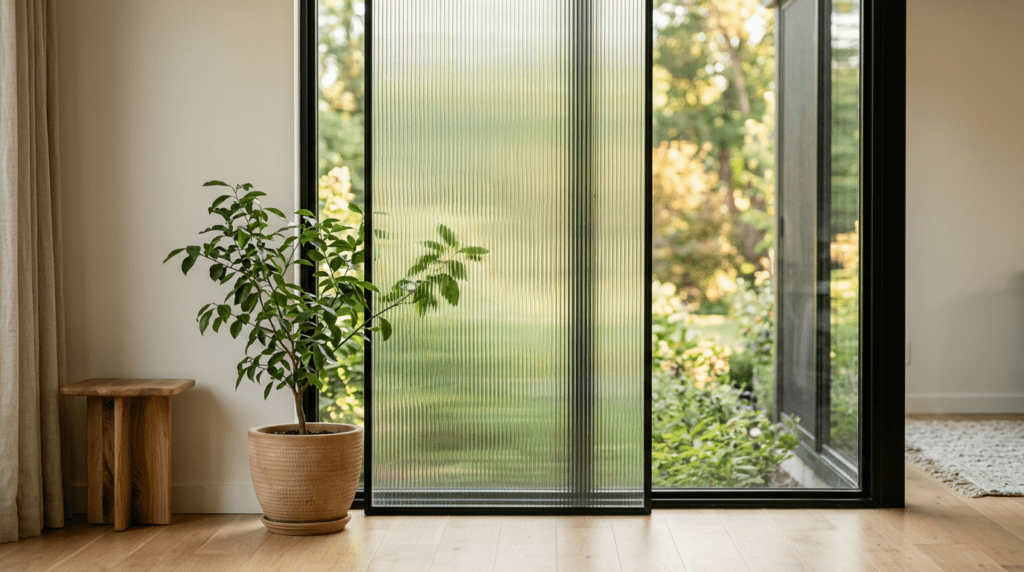
- Reeded or fluted runs evenly spaced vertical grooves for a clean, contemporary look with medium privacy.
- Frosted or satin is a smooth, even blur and the usual bathroom default, at medium to heavy privacy.
- Glue-chip has a fern-like frost that suits doors and sidelights.
- Flemish uses a rolled, rippled texture that heavily distorts the view.
- Seeded scatters tiny bubbles for a vintage, lightly obscured effect.
- Pebble or chinchilla packs a dense, bumpy texture for heavier privacy.
Privacy Levels: How Obscure Is Obscure?
Privacy is not all-or-nothing, and most suppliers rate it on a scale so you can match the glass to how exposed the window is. A common system runs from level one to level five, where one barely distorts the view and five blocks it almost entirely. Light, medium, and heavy are the plainer words for the same idea.
At the low end, a lightly textured pane softens shapes but still lets you make out movement and rough outlines, which is fine for a window that faces a private yard. In the middle, the glass detects movement but hides who or what is behind it, the right setting for most bathrooms and street-facing rooms. At the top end, a heavy frost or dense pattern stops even movement from registering, which suits a ground-floor window a few feet from a sidewalk.
The honest way to choose is to think about distance and what is on the other side. A bathroom window over a tub on the second floor needs less obscurity than a half-bath window at eye level beside the front walk. More privacy almost always means less light and a busier look, so buy the level the window actually needs rather than the heaviest on the shelf.
One-Way and Reflective Glass: Read the Fine Print
One product gets oversold, and it causes more disappointment than any other: one-way or reflective privacy glass. The mirror-style coating works by bouncing the brighter side back at itself, so during the day, with more light outside than in, the outside sees a mirror and you see through it. It feels like magic in a showroom.
The problem is that it reverses after dark. Once the sun goes down and you turn the lights on, the brighter side is now inside, and the glass becomes a clear window into your lit room from the street. For a Columbus ground-floor room that you actually use at night, a reflective product delivers privacy at exactly the wrong hours. If you need night privacy, a permanent textured or frosted pattern, or a shade you can close, is the honest answer. Reflective treatments are for glare and daytime heat, not for keeping the evening private.
Where Each Type Works Best in the Home
The right pattern depends entirely on the room and how close the next set of eyes is. A few placements come up on almost every job, and each one leans toward a particular level of obscurity.
Bathrooms are the classic case and usually want medium to heavy privacy, with frosted or a dense pattern over the tub or beside the shower. Entry doors, sidelights, and transoms use decorative patterns like glue-chip or reeded to keep the foyer from being on display while still glowing with light, and an entry door with glass is the most-seen privacy glazing in any house. Beyond those, the pattern follows the exposure:
- Bathrooms want frosted or pebble at medium to heavy privacy, tempered where the glass sits near the tub or shower.
- Front doors and sidelights use glue-chip, reeded, or Flemish for curb appeal and a screened foyer.
- Stairwell and hallway windows need only a light to medium texture, since they face the street but sit above eye level.
- Ground-floor bedrooms and offices call for medium to heavy glass, paired with a shade for night and sleep.
- Kitchens over the sink suit a light rain or seeded pattern, where you still want a glimpse of the yard.
The Bathroom Window: Tempered, and the First to Fog
The bathroom window earns its own section because it sits at the intersection of two rules people forget. First, any glass within a set distance of a tub or shower has to be tempered safety glass by code, so it breaks into blunt pieces instead of shards. Tempered glass is made to size at the factory and cannot be cut afterward, which means the obscure unit has to be ordered to the exact opening.
Second, the bathroom is the harshest spot in the house for a sealed glass unit, and in Ohio that is saying something. Daily steam drives moisture at the glass, and a cold winter pane turns that humidity into condensation against the seal. Over enough freeze-thaw cycles the seal gives out and the unit fogs from the inside, the same failure we fix on any foggy double-pane unit. The cruel twist with obscure glass is that the pattern hides the fog, so a failing seal can sit unnoticed for a season.
On bathroom calls around Columbus, the obscure window is almost always the one in the worst shape. The frosted texture masks a fogged seal, so by the time anyone notices the haze, condensation has been sitting behind the pattern for months.
If the bathroom window also needs to vent that steam, an operable unit matters as much as the glass. A crank-out awning window sheds rain while it stays open and pushes moist air out, which keeps the obscure pane and the sill around it drier through the worst of the season.
Privacy Without Replacing the Whole Window
Wanting more privacy does not always mean buying a new window. The right move depends on what shape the existing unit is in, and there are three honest tiers. If the frame and the seal are sound and you only want privacy, the cheapest fix is a frosted or patterned film applied to the glass you already have, which is reversible and forgiving for a rental or a trial run.
A step up, and the most durable answer short of a full unit, is swapping the glass itself. The sash stays, the frame stays, and only the pane changes to an obscure one. That keeps the cost down while giving you a permanent, factory-made pattern that will not peel or bubble the way a film can. It is the same glass-only work behind most of our privacy jobs.
A full new window only makes sense when the seal has already failed, the frame is rotted or out of square, or you are upgrading the whole opening anyway. Pairing the privacy upgrade with a replacement you needed regardless is the one time buying new for privacy alone adds up. When the window is otherwise fine, treat or swap the glass and leave the rest in place.
Energy, Cleaning, and What to Expect
Two practical questions come up once the pattern is chosen: does obscure glass hurt energy performance, and is it harder to keep clean. On energy, the answer is reassuring. The pattern lives on a single pane inside a sealed insulated unit, so it pairs normally with a Low-E coating and an argon fill, and a frosted or textured window insulates just as well as a clear one of the same build.
Cleaning is where the texture asks a little more. A smooth frosted face wipes easily but shows fingerprints and water spots, and Ohio hard water can leave mineral spotting that a quick swipe will not lift. Deeply textured patterns like reed or pebble trap pollen and dust in their grooves, so they want a soft brush rather than a flat squeegee. None of this is a deal-breaker; it is just worth knowing that the heaviest patterns trade a little upkeep for their privacy.
One more expectation to set: a permanent pattern is permanent. You cannot decide in three years that you want the clear view back without changing the glass. That is the strongest argument for matching the level to the need up front, and for using removable film anywhere you are not sure.
Match the Pattern to Your Home
A privacy pattern is also a design choice, and the wrong one looks borrowed from another house. Reeded and frosted panels suit clean, modern trim, while glue-chip and Flemish textures belong with traditional and historic homes. In Columbus neighborhoods like German Village and Victorian Village, original entry doors and bathroom sashes often carry antique glue-chip or rolled patterns that are worth restoring rather than scrapping.
When an old decorative or leaded pane cracks, replacing just that glass keeps the character of the house intact, which is a different job from dropping in a modern frosted unit. If your home has original patterned glass, weigh repair against replacement before you assume it has to go. Matching a new pattern to the era of the house, or saving the old one, is what keeps the window from looking like an afterthought stuck on the front of an older home.
Not Sure Which Privacy Glass You Need?
Still deciding whether your situation calls for a film, a glass swap, or a new unit, or whether that hazy bathroom window is a privacy upgrade or a failed seal hiding behind the pattern? A quick look usually settles it.
Book a free, no-pressure glass assessment with our Columbus and Cincinnati team, and get a straight answer on the right pattern for each window and whether the existing unit is worth keeping.
FAQ: Privacy and Patterned Glass

Ready to fix your windows? Get a free quote in 30 seconds.
Family-owned, licensed & insured. Free, no-obligation quotes.