Most people buy a window for the view and the light, then learn the real difference the first time they try to open it. Single-hung and double-hung windows look nearly identical from the curb, yet they behave differently once they are set in the wall. The gap between them comes down to one thing: how many of the sashes actually move.
This guide compares the two on the things you live with every day, including ventilation, cleaning, energy loss, cost, and security, and shows where each earns its place in an Ohio home. If you already know you want both sashes to open, a double-hung window is the upgrade most homeowners reach for, though it is not the right call for every opening.
Quick answer: A single-hung window opens only at the bottom, with the top sash fixed in place. A double-hung opens at both the top and bottom and usually tilts in for cleaning. Single-hung costs less and seals a little tighter; double-hung ventilates better and is far easier to clean on upper floors.
The Core Difference: One Moving Sash or Two
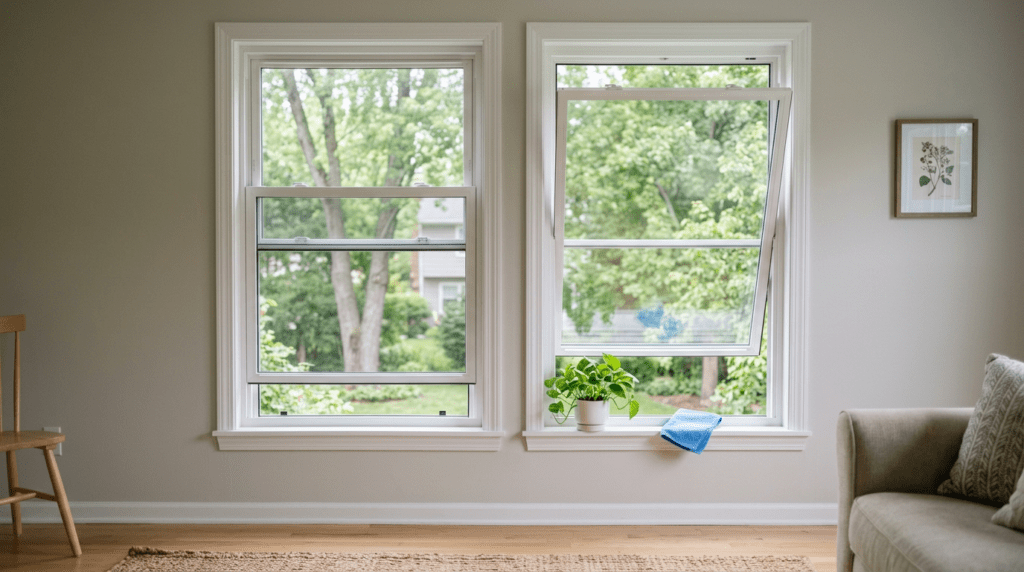
A hung window is one where the sashes slide vertically inside the frame, held at height by hidden balances rather than a crank. The single-hung version has one operable sash, the bottom one, which slides up while the top sash stays fixed in place for good. The double-hung version lets both sashes move, so the top can slide down while the bottom slides up.
That single design choice ripples through everything else. With only one moving panel, a single-hung window has fewer parts to seal, fewer parts to fail, and a lower price. The second moving sash on a double-hung adds another set of balances, another weatherstrip line, and the tilt-in feature that makes upstairs cleaning realistic. Neither is better in the abstract; they are tuned for different priorities.
Telling them apart takes five seconds. Reach up and try to slide the top sash down, or look for a pair of tilt latches at the top of the lower sash. If the upper sash moves or both sashes tilt inward, you have a double-hung; if only the bottom budges, it is single-hung. Many older Columbus homes have true divided-light double-hungs on weight-and-pulley balances, while a lot of newer builds use single-hung to hold costs down.
Ventilation and Airflow
Ventilation is where double-hung windows pull ahead, and the margin is not small. Because the top sash drops down, warm stale air can leave through the upper opening while cooler air enters at the bottom. That vertical loop, sometimes called the stack effect, moves air through a room without a fan running.
A single-hung window opens only at the bottom, so it draws air through one gap. It still ventilates a room well enough, but you lose the ability to fine-tune where the air exits. In a humid Ohio summer, the double-hung trick of cracking the top sash lets damp indoor air escape near the ceiling while keeping rain from blowing in through a wide-open bottom.
There is a comfort angle too. Opening the top sash keeps the breeze above furniture and out of the path of anyone sitting near the window, and it is safer over a porch roof or a busy sidewalk where an open bottom sash is an invitation. If steady cross-breeze matters more than anything, a casement window that swings fully open beats both, but among hung windows the double-hung wins on air.
Cleaning and Reaching the Glass
The cleaning difference is the one homeowners feel most on a second story. Modern double-hung sashes tilt inward, so you can wash the outside of both panes while standing in your living room. No ladder, no leaning out over the lawn, no skipping the upstairs windows for another year.
A single-hung window tilts only the bottom sash, if it tilts at all, which means the exterior of the fixed top pane is reachable only from outside. On a ground-floor window that is a minor chore. On a second-story bedroom it means a ladder and good weather, which is why those upper panes so often go uncleaned and collect Ohio’s hard-water spotting and spring pollen film.
The method matters as much as the access if you want clear results, and our guide to cleaning windows without streaks walks through it. For tall or hard-to-reach openings, though, the tilt-in convenience of a double-hung is the feature people thank themselves for every spring.
Energy Efficiency in a Freeze-Thaw Climate
On paper, a single-hung window holds the efficiency edge, and the reason is simple. The fixed top sash is sealed shut for good, so there is one less moving joint for air to sneak through. Fewer gaps means fewer places for a draft, which is why single-hung units often post slightly better infiltration numbers out of the box.
That advantage is real but small, and it narrows fast with quality. A well-built double-hung with tight weatherstripping and warm-edge insulated glass will outperform a cheap single-hung every time. The weak point on a double-hung is the meeting rail where the two sashes overlap, and on older units that joint can loosen and leak as the seals age.
Ohio’s freeze-thaw cycle is hard on both styles. Water that works into a sash track freezes, expands, and stresses the weatherstrip and balances over a winter. The fix is the same regardless of type: tight seals, good glass, and clear weep holes. If your glass fogs up between the panes, that is a failed seal rather than a drafty sash, and an insulated glass replacement restores it without swapping the whole window.
Cost and Long-Term Value
Single-hung windows cost less, and the reason is in the parts list. One moving sash means fewer balances, less hardware, and a simpler install, so both the unit and the labor come in lower. For a whole-house replacement on a budget, that difference adds up quickly across a dozen openings.
Double-hung windows ask for more upfront and give more back in daily use and resale appeal. Buyers and appraisers tend to recognize them as the higher-spec option, and the easier cleaning and ventilation are features people notice. The trade is more moving parts to maintain over the decades, though those parts are designed to be serviced rather than replaced.
The honest way to weigh it is by opening, not by whole house. A hard-to-reach upstairs window earns the double-hung premium; a basement or garage window rarely does. If you are pricing a full project, a new window installation estimate that mixes types by location usually beats committing every opening to the same style.
Security, Safety, and Egress
Security is closer between the two than the marketing suggests, but there are real differences. A double-hung lets you vent a room by lowering the top sash while the bottom stays locked, which is genuinely safer in a child’s room or any ground-floor window you want airflow through without an open gap at waist height.
The flip side is that a double-hung has two sashes to latch, and if the upper one drifts down even slightly the lock may not seat fully. A single-hung has just the one bottom latch to check, which is one less thing to get wrong. Both styles accept aftermarket sash locks and vent stops if you want a firmer setup.
Egress is the rule people forget. Bedrooms need a window that opens wide enough for a person to climb out in a fire, and because both styles open at the bottom, both can meet egress as long as the opening is sized to code. The sash that moves is the same on each, so neither type has an edge there; the dimensions of the opening are what the inspector checks.
What Actually Wears Out: Balances and Seals
Most comparisons stop at the showroom and never mention what a window feels like ten years in. The hidden balances that hold a sash at any height are the parts that wear, and a double-hung has two sets of them, one per sash, where a single-hung has one. Twice the balances means twice the eventual maintenance, but it also means each is easy to reach and replace.
The other quiet failure point is the seal, both the weatherstrip at the meeting rail and the seal around the insulated glass.
On replacement jobs around Columbus, the double-hung windows we pull out have almost always loosened at the upper sash first, where the second set of balances and the extra weatherstrip line take the brunt of years of freeze-thaw.
None of this makes a double-hung a poor buy. It means the extra capability comes with extra parts, and those parts are normal wear items rather than defects. A single-hung gives you less to maintain at the cost of less to use, which for a rarely-opened window is exactly the right trade.
Which Window Is Right for Your Home?
The choice gets easy once you stop thinking about the whole house and start thinking about each opening. Two questions settle most of them: how often will this window actually open, and how hard is the outside of it to reach? A window you open daily or clean from a ladder leans double-hung; one you rarely touch leans single-hung.
A few patterns hold up across most Ohio homes:
- Second-story bedrooms and bathrooms: double-hung, so you can clean the outside from inside and vent safely up high.
- Ground-floor, garage, and basement windows: single-hung is usually plenty, since access and airflow are easy anyway.
- Historic Columbus homes: double-hung matches the original divided-light look most period houses were built with.
- Tight renovation budgets: single-hung frees money for better glass, which matters more than the second moving sash.
- Rooms that need real cross-breeze: consider a casement instead, which opens fully to the air.
There is no rule that every window in a house must match. Mixing styles by location, double-hung where reach and ventilation matter and single-hung where they do not, gives you the function you need without paying the premium on openings that will never use it.
Not Sure Which Style Fits Your Home?
Still weighing which style suits your home, your climate, and your budget? The right answer usually depends on the floor, the room, and how each opening faces Ohio’s weather, and a quick look in person sorts it out faster than any chart.
Book a free, no-pressure window consultation with our Columbus-area team and get a straight recommendation, opening by opening, with no obligation to buy.
FAQ: Single-Hung vs Double-Hung Windows

Ready to fix your windows? Get a free quote in 30 seconds.
Family-owned, licensed & insured. Most quotes delivered the same day.