
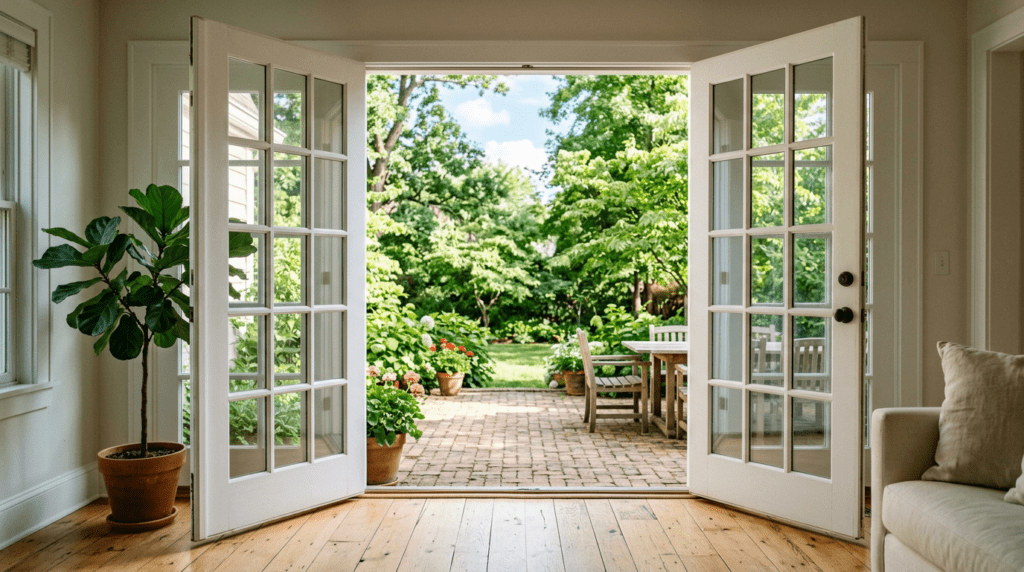
A French patio door swings open on hinges, the way a front door does, instead of gliding sideways on a track like a sliding patio door. Open both leaves and the whole doorway clears for a wide, glass-framed opening onto the patio. That swing is the appeal, and it is also the thing you plan the room around.
Below is what a hinged French patio door really is, the honest pros and cons, how inswing versus outswing changes the math in an Ohio winter, the seams that cause winter drafts, and what moves the price. There are no dollar figures here, because the cost rides on size, material, glass, and the shape of your opening more than on any sticker.
Quick answer: A French patio door is a hinged, swinging glass door, usually a pair, that opens from the center inward or outward. It gives a wider opening and a classic look, seals well with a multipoint lock, but needs swing clearance, adds a screen separately, and costs more than a slider. Fiberglass or clad frames hold up best in Ohio.
What Is a Hinged French Patio Door?
A French patio door is a glass door, almost always sold as a pair, that swings open on hinges from a center line. One or both leaves can open, and the doors can be set to swing into the room or out toward the patio. Unlike a glider that rides a bottom track, nothing slides here; each leaf hangs on hinges screwed to the side jamb, the same way an entry door does.
When you buy a pair, one leaf is the active door you use every day, and the second is the inactive leaf that stays put until you need the full opening. The inactive leaf is held shut by flush bolts that drop into the head and the threshold, and the two doors meet at a vertical seam covered by a strip called the astragal. Open both and the astragal travels with the inactive leaf, leaving a clear, post-free doorway that is the whole reason people choose this style.
That is the core difference from a sliding patio door, which always keeps half its width as fixed glass. If you are still deciding between the two, our side-by-side on French versus sliding patio doors weighs them against each other. The rest of this guide stays on the hinged door and what living with one in Ohio actually involves.
The Case for French Patio Doors
The biggest draw is the opening itself. Swing both leaves and you get the full width with no center post, which makes moving a sofa or a sheet of plywood through the wall easy and turns a summer evening into a real indoor-outdoor room. A slider can only ever open half its width, so for airflow and for hauling things in and out, the hinged door wins on a still day.
Looks are the other half of the appeal. The wider frames and the taller bottom rail read as traditional, and on an older Columbus or Cincinnati home they suit the architecture in a way a broad sheet of sliding glass does not. A well-made hinged door can also seal tightly, because a multipoint lock pulls the active leaf into compression weatherstripping at several points up the height of the door rather than at a single latch.
- A full, unobstructed opening when both leaves swing, for furniture and fresh air.
- A classic, higher-end look that fits period homes and adds curb appeal.
- Strong sealing potential from a multipoint lock and compression weatherstrip.
- Flexible styling with full-glass or grille-divided lites, sidelites, and a transom above.
The Trade-offs to Weigh
The swing that makes the door appealing is also its main limitation. Each leaf needs a clear arc of floor or patio to open into, so a hinged door eats square footage a slider never touches. In a tight room or on a small deck, that swing can rule the style out before any other factor matters.
There are practical gaps people discover after the fact. A French door does not come with a screen the way most sliders do, so bug season in Ohio means adding a retractable or hinged screen separately. There are also more moving parts to keep happy: two leaves, extra hinges, a multipoint lock, and the center astragal all need to stay in adjustment, and the seam where the leaves meet is the spot most likely to whistle on a windy winter night.
- Swing clearance is required inside or out, and it is not optional in tight spaces.
- No built-in screen in most cases, so budget a separate one for summer.
- More hardware to maintain than a slider, including hinges and a multipoint lock.
- A center seam to seal that becomes the first place to draft as weatherstrip ages.
- Higher cost on average than a comparable sliding door.
Inswing or Outswing? The Ohio Call
Most French patio doors can be ordered to swing either way, and in this climate the choice is more than a matter of taste. An inswing door opens into the room, which keeps the hinges, sill, and weatherstrip tucked inside, away from wind-driven rain and the worst of the freeze-thaw cycle. The trade is interior floor space, plus the chance of pulling water inward if the threshold and sweep are not sealed well.
An outswing door opens onto the patio, freeing up the room and shedding rain outward because the leaf presses harder against its stops as the wind pushes on it. The catch is the Ohio winter: a few inches of drifted snow or a glaze of ice on the patio can block an outswing door, and its hinges and threshold sit more exposed to the weather. As a rough rule, lean inswing where snow piles against the door, and outswing where the patio stays clear, rain matters more than snow, and you want every inch of the room.
Either way, the door has to be hung dead plumb and square so both leaves meet evenly at the center. A pair that is even slightly out of true will gap on one side and bind on the other, and no amount of weatherstripping fixes an opening that was never trued first.
The Meeting Stile: Where Winter Drafts Start
The seam where the two leaves come together is the defining feature of a French door and its built-in weak point. A sliding door seals along a single interlocking edge; a hinged pair has weatherstrip down both side jambs plus the center, and that center meets against the astragal with almost no overlap. More linear feet of seal means more seal that can flatten, harden, and leak, and the middle of a tall double door is exactly where winter wind looks for a way in.
This is why the lock matters as much as the glass. A true multipoint lock throws bolts at the top, center, and bottom and pulls the active leaf tight against its weatherstrip along the whole height, while a single deadbolt only cinches the middle and lets the corners stand off. When one of these doors drafts in January, the fix is usually fresh astragal weatherstrip and a lock back in proper tension, not a replacement door.
On winter service calls around Columbus, the cold draft people feel at a French patio door almost always traces to the center where the two leaves meet, not to the glass. A flattened astragal seal or a multipoint lock that has lost its tension lets the wind through, and both are a quick adjustment rather than a new door.
The Threshold and Sill: Where Rot Begins
A patio door sits low to the ground, often near grade, which puts its threshold and sill in the path of every puddle, splash, and snowmelt that reaches the wall. That makes the bottom of the door the part that fails first, long before the glass or the hinges give any trouble. Water that sits in the corners soaks into end-grain wood and, through a freeze-thaw winter, expands and pries the joints apart.
Two cheap details keep that from happening, and homeowners skip both. The first is an adjustable threshold cap, which screws up or down to meet the door sweep so there is no daylight gap at the bottom; the dollar-bill test, closing a bill in the door and feeling for drag as you pull it out, tells you whether the sweep is actually touching. The second is keeping the sill drainage and caulk joints clear so water runs out instead of pooling.
When the bottom corners already feel soft to a screwdriver probe, water has been getting in for a while, and dropping a new door onto a rotted sill just hides the problem. A rotted sill or threshold needs to be repaired or rebuilt before any new door goes in, or the new door inherits the same slow leak.
The Glass Matters More Than the Grille
A French patio door is mostly glass, so the sealed unit in each leaf does more for comfort than any styling choice. The grille pattern is cosmetic; what keeps the door from feeling cold in February is a double-pane insulated glass unit with a Low-E coating and an argon fill, plus a warm-edge spacer around the perimeter to keep the glass edge from sweating. Triple-pane is worth a look on a heavily exposed wall, though the extra weight asks more of the hinges over the years.
Because it is a sealed unit, the glass can fail the same way a window does. When the seal around the edge gives out, moisture works in between the panes and fogs the glass in a haze no cleaning will touch; that calls for replacing the sealed glass unit, not the whole door. A pane that takes a sharp thermal-stress crack on a cold, bright day is a glass repair on its own as well.
One code point is worth knowing: glass in and around a door is a hazardous location, so the lites in a patio door are tempered safety glass that crumbles into blunt pieces instead of shards if it breaks. That is not an upgrade to negotiate; it is a requirement, and any replacement glass has to match it.
Materials and Configurations Worth Knowing
The frame material decides how a French patio door holds up to Ohio’s swings far more than the brand on the hinge. Wood looks the part on a historic home but moves with humidity and needs the threshold kept sealed or it rots. Clad wood wraps that warmth in an aluminum or fiberglass skin that sheds weather, while fiberglass on its own is the workhorse here because it barely expands or contracts through freeze-thaw, so a wide door stays true and the seals stay tight.
The cheaper and stronger ends of the range each carry a catch. Vinyl is the budget choice but can flex on a large door, and steel is secure but conducts cold and can dent. The same trade-offs run across the full range of patio and entry door options, so match the material to the wall’s exposure rather than to the showroom finish.
Configuration is the other half of the order. Beyond a single operating leaf or a full double, you can sidestep the swing problem with a French-gliding door that keeps the wide-frame look but rides a track, so it needs no clearance at all. Sidelites beside the doors and a transom above bring in more light, and the glass can be a single full lite or divided with grilles to match the windows on the rest of the house.
- Fiberglass or clad wood for the best balance of stability and looks in a freeze-thaw climate.
- Single, double, or French-gliding depending on how much clearance you have.
- Sidelites and a transom when you want more daylight than the doors alone give.
- Full-lite or grille-divided glass to match the home’s existing windows.
What Drives the Cost
French patio doors usually cost more than a comparable slider, and it helps to know why before you read a quote. You are buying two operating leaves instead of one panel and one fixed pane, plus the extra hardware that comes with them: more hinges, a multipoint lock, and the astragal. The frames are wider and heavier, there is more glass to make, and hanging two leaves so they meet cleanly is more involved labor than dropping a slider into a track.
From there, the usual levers move the number. Size, whether you add sidelites or a transom, the frame material, the glass package, the swing direction, custom grilles or finishes, and the shape your existing opening is in all push the cost up or down. The opening matters more than people expect: an out-of-square or settled opening in an older home has to be trued and re-flashed so the doors hang plumb, which is where a full door and opening installation earns its keep over a quick swap.
Because so much rides on those variables, a flat price online means little for your wall. The honest number comes from measuring the opening, checking the sill, and pricing the exact door you want, which is what a free in-home assessment is for.
Thinking About a French Patio Door?
A French patio door can be the best-looking, hardest-working opening in the house, or a drafty, sticking headache, and the difference is almost always the install and the condition of the opening rather than the door itself. A straight read on your wall, your sill, and the swing your room allows saves a lot of second-guessing.
Book a free, no-pressure in-home assessment with our Columbus and Cincinnati team, and get an honest answer on whether a hinged door, a glider, or a repair to what you already have is the right move.
FAQ: French Patio Doors

Ready to fix your windows? Get a free quote in 30 seconds.
Family-owned, licensed & insured. Free, no-obligation quotes.