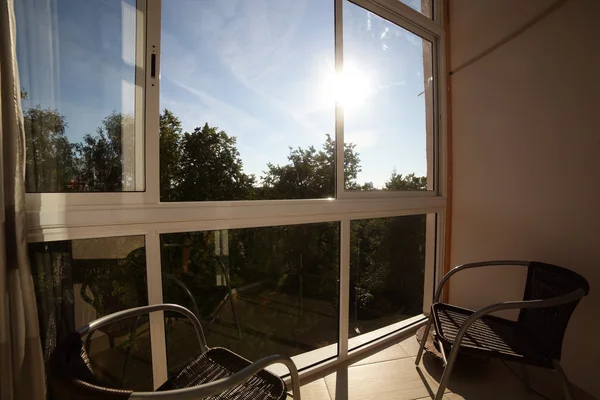
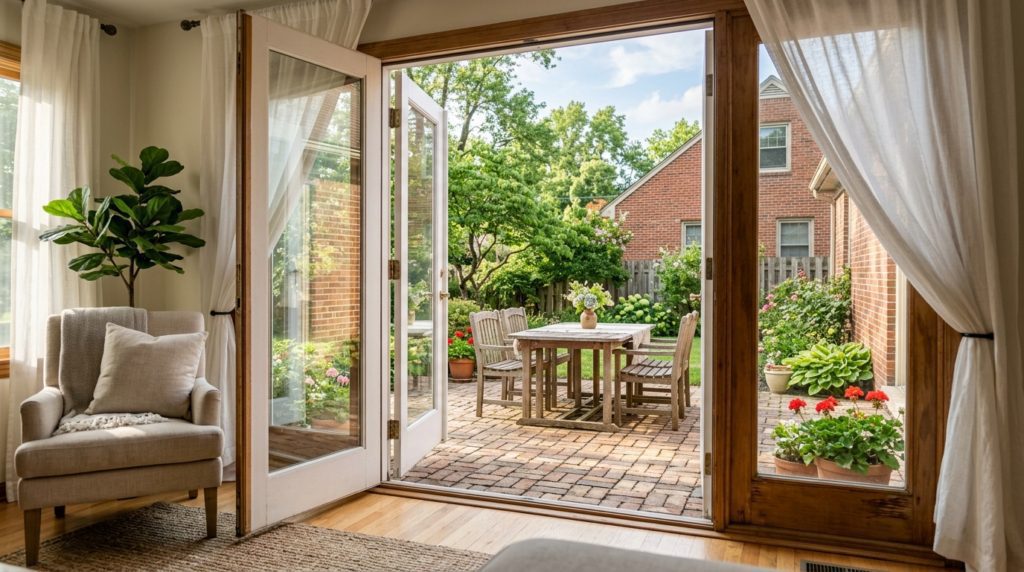
Patio doors come in five main styles, and which one fits depends on your wall space, your home’s character, and how Ohio winters treat the hardware over time. The wrong choice isn’t just a style problem; it can mean a draft by year three or a door that sticks every January.
Whether you are replacing an aging slider or adding a door where there wasn’t one before, our sliding door repair and replacement team works across Columbus and Cincinnati to install the right unit the right way.
Quick answer: The five main types of patio doors are sliding glass, French hinged, bifold, multi-slide, and sliding French. Sliding fits most spaces; French hinged gives the widest opening; bifold and multi-slide fold away to erase the wall entirely. For Ohio homes, the frame material and glass package matter as much as the door style.
Sliding Glass Patio Doors
The sliding glass patio door is the most common type installed in American homes over the last fifty years, and for good reason. It needs no swing clearance, fits openings as narrow as five feet, and costs less to buy and install than most alternatives. One panel is fixed to the frame; the other glides on a track, and you get a wide glass opening with a small footprint.
The trade-off is that only about half the frame ever opens at once, since the sliding panel covers the fixed one rather than moving out of the way. The track also collects debris: dust, leaves, and in winter, ice. If the track is not kept clear and the weep holes are blocked, water sits there, freezes, and puts the rollers under stress they were not designed to handle.
Security on a basic sliding door is limited. A standard latch keeps the panel from sliding but does not prevent it from being lifted out of the track from outside if no pin is installed in the top channel. An anti-lift pin closes that gap for almost nothing. Multi-point locks and reinforced handles provide a more complete solution for homeowners who want more than builder-grade hardware.
- Best for: patios where swing clearance is tight, smaller openings, and projects where simplicity and cost matter.
- Weak point: track maintenance and basic security, both of which are inexpensive to upgrade.
- Ohio issue: clogged weep holes let water sit in the track, freeze, and damage rollers through a single winter.
French Patio Doors
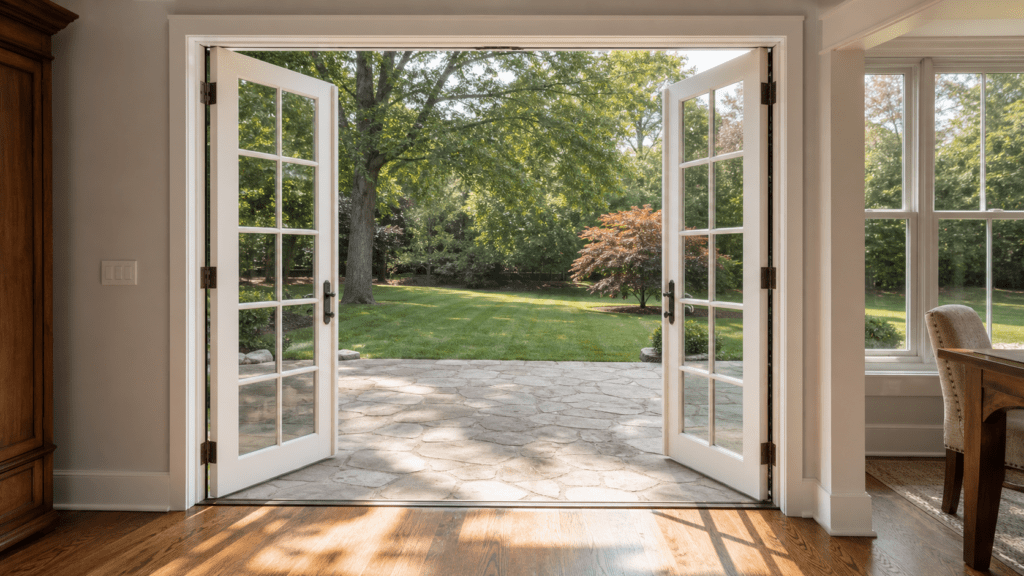
French patio doors are two hinged panels that swing open on a center meeting rail or separate side jambs. When both panels open at once, they give the widest unobstructed opening of any door style, with no track and no fixed glass eating into the usable width. The look is traditional and pairs well with colonial, craftsman, and farmhouse exteriors.
The swing is the thing to plan around. A door that opens inward needs three or more feet of clear floor space inside; furniture placement becomes part of the spec. Outswing doors avoid that trade-off but face the weather directly: snow piled against the threshold can block an outswing door from opening, and the hinges are exposed to the elements year-round. Most Ohio installers favor outswing with a raised threshold and a solid drip cap above the frame, which sheds water away from the sill and prevents the base rot that catches up with poorly sealed units.
Both panels need seals along the center meeting rail, and those seals bear the brunt of every temperature swing. Fiberglass is the preferred frame material for French doors in cold climates because it does not shrink and swell the way wood does, keeping the meeting rail tight through freeze-thaw cycles. Wood frames are beautiful and match older Columbus-area homes well, but they demand repainting every few years to keep moisture out of the grain.
- Best for: full-width openings, traditional home styles, spaces where an unobstructed passage is the priority.
- Weak point: swing clearance requirement and seal maintenance at the center meeting rail.
- Ohio note: outswing with a raised threshold handles snow best; fiberglass frame is the durability choice here.
Bifold and Multi-Slide Patio Doors
Bifold and multi-slide doors share the same appeal: they fold or slide away so completely that the boundary between inside and outside nearly disappears. Bifold panels are hinged to each other accordion-style, folding back to one side or stacking evenly at both sides. Multi-slide panels each move on their own tracks, pocketing into the wall cavity or stacking beside the frame. Both styles are common in contemporary designs where the goal is a seamless indoor-outdoor connection across a wide opening.
The cost and complexity jump significantly compared to a standard slider or French door. The rough opening needs to be wider, the framing more precise, and the hardware more robust. A bifold or multi-slide door that is not level and plumb from day one will give you problems: panels that bind, seals that gap, and hardware that wears prematurely. This is not a style where the margin for installation error is generous, and it is worth being selective about who sets it.
In Ohio’s climate, the greater number of moving parts, seals, and hinges means more potential failure points when temperatures cycle hard. Premium weatherstripping across every panel junction is not optional here; it is what keeps the heating bill in line. Despite the added complexity, these doors are the right tool for wide openings on large patios, covered porches, or additions where the full wall is meant to open up in warm weather.
- Best for: large openings, modern floor plans, and patios where the whole wall is meant to open.
- Weak point: cost, hardware complexity, and tighter installation tolerance than any other door type.
- Ohio note: insist on premium weatherstripping at every panel joint — it prevents air infiltration when temperatures drop.
Patio Door Materials: Vinyl, Fiberglass, and Wood
The frame material determines how a patio door holds up over the long run far more than most homeowners realize when they are comparing styles. Each material has real strengths, real weaknesses, and a performance envelope it is suited for.
Vinyl is the most widely installed material in residential patio doors because of its low upfront cost, zero paint requirement, and decent insulation value. The limitation in Ohio is that vinyl expands in summer heat and contracts in winter cold. On an entry-level unit, that cycling causes frame corners to gap and seals to compress unevenly over years. A quality vinyl door with reinforced corners handles that movement better, but it is worth knowing what grade of material is in the unit you are buying.
Fiberglass does not expand and contract with temperature the way vinyl does. It resists moisture, holds color without fading, and accepts paint if you want to change the look later. It holds its shape through decades of Ohio freeze-thaw cycles better than any other material at a comparable price point. The upfront cost runs higher than vinyl, but fewer hardware adjustments and seal failures across a ten-year span often close that gap.
Wood remains the best aesthetic match for Columbus’s older housing stock: Victorian, craftsman, and colonial-era homes where a vinyl slider would look out of place. The maintenance commitment is real. The exterior surface needs to be painted or stained every three to five years to seal out moisture; neglect that and the wood softens, the frame warps, and the door begins to draft. Clad-wood frames, with a fiberglass or aluminum exterior shell and a wood interior, are the practical compromise that cuts maintenance without sacrificing the interior look.
- Vinyl: affordable and low-maintenance, but quality varies; choose reinforced corners for Ohio’s temperature swings.
- Fiberglass: dimensionally stable, durable, and low-maintenance; the strongest performer in freeze-thaw climates.
- Wood / clad-wood: the right look for older homes, but exterior maintenance every few years is non-negotiable.
Glass Options and Energy Performance
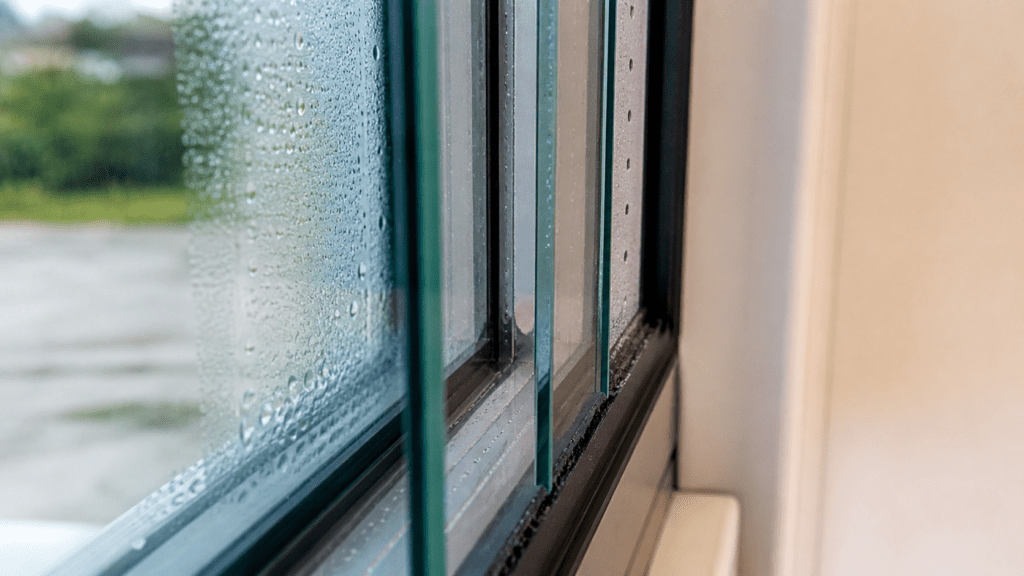
A patio door is mostly glass, so what the glass does matters at least as much as what the frame is made of. Single-pane glass has no place in an Ohio home; the heat loss through even a small single-pane slider shows up in the heating bill every winter. Double-pane insulated glass with a Low-E coating is the baseline for this climate, and triple-pane is worth considering for north-facing walls or large glass areas.
Low-E coatings are applied to one or more surfaces inside the sealed unit. The coating reflects long-wave radiant heat back into the room in winter and rejects solar heat gain in summer. For Ohio, a High Solar Gain Low-E coating allows passive winter warmth through south-facing glass while still blocking summer overheating. Your installer should be able to tell you which coating is specified on the door you are buying, not just that the door is “Low-E.”
The gas fill between panes also contributes. Argon-filled units insulate better than air-filled units of the same glass thickness for a modest additional cost. Krypton fill is more effective still but is typically reserved for triple-pane units or thin-profile frames where argon alone won’t fit the spec.
When comparing options, check the NFRC label: the U-factor is the whole-unit insulation rating (lower is better), and the SHGC is the solar heat gain coefficient. For the North-Central climate zone that includes Columbus and Cincinnati, ENERGY STAR requires a U-factor at or below 0.27 for doors. A door that does not hit that number will cost more to heat and is worth questioning during any quote conversation.
- Double-pane Low-E + argon: the minimum for Ohio; covers most residential installs well.
- Triple-pane: worth considering for large glass areas, north-facing walls, or rooms with persistent cold-wall complaints.
- ENERGY STAR target: U-factor at or below 0.27 for the North-Central zone.
What Ohio Winters Do to Patio Doors
Ohio’s climate puts patio doors through a stress test that milder climates never replicate. The freeze-thaw cycle is the main culprit: when temperatures cross the freezing mark repeatedly through a single winter, any water that has worked its way into a track, a frame corner, or a seal bead freezes, expands, and forces things apart. A door that was installed with shallow flashing or without a properly sealed threshold in year one will show the damage by year four or five.
The most common freeze damage we see on sliding doors around Columbus isn’t the glass. It’s the weatherstripping: compressed all summer and then brittle in January. By year five or six, you can feel the draft with the door latched. That’s years of cycling, not a sudden failure.
Hard water is a secondary problem specific to this region. Columbus’s water supply carries mineral hardness that leaves calcium deposits on glass when outdoor spray or condensation evaporates without being wiped. Left alone, those deposits etch into the surface coating. A squeegee after rain and a monthly wipe with diluted white vinegar keeps the glass clear without abrasives.
Ice on the track is the winter problem sliding-door owners know well. The track sits at floor level, collects snow tracked in from the patio, and can freeze overnight. A spray of silicone lubricant on the track rollers each October prevents the door from refusing to move on a January morning.
When condensation appears between the panes, the sealed unit has failed and moist interior air is reaching the cold inner surface through the breach. That is not a cleaning problem; it calls for an insulated glass replacement to stop moisture from working further into the frame.
Security: What Actually Matters
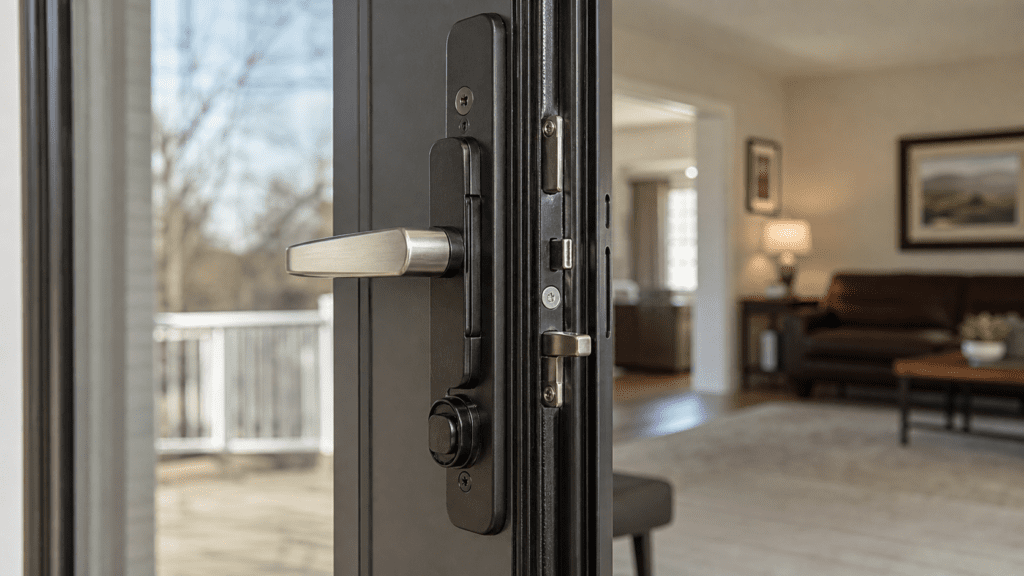
Sliding patio doors have a reputation as a weak point in home security, and on a poorly equipped door, that reputation is earned. A standard patio latch keeps the panel from sliding, but most sliders can be lifted out of the lower track from outside if no anti-lift pin is installed in the top channel. That is a small, inexpensive fix that most homeowners are never told about.
The most effective security upgrades for sliding doors, in order of impact, are an anti-lift pin in the top channel, a foot bolt or floor bar for use at night, and a multi-point locking handle that throws bolts into both the top and bottom of the frame. Laminated or tempered glass raises the effort required for a forced entry and is worth adding on any door that faces an unsecured backyard.
French doors have a different vulnerability. The center meeting rail, where the two panels meet, is the easiest point to force if the door has only a single-point latch. A three-point or five-point locking system that throws bolts into the head and sill in addition to the latch is the correct solution, and the cost of that hardware is modest compared to the door itself.
Bifold and multi-slide configurations vary enough that security has to be evaluated unit by unit, but the principle holds across all types: the hardware must restrict both horizontal and vertical movement at every panel, and every meeting-rail contact point needs a positive lock that is not just a spring-loaded tab.
- Sliding door baseline: anti-lift pin in the top channel plus a multi-point lock handle.
- French door baseline: three-point locking that throws bolts into the head and sill of the frame.
- Glass upgrade: laminated safety glass on any door that faces an unsecured area.
How to Choose the Right Patio Door
Start with the opening, not the style. How wide is the rough opening, and how much floor space is available on the swing side? A sliding door fits almost any opening; a French door needs swing clearance; bifold and multi-slide panels need a wider frame and a specific framing depth to operate correctly. Measure first, browse second.
Home style comes next. A traditional colonial or craftsman home usually reads well with French doors; a contemporary house with clean lines suits a slider or a multi-slide panel system; a cottage or farmhouse can go either way depending on the patio configuration. Style mismatch is more visible on a patio door than on a window because the door is a dominant feature of any room it sits in.
Then layer in the material and glass decision. For most Ohio replacements, fiberglass with double-pane Low-E argon is the combination that hits the balance of durability, insulation, and cost. Triple-pane makes sense if the opening is large or the room faces north. Wood makes sense if the home’s character calls for it and you are prepared for the maintenance schedule it requires.
Finally, think through the use pattern honestly. A door that opens once a day to let the dog out puts different wear on the hardware than one that opens fifty times a day during a summer deck season. Rollers, hinges, and seals are rated for cycle counts, and a premium hardware package on a high-traffic door earns its cost over time. Our entry and patio door pages cover the specific configurations and product lines we work with most often in Columbus and Cincinnati.
Thinking About a New Patio Door?
The door type is the starting point, not the finish line. Getting the right choice installed correctly is what determines how the door performs five winters from now, and that starts with a proper look at the opening, the wall, and how the house was framed.
Book a free, no-pressure patio door assessment with our team in Columbus and Cincinnati and get a straight answer on which type, material, and glass package fits your home and your climate.
FAQ: Types of Patio Doors

Ready to fix your windows? Get a free quote in 30 seconds.
Family-owned, licensed & insured. Free, no-obligation quotes.