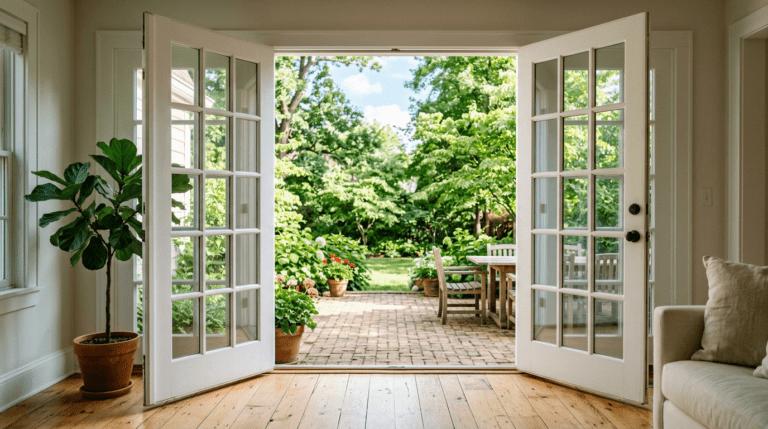
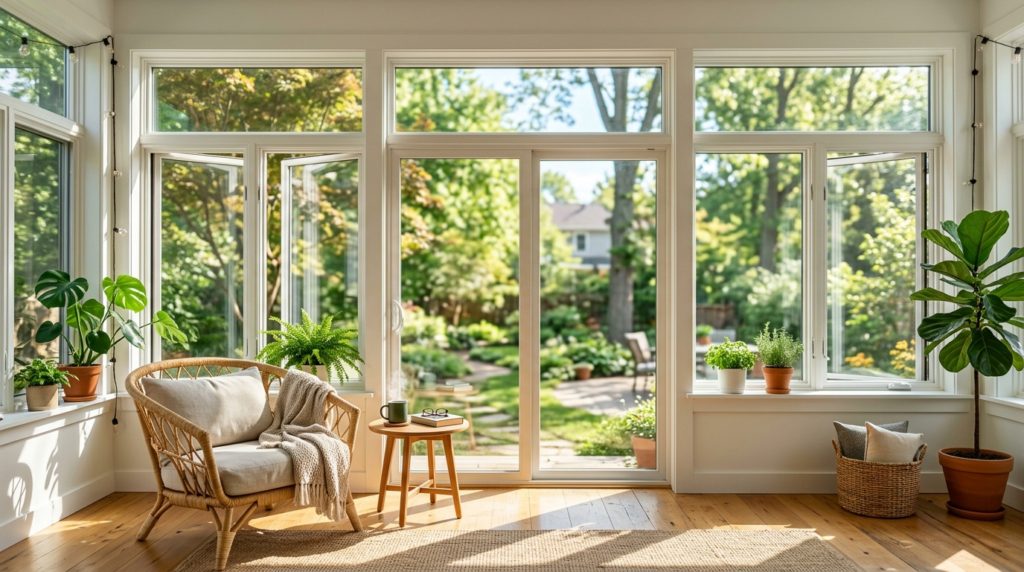
A sunroom lives or dies by its glass. In an ordinary room the windows are a feature; in a sunroom they are most of the wall, sometimes ceiling to floor on three sides. That changes the math. A window package that feels fine in a bedroom can leave a sunroom freezing in January and stifling in July, because there is no insulated wall behind it to make up the difference.
So the choice of sunroom windows is really the choice of how the room will feel year round. This guide walks through the one decision that drives every other (three-season versus four-season), the window styles that suit the space, the glass and frame options that handle an Ohio climate, the cost factors that move the number, and the condensation trap that catches more homeowners than any other. If the room is part of a larger project, a new window and door installation ties the glazing into the existing wall correctly from the start.
Quick answer: Choose sunroom windows by deciding first whether the room is three-season or four-season, because that sets the glass. Three-season rooms use lighter glazing and plenty of operable windows for airflow; four-season rooms need double or triple low-E glass with tight seals to stay comfortable through an Ohio winter.
Why Sunroom Windows Are a Different Decision
In a typical room, glass makes up maybe a fifth of the exterior wall, and the insulated framing around it carries the comfort load. A sunroom flips that. Glass can account for the great majority of the enclosure, so whatever the window does, the room does. There is little or no insulated wall to hide a weak glass package.
That single fact reshapes every choice that follows. The glass spec is no longer a detail; it is the comfort spec for the whole room. A coating that controls summer heat, a gas fill that slows winter heat loss, and a frame that does not conduct cold all matter far more here than they would behind a normal wall.
It also means small differences multiply. A sunroom might hold eight or ten windows where a bedroom has one, so a seal that leaks a little, or a frame that runs cold, is repeated across the room many times over. Picking the right unit once pays off across the entire wall of glass.
Three-Season vs. Four-Season: Decide This First
Before you look at a single style or color, settle how you intend to use the room across the year. This one decision drives the glass, the frame, the cost, and whether the space is comfortable in February or just in May. The two paths are genuinely different rooms, not two price tiers of the same room.
A three-season room is built for spring through fall. It leans on lighter glazing and a high share of operable windows for ventilation, and it is not tied into the home’s heating and cooling. It is bright, breezy, and the value choice, but it is not meant to hold heat in deep winter.
A four-season room is conditioned living space. It needs double or triple low-E glass, tight compression seals, well-insulated frames, and usually a connection to the home’s HVAC so it stays usable year round. The common, expensive mistake is building a three-season room and then trying to heat it in an Ohio January. Single-pane or basic glass cannot hold that heat, the bills climb, and the cold glass sweats. Decide the rating at the design stage, not after the room is up.
Sunroom Window Types and Where They Fit
Most sunrooms mix a few window styles rather than using one everywhere. The goal is to balance unobstructed views, enough operable units for a real cross-breeze, and easy cleaning, since there is a lot of glass to keep clear. Even if you do not own these styles yet, it helps to know what each one does before you lay out the wall.
A good rule is to place fixed glass where the views and light matter most, then ring it with operable windows you can actually reach and open. The styles below are the ones that show up most in sunrooms around central Ohio.
- Casement windows crank outward on a hinge, seal tightly when closed, and catch a side breeze, which makes casement units a strong pick for ventilation and energy.
- Picture windows are large fixed panes for maximum light and view; fixed picture glass often sits high or out of reach above operable windows.
- Double-hung windows open at top and bottom and tilt in for cleaning, so double-hung units suit a sunroom over a porch or deck.
- Sliding windows glide horizontally on a track, work well in wide low openings, and are easy to operate.
- Awning windows hinge at the top and open out, venting even during a light rain, which is useful up high or over a counter.
Glass and Energy Options That Suit Ohio
Because the glass is most of the room, its makeup decides comfort more than anything else. The two levers are the number of panes and the coatings between and on them. Single-pane glass belongs only in a true three-season room you will close up for winter. For anything used in cold weather, insulated glass is the floor, not the upgrade.
Ohio’s swing from humid summers to hard freezes asks the glass to do two jobs at once: keep summer heat out and winter heat in. A low-E coating reflects heat back toward its source, argon gas between the panes slows the transfer, and a warm-edge spacer keeps the pane edges from running cold and sweating. Get those three right and the room stays livable in both seasons.
- Dual-pane low-E with argon is the practical baseline for a year-round sunroom in this climate.
- Triple-pane adds insulation for very exposed walls or the coldest rooms, though it is not always worth the added weight and cost.
- Low-E coatings come in strengths; a stronger solar-control coating helps on sun-baked walls, a milder one preserves winter gain.
- Tints (light bronze or grey) cut glare and UV that fades furniture, useful on a bright southern or western wall.
Large panes also take thermal stress, and a chip at the edge can spread into a crack on a hot afternoon. A single cracked pane is usually a glass repair rather than a reason to replace the unit.
Frame Materials for a Wall of Glass
The frame holds the glass, seals the gaps, and either helps or hurts the energy picture. In a sunroom, where the frames are exposed to direct sun for hours and repeated across the whole wall, two things matter most: how well the material resists fading and warping, and whether it conducts cold into the room.
Vinyl and fiberglass are the usual recommendations for sun-exposed sunrooms. Vinyl insulates well, never needs repainting, and modern color-stable formulas resist fading even after years of direct sun. Fiberglass is stiffer and very stable, a good match for large openings. Wood and aluminum-clad wood look beautiful but ask for more upkeep on the interior. Bare aluminum frames conduct cold readily, so in this climate they need a thermal break, or the frame itself becomes the cold spot where condensation forms.
The Condensation Trap Nobody Warns You About
This is the problem that surprises the most homeowners, and it is the direct result of under-speccing the glass. A sunroom is a glass box. Fill it with warm, humid indoor air in winter, and that moisture finds the coldest surface in the room, which is the inside face of cold glass. The result is fog, then frost, then water running down the pane and pooling on the sill.
Left alone, that standing water does what water always does in this climate. It wicks into the sill and frame, freezes and thaws, and over a season or two it rots the wood and lifts the finish. The fix is upstream: a four-season room needs insulated low-E glass with a warm-edge spacer and a properly conditioned, not over-humidified, space. A three-season room should simply not be heated and lived in through a hard Ohio winter.
On sunroom calls around Columbus, the water on the sill in January is almost never a leak. It is warm room air condensing on glass that was never specified to stay warm. The glass, not the weatherstripping, is the thing to fix.
One caution: condensation between the panes is a different failure. That is moisture sealed inside the glass unit, which means the seal has given out and the glass has lost its insulating gas. A fogged pane that will not wipe clear is an insulated glass replacement, not a wipe-down.
Orientation: Match the Glass to Each Wall
A sunroom rarely faces one direction, so the same glass is not ideal on every wall. The sun that warms the room for free in winter is the same sun that overheats it in summer, and a single coating cannot fully serve both. Reading the orientation before you order saves a room that bakes by mid-afternoon.
South and west walls take the most heat and glare, so they benefit from a stronger solar-control low-E or a light tint to keep July comfortable. North-facing glass gets little direct sun, so clear, high-transmission glass makes the most of the limited daylight. East walls see balanced morning light and tolerate a flexible glass choice. Planning the coating wall by wall, rather than ordering one package for the whole room, is the difference between a room you use all summer and one you avoid after noon.
What Actually Drives the Cost
Sunroom window pricing is not one number, and chasing a single quote misses the point. Because glass is so much of the wall, the count and quality of the windows is a large part of the total, and the choices that make a room comfortable are the same ones that move the cost. Rather than a figure, it helps to know the levers.
The first lever is the season rating, because four-season glass packages, tighter frames, and the HVAC tie-in cost more than a ventilated three-season build by design. The rest follow from there.
- Number and size of windows, since the glass is most of the enclosure.
- Glass package, from single-pane up through triple-pane low-E with argon.
- Frame material, with clad wood and fiberglass above standard vinyl.
- Operable versus fixed ratio, because every opening unit adds hardware and seals.
- Installation and air sealing, which decide whether the rated glass performs in the wall.
For a build tied into the home, a professional installation and an on-site assessment give a real number for your room and orientation.
How to Choose: A Simple Framework
With the pieces on the table, the choice becomes an order of decisions rather than a guess. Work through them in sequence, because each one narrows the next: the season rating sets the glass, the orientation tunes the coating, and the layout sets how many operable units you need.
The single most common regret is skipping the first step and shopping styles before settling on how the room will be used. Pin that down, and the rest falls into place.
- Decide the season rating. Three-season for spring through fall, four-season for year-round, conditioned use.
- Read the orientation. Note which walls face south and west for heat control, north for daylight.
- Set the ventilation ratio. Choose enough operable windows, placed for a cross-breeze, balanced with fixed glass for views.
- Match the glass package. Insulated low-E with argon for any cold-weather use, with coatings tuned per wall.
- Pick the frame. Favor low-maintenance, color-stable vinyl or fiberglass for sun-exposed walls.
- Plan the install. Confirm the air sealing and flashing, since the rating only holds in a tight opening.
Planning a Sunroom and Not Sure Where to Start?
The right sunroom windows come down to how you will use the room and which way it faces, and those answers are easier to reach with someone who has glazed a lot of glass boxes in this climate. There is no sense guessing on the one choice that decides whether the room is comfortable.
Book a free, no-pressure assessment with our Columbus-area team, or read more about a full window and door installation if the sunroom is part of a larger project.
FAQ: Choosing Windows for a Sunroom

Ready to fix your windows? Get a free quote in 30 seconds.
Family-owned, licensed & insured. Free, no-obligation quotes.