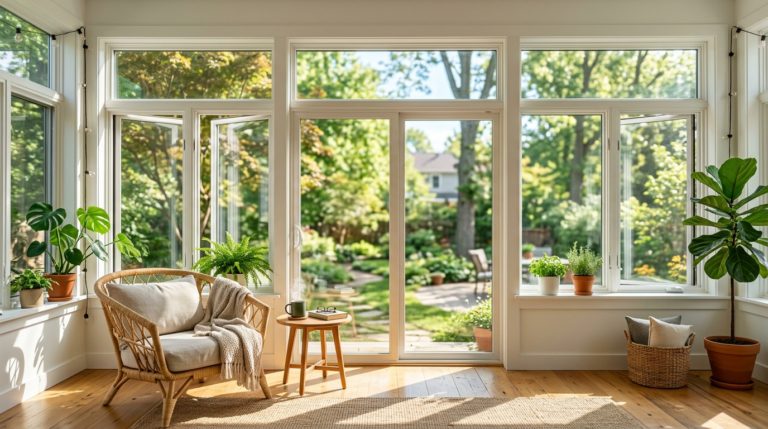
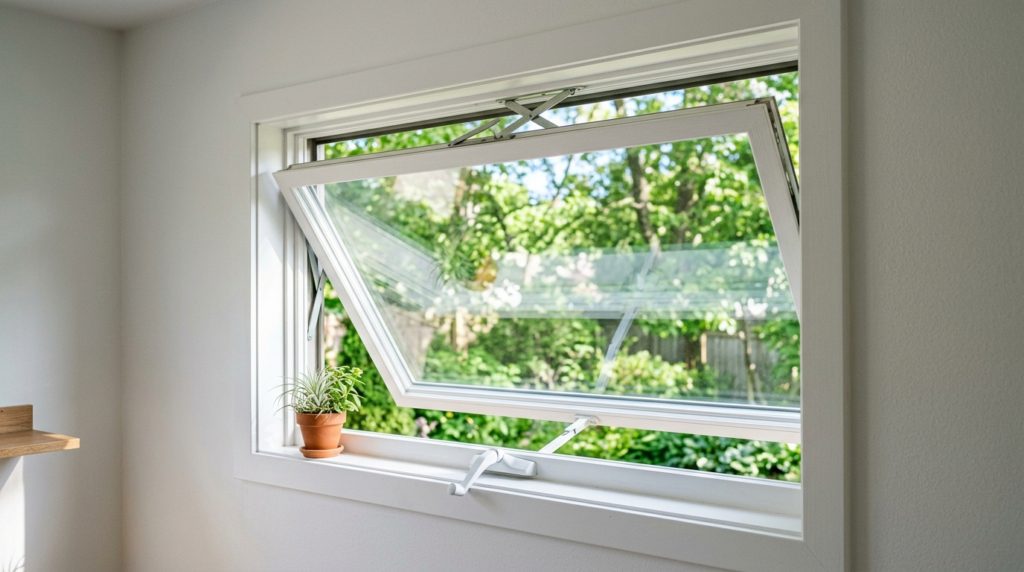
An awning window hangs from a hinge along its top edge and swings open from the bottom, so the glass tilts out like a small awning over the opening. That one design choice shapes everything about where the window shines and where it falls short. It vents in the rain, seals tight against winter wind, and tucks into spots a sliding window cannot, yet it also caps out at a small size and is the wrong pick for an escape route.
This guide covers what an awning window actually does well, the trade-offs worth weighing, how it stacks up against casement and hopper styles, and the rooms where it earns its place. If you are weighing a swap or a new opening, our team installs and services awning windows across the Columbus and Cincinnati area and sees firsthand which ones hold up.
Quick answer: Awning windows hinge at the top and open outward at the bottom. Their strengths are rain-friendly ventilation, a tight compression seal for energy efficiency, and high placement for privacy. Their limits are small size, hard-to-reach cleaning, and the fact that they cannot serve as a code-legal escape window.
What an Awning Window Is and How It Works
An awning window is a single sash hinged along its top edge. You turn a crank or a fold-down handle and the bottom of the sash pushes outward, pivoting on that top hinge until the glass sits at an angle to the wall. Most models open to about 45 degrees, far enough to pull in air but not as wide as a casement, which swings on a side hinge to a full 90.
The crank operation matters for more than convenience. As the sash closes, it draws in against a continuous gasket and presses flat onto the frame, the same compression seal a casement uses. That is a tighter closure than any sliding window, where the sash has to glide past the frame and can never clamp down as hard. The trade-off is moving hardware: an operator arm, a hinge track, and the gasket all do real work and eventually wear, where a fixed pane has nothing to fail.
Because the sash is usually wider than it is tall, awning windows read as horizontal bands. That shape is why you see them high on bathroom walls, stacked beneath a large fixed pane, or in a row near the ceiling. The casement is the close cousin that handles the taller openings.
The Benefits of Awning Windows
The headline advantage is ventilation you can use in weather that would force other windows shut. Because the open sash tips outward and downward, it forms a little roof over the gap, so a light rain runs off the glass instead of dripping onto the sill. On a humid Ohio evening you can crack one open for a cross-breeze and leave it that way through a passing shower.
The second real strength is the seal. That compression closure cuts air infiltration, which is what you feel as a draft and pay for on a heating bill. Pair the tight seal with high placement and you get a window that adds privacy and frees the wall below for furniture or cabinets, without giving up daylight. The practical wins stack up:
- Rain-friendly airflow lets you vent overnight or during a light shower without water reaching the sill.
- A tighter seal than sliders means the sash clamps onto the frame, so less air leaks in winter.
- Better security comes from a sash set high and cranked shut, which is hard to reach or pry from outside.
- Privacy with light follows from high placement that lets sun in while keeping sightlines out.
- Freed wall space stays usable because nothing slides sideways or sits at eye level.
The Drawbacks to Weigh
None of the strengths come free, and the same outward swing that sheds rain creates the main headaches. The exterior face of the glass points away from you when the window is open and is often mounted high, which makes cleaning the outside awkward, usually a job from a ladder or with a long-handled tool. In Ohio that outer pane still collects pollen in spring and hard-water spotting from sprinklers, so it does need attention.
Size is the other hard limit. Because the whole sash hangs off a top hinge and projects outward, manufacturers cap the dimensions to keep the unit from sagging or catching wind, generally around three feet wide and two feet tall. That keeps the style out of any role where you want a big, open expanse. A few more trade-offs to keep in mind:
- It projects outward, so an open sash over a deck, walkway, or path is a head-knock hazard and gets in the way.
- The opening angle is limited to about 45 degrees, less raw airflow than a casement that swings to 90.
- You have to close it in a real storm, because the rain shield works in a light shower, not in driving, wind-blown rain.
- There are moving parts to maintain, since the crank, operator arm, and hinge need the odd cleaning and lube.
- It is not an escape window, which rules it out of many bedrooms and basements, as the next section explains.
Awning vs. Casement vs. Hopper Windows
All three of these are crank-or-tilt windows that seal by compression, and they get mixed up constantly, but the hinge location changes how each one behaves. An awning hinges at the top and opens out at the bottom. A casement hinges on the side and swings out like a door. A hopper is the upside-down awning: hinged at the bottom, it tilts inward from the top, which is why you find them on basements and below-grade openings.
The choice usually comes down to opening size and where the sash goes when it is open. A casement opens widest and reaches taller dimensions, so it suits a single large opening where you want maximum air or an escape route. The top-hinged style wins where you want a wide, short window up high that vents in the rain. A hopper makes sense where an inward swing is fine and an outward one is not, such as a tight basement well.
If you are deciding specifically between the top-hinge and bottom-hinge styles, our deeper awning vs. hopper comparison walks through each spot in the house. For a taller opening or anywhere you need a code escape, a casement window is usually the better tool.
Why They Can't Serve as Egress
This is the trade-off that catches people out, and it is a safety issue, not a preference. Building codes require any bedroom and most finished basements to have an emergency escape and rescue opening: a window big enough and reachable enough for a person to climb out and a firefighter to climb in. The benchmark is a clear opening of roughly 5.7 square feet, at least 20 inches wide and 24 inches tall, with the sill within reach of the floor.
An awning window fails that test on two counts. Its size caps out well below the required clear opening in most cases, and when it is open the sash projects across the very space you would climb through. In a basement window well the problem is worse, because the tilted-out glass blocks the climb-out path, which is why code generally does not allow this style in escape wells at all.
The fix is to match the opening to the job. Where you need an escape route, a side-hinged casement opens wide enough to qualify, and a hopper that swings inward keeps the well clear. Save the top-hinged unit for openings that are about ventilation and light, not exit.
The Best Rooms and Places to Use Them
Awning windows earn their keep wherever you want air and daylight from a spot other windows cannot serve. The classic location is high on a bathroom wall, where the window sits above eye level for privacy yet still vents steam after a shower. Over a kitchen sink they are easy to push open with one hand without leaning across the counter, and they let cooking heat escape.
The horizontal shape also makes them natural partners for a fixed pane. Stack a row of them beneath a large picture window and you keep the unbroken view while gaining ventilation the fixed glass cannot offer. The same trick works in a stairwell, a hallway, or a finished basement that already meets egress another way, bringing light into spots that are otherwise dark.
Where they do not belong is anywhere the open sash gets in the way. Skip them over a deck, a porch, a patio seating area, or a walkway, since the projecting glass becomes an obstacle and a head hazard. Good places to put one include:
- Bathrooms, high on the wall for privacy plus steam venting.
- Over a kitchen sink, for easy one-hand operation with no reaching.
- Beneath a picture window, for ventilation without breaking up the view.
- Laundry rooms and basements, for air and light in damp, low spots where egress is met another way.
- Stairwells and hallways, for daylight high on a wall where furniture sits below.
How They Hold Up to Ohio Weather
The same features that sell an awning window get tested hard by an Ohio climate that swings from humid summers to freeze-thaw winters. The compression seal that makes the window efficient is only as good as its weatherstripping, and that gasket stiffens and shrinks over years of cold. Once it stops clamping, you feel the draft and the energy edge disappears, which is the first thing to check on an older unit that suddenly feels cold.
Winter is also hard on the moving parts. A sash that projects outward catches snow and ice, and meltwater that refreezes in the hinge track can seize the operator so the crank binds or strips. Keeping the sill and hinge channel clear before the cold sets in keeps the mechanism honest.
On service calls around Columbus, the crank window that won’t close in February is rarely a broken operator. It is ice in the hinge track or a gasket gone hard, and once the sash can’t seat, the draft and the fog on the glass follow close behind.
That fog is the other tell. When the glass between the panes clouds over, the insulated seal has failed, not the window itself, and the unit can often be reglazed rather than replaced; see our note on foggy, failed insulated glass. High-mounted units make this worth catching early, since the repair means a ladder either way.
Materials and What to Spec
What an awning window is made of decides how it ages, especially under Ohio’s temperature swings. The frame material sets the maintenance and the insulation, while the glass package sets the comfort. None of these is a cheapest-wins decision, because the operator and hinge see the same weather as the frame.
Frame choices each carry a clear trade. Vinyl is the affordable, low-maintenance default and insulates well, though color options are limited. Fiberglass and composite cost more but stay dimensionally stable through freeze-thaw, so the seal holds its fit longer. Wood looks the part in a historic Columbus home but wants upkeep, and aluminum is strong yet conducts cold, which can invite condensation. On the glass, ask for these:
- Double-pane insulated glass with a low-E coating to cut summer heat gain and winter loss.
- An argon gas fill for a little more insulation between the panes.
- A warm-edge spacer at the glass edge, where seals fail first and fog starts.
- A quality operator and hinge, since the hardware is what wears, not the pane.
If you are adding these windows as part of a larger project or opening a new wall for them, plan it with a proper window installation so the rough opening, flashing, and air seal are right from the start.
Keeping Them Working: Maintenance and Cleaning
An awning window rewards a little routine care, mostly because it has hardware a fixed pane does not. Twice a year, wipe the hinge track and the sill clear of grit, then put a light shot of dry silicone, never an oily lubricant that attracts dirt, on the operator and hinge so the crank stays smooth. If the crank still slips or grinds after cleaning, our crank replacement guide walks through matching and swapping the operator. Check the weatherstripping at the same time and replace it once it no longer springs back, since that gasket is the whole energy story.
Cleaning the glass is the part people underestimate. Because the sash opens outward and usually sits high, the exterior face is awkward to reach, and in this climate it picks up pollen and hard-water spots that show in low sun. Crank the window fully open to get at as much of the outer pane as you safely can, and use a proper method to avoid streaks; our guide to cleaning glass streak-free applies here too. For anything beyond comfortable reach, a long-handled tool beats an unsteady ladder.
Not Sure an Awning Window Is the Right Fit?
Awning windows are a smart pick in the right spot and the wrong one where you need size or an escape route, and the difference is easy to miss from a catalog. If you are weighing them for a bathroom, a basement, or a wall of fixed glass, a quick look at the actual opening saves a costly mismatch.
Get a free, no-pressure assessment from our Columbus and Cincinnati team and a straight answer on whether one fits, or whether a casement or hopper does the job better. Start with a free window quote and we will take it from there.
FAQ: Awning Windows

Ready to fix your windows? Get a free quote in 30 seconds.
Family-owned, licensed & insured. Free, no-obligation quotes.