Stand in front of a wide patio opening and you have one real decision to make: should the glass slide or fold? Both turn a wall into a doorway to the yard, but they do it in opposite ways, and the right pick depends less on looks than on how you live in the room and how the door holds up to an Ohio winter.
A sliding door glides one panel past another along a track. A bi-fold door is a row of hinged panels that concertina to one side. That single difference ripples through everything that follows: how much wall opens, how the door seals against the cold, what it costs, and what wears out first. If your current slider sticks or drafts, the fix may be a tune-up rather than a swap, so it is worth a quick look at sliding patio door repair before you replace anything.
Quick answer: Sliding patio doors save space, seal tighter against cold, and cost less, the practical pick for most Ohio homes. Bi-fold doors open almost the whole wall for a true indoor-outdoor feel, but they need room to stack, more upkeep, and a bigger budget. Choose by how wide you want the opening and how much winter it faces.
How Each Door Actually Works
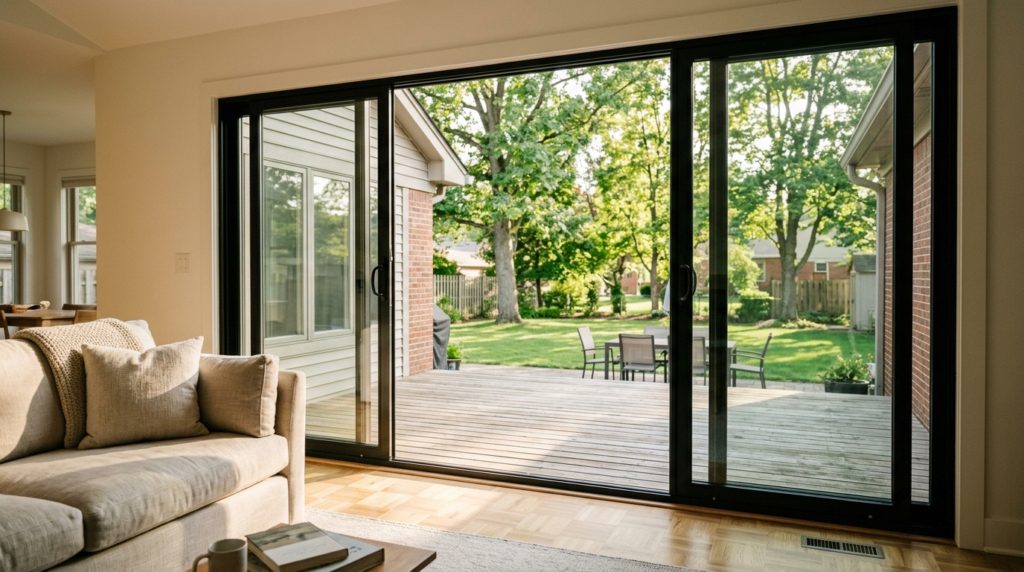
Both doors ride on a track, but they move in completely different ways, and picturing that motion is the fastest route to the right choice. A sliding door, sometimes called a gliding door, is built from two or more big glass panels. At least one panel is fixed in place while another rolls past it, so the door opens by sliding sideways within its own frame. Nothing swings into the room or out onto the patio.
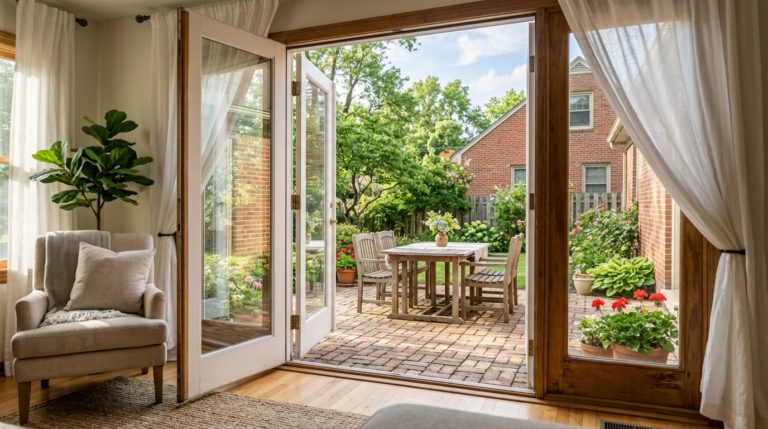
A bi-fold door works like an accordion. Several narrower panels are hinged together and hung from a top track, and when you pull the lead panel, the whole run folds into a stack at one end of the opening. Most setups also include a single hinged panel, called a day door, that opens on its own for everyday in-and-out without folding the entire wall back.
That mechanical split is the root of every other difference. The sliding door keeps its glass in the plane of the wall at all times. The bi-fold trades that simplicity for the ability to clear almost the whole opening, and it asks for more hardware and more room to do it. Patio doors come in several more styles too, and our guide to patio and entry doors covers where each one fits.
Space: How Much Room Each One Needs
Floor space is where the two doors part company first, and it is the factor that quietly rules many out before any other comparison matters. A sliding door needs none of the room a swinging door demands. The panels travel inside the width of the opening, so furniture, a dining table, or a kitchen island can sit right up to the glass on either side. In a tight breakfast nook or a condo, that is often the only door that fits.
A bi-fold pays for its dramatic opening with stacking space. When the panels fold back, they gather into a thick bundle of glass and frame that projects into the room or out onto the deck, depending on which way you hang them. You need a clear stretch of wall beside the opening for that stack to live, and you lose the use of it whenever the door is open.
So the space question runs both directions. Sliding doors win indoors, where they never intrude. Bi-folds can win outdoors if you have a wide deck or patio to fold onto, but only if there is somewhere for the stack to go. Measure the wall beside the opening, not just the opening itself, before you fall for the folding look.
The Opening: Half the Wall, or Nearly All of It
If the whole point is to erase the line between inside and out, this is the section that decides it. A standard two-panel sliding door only ever opens to about half its width, because one panel stays put and the other can slide no farther than the fixed one. A three or four-panel slider, or a pocket version that disappears into the wall, widens that gap, but a simple slider always leaves a stationary pane in the way.
A bi-fold clears far more. Because every panel folds away, a well-planned run can open roughly nine-tenths of the opening, leaving almost nothing between the kitchen and the patio. For summer parties, for carrying trays out to a grill, or for letting a breeze run through the house on a mild evening, that uninterrupted gap is the bi-fold’s headline feature and the reason people accept its trade-offs.
Match the opening to how you actually use the room. If you mostly want light, a view, and an easy step outside, a slider’s half-opening is plenty. If you entertain across the threshold and want the wall to vanish, the bi-fold earns its keep. Sliding doors stay popular precisely because most families need a doorway, not a missing wall.
Views and Sightlines When the Door Is Closed
A patio door spends far more of its life closed than open, so the view through the glass on an ordinary Tuesday matters as much as the wide-open moment. Here the sliding door usually has the edge. Its panels are large, and the frames between them are few, so a closed slider gives you broad, mostly uninterrupted sheets of glass looking out at the yard.
A bi-fold, by contrast, is divided. Every fold needs its own stile and rail, so a closed bi-fold shows a regular grid of frames marching across the opening. Some homeowners like that rhythm; others find it chops up the view they were trying to open up. The irony is real: the door that opens widest is also the one with the most frame in the way when it is shut.
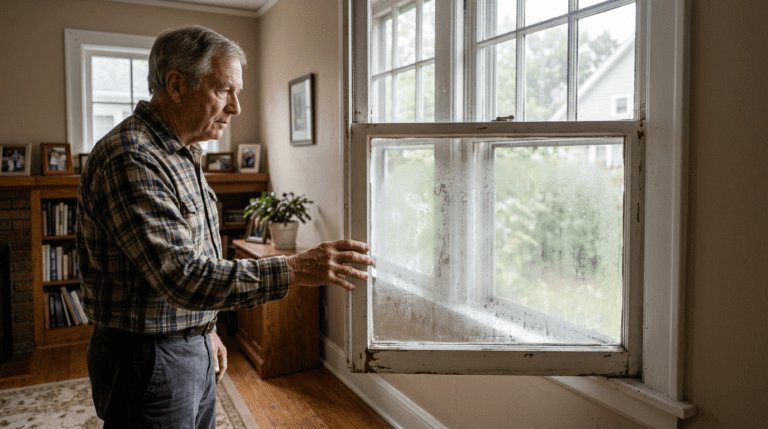
Glass quality counts for both. A failed seal that fogs the panes ruins the view on either style, and that is a glass problem more than a door problem. If your current door’s panes have gone cloudy, glass repair or replacement can often restore the view without touching the door itself. When you do compare new doors, look at them closed and open, in daylight, before you decide.
Energy Efficiency in an Ohio Winter
This is where the Ohio climate should steer the decision, and where most national comparisons go quiet. A door’s energy performance is only partly about the glass package. The other half is the seal around every place two pieces meet, and that is exactly where the two designs differ most.
A sliding door has very few of those meeting points. The panels overlap at one interlock and weatherstrip against the frame top, bottom, and sides. A bi-fold multiplies them. Every hinged panel meets its neighbor at a stile, and every one of those joints is a length of weatherstrip that has to stay tight through years of folding, freeze-thaw swing, and grit. The more joints a door has, the more chances cold air has to find a way in.
On patio doors we service around Columbus, the cold-air complaints cluster at the folds and the bottom track, not the glass. A slider with one good interlock tends to hold its seal through the winters far better than a multi-panel door with five places to leak.
None of this rules out a bi-fold in a cold climate. A well-built, properly installed folding door with good thermal breaks performs well. But it has more seal to maintain and more ways to draft as it ages, while a quality slider stays tight with less fuss. In Columbus and Cincinnati winters, that difference shows up on your heating bill and in how the room feels in January.
Daily Use, Thresholds, and Accessibility
How a door feels on the hundredth day matters more than how it looks on day one. A sliding door is the simpler everyday operator: grab the handle, push, and step through. Its main daily quirk is the track, which collects dirt and can stiffen the glide if it is not kept clean. There is no leaf swinging into your path.
A bi-fold asks a little more of daily life, which is why the day door exists. Folding the whole run back is a deliberate act, not something you do to let the cat out, so a single hinged panel handles routine trips while the full fold is saved for entertaining. Without a day door, a bi-fold can be a chore for ordinary in-and-out.
Thresholds are the accessibility wrinkle, and they pull in two directions in this climate. A low, flush threshold is easier for a wheelchair, a walker, or a loaded laundry basket, and bi-folds and modern sliders both offer one. But a low threshold has less height to hold back a wind-driven Ohio rain, so it leans harder on good drainage and weatherstripping to keep storm water out. A standard raised sill sheds water better but is a bigger step and trip point. Pick the threshold for the people and the weather that use the door most.
Maintenance and What Wears Out
Every moving door eventually needs attention, and the number of moving parts tells you how much. A sliding door is mechanically simple: two or three panels, a set of rollers, a track, a lock, and the weatherstrip. Keep the track clean and the rollers adjusted and a slider runs smoothly for years. When something does go, it is usually a worn roller or a packed track, both straightforward fixes.
A bi-fold has more of everything. Multiple panels mean multiple hinges, multiple rollers or pivots, a top and bottom track, and a multi-point lock that all have to stay in alignment for the panels to fold and meet cleanly. More parts mean more periodic adjustment, especially as the house settles and the seasons swing. Here are the parts that tend to need care on each style:
- Sliding door: the bottom track and rollers, which collect grit and wear flat over time.
- Bi-fold door: the hinges and pivots between panels, which loosen and need realignment.
- Both doors: the weatherstripping, which hardens and shrinks in cold and should be checked each fall.
- Both doors: the lock and its keepers, where a panel that has dropped out of alignment shows up first.
The takeaway is not that bi-folds are unreliable. It is that they trade some long-term simplicity for their wide opening, and that a slider is the lower-maintenance of the two. In a region where doors freeze, swell, and dry out across the year, fewer moving parts is a quiet advantage.
What Drives the Cost of Each
Cost on patio doors is less about a sticker number and more about how much door and how much wall the job involves. As a rule, a sliding door costs less than a comparable bi-fold, both to buy and to install, because it is a simpler unit with fewer panels and less hardware. A bi-fold is a more complex product, and the wider, multi-panel versions climb fastest.
Beyond the door itself, a few things move the final number more than the brand on the frame. Knowing them helps you compare quotes that look far apart for reasons that have nothing to do with quality.
- Panel count and width, since more glass and more folds mean more material and labor.
- Structural changes, because widening an opening for a big bi-fold can need a new header or beam to carry the load above it.
- Glass package, where low-E coatings and triple panes raise the unit price on either style.
- Threshold and flashing, as a low, weather-tight sill takes more careful detailing to install.
- Existing conditions, like rot or an out-of-square opening found once the old door comes out.
Because so much rides on the opening behind the door, a real figure only comes after someone measures the actual wall. If you are also opening or moving the wall, a folding system often belongs in a larger window and door installation project rather than a simple swap.
Which Should You Choose?
Put the two doors side by side and the choice usually sorts itself once you are honest about the room and the budget. There is no universally better patio door; there is the one that fits your opening, your weather, and the way you live. The list below maps the common situations to the door that tends to win them.
Use it as a starting point rather than a verdict, since a tight wall beside the opening or a hard-used family entrance can tip the decision either way. When two options seem close, the simpler, tighter-sealing slider is the safer default in this climate.
- Limited floor space or a tight budget: a sliding door, which never intrudes and costs less.
- Cold-weather comfort and low upkeep are top priorities: a sliding door, with fewer seals to fail.
- You entertain across the threshold and want the wall to open up: a bi-fold, if you have room for the stack.
- A wide opening onto a generous deck or patio: a bi-fold, for the indoor-outdoor flow.
- Best closed-door view and slim sightlines: a sliding door, with less frame across the glass.
- Accessibility with a flush threshold: either style, paired with good drainage for Ohio storms.
Still Weighing Sliding Against Bi-Fold?
The surest way to settle sliding versus bi-fold is to have someone look at your opening, your wall, and how the room is used, then walk you through what each door would really cost and how it would seal. A short visit separates the door you want from the door that fits.
Book a free, no-pressure assessment with our Columbus and Cincinnati-area team and get a straight recommendation for your space. Start with a free quote and we will help you choose the patio door that suits your home and your winters.
FAQ: Sliding vs Bi-Fold Patio Doors

Ready to fix your windows? Get a free quote in 30 seconds.
Family-owned, licensed & insured. Free, no-obligation quotes.