Look at almost any window in your house and you are looking at float glass. It is the clear, flat, distortion-free glass that makes up more than nine in ten flat panes produced worldwide, from a bedroom window to a storefront. The name comes from how it is made: molten glass literally floats on a bath of liquid metal so it comes out perfectly flat.
This guide explains what the material is, walks through how a continuous ribbon of it is formed, and covers the parts most explainers skip: the difference between the tin side and the air side, the thicknesses you can buy, and the tempered, laminated, and insulated products that all start as plain float glass. When a pane cracks or fogs, that base sheet is what a glass repair and replacement job has to match.
Quick answer: Float glass is flat glass made by floating molten glass on a bed of molten tin, which gives it smooth, parallel, distortion-free surfaces. After forming, it is cooled slowly in an oven called a lehr to relieve internal stress, then cut to size. It is the base material for most window, mirror, and safety glass.
What Float Glass Is and Why It Took Over
Float glass is a sheet of soda-lime glass with two flat, parallel faces and almost no optical distortion. That flatness is the whole point. When you look through an old hand-blown or drawn pane, the image ripples and bends because the surfaces are slightly uneven. A modern float pane shows the view outside cleanly because both faces are smooth to within a fraction of a millimeter.
Before this process existed, the only way to get a truly flat sheet was plate glass, which was cast and then ground and polished on both sides. That work was slow, wasteful, and expensive, and the finished glass broke into large, dangerous shards. The float method, perfected by the British firm Pilkington in the late 1950s, replaced all of that by forming a flawless surface as the glass cools, with no grinding at all.
The result was cheaper, clearer, and faster to produce, and it spread fast. Today the same basic line runs around the clock making the glass for windows, doors, mirrors, furniture, and the screens on many devices. Understanding it helps you make sense of every other glass term you will run into, because they nearly all describe what gets done to a float sheet after it leaves the line.
How Float Glass Is Made, Step by Step
The float line is one continuous machine that can stretch the length of a few football fields and never stops. Raw materials go in at one end as a dry powder and a finished glass ribbon comes out the other, already cut into sheets. The genius of it is that gravity and surface tension do the flattening for free while the glass is still liquid.
It starts in a furnace running near 1,600 degrees Celsius, hot enough to melt sand into a glowing, honey-thick liquid. From there the molten glass flows onto the tin bath, where the two stages that define the process happen: floating and annealing. Here is the sequence from batch to finished pane.
- Melt the batch. Sand and the other raw materials are heated in a furnace until they fuse into a uniform molten glass with no bubbles or unmelted grains.
- Float on molten tin. The liquid glass pours onto a long bath of molten tin and spreads out. Because glass floats on the denser metal and tin stays perfectly level, the sheet forms with smooth, parallel top and bottom faces.
- Control the thickness. The speed of the ribbon and adjustable rollers at the edges stretch or hold the glass to the target thickness as it travels down the bath and begins to firm up.
- Fire-polish the top. The upper face is finished by heat alone in the bath atmosphere, which is why it is called the air side and comes out exceptionally smooth.
- Anneal in the lehr. The stiffening ribbon moves into a long oven called a lehr and is cooled slowly and evenly to relieve the internal stress that would otherwise make it crack or shatter unpredictably.
- Cut to size. The glass emerges at room temperature as a flat ribbon, edges are trimmed, and automatic cutters score it into stock sheets for shipping or further processing.
The Raw Materials Behind Every Pane
For something this refined, the ingredient list is short and surprisingly humble. The bulk of every batch is plain silica sand, one of the most common materials on earth, which is why glass has never run short of supply. The rest of the recipe is there to make the sand easier to melt and the finished glass more durable.
Manufacturers also fold in a large share of recycled glass, called cullet, which melts at a lower temperature than raw sand and cuts the energy the furnace needs. Each component earns its place for a specific reason rather than as filler.
- Silica sand is the main body of the glass and gives it transparency and hardness.
- Soda ash lowers the melting point of the sand so the furnace does not have to reach an impractical temperature.
- Limestone stabilizes the mix and keeps the finished glass from slowly dissolving in water over the years.
- Dolomite adds magnesium that improves hardness and scratch resistance.
- Cullet (recycled glass) speeds melting and lowers energy use without changing the final product.
Tin Side vs Air Side: The Difference That Matters
Because one face of the ribbon rests on molten tin and the other is finished by heat, the two sides of a float pane are not identical. A trace of tin works its way into the bottom surface, while the top is polished purely by the bath’s heat. The result is a tin side and an air side, and the difference is invisible in a finished window but very real to anyone fabricating the glass.
On the bench, the tin side is the one you can feel matters. We score and snap glass on the air side because it breaks cleaner, and when a sheet needs a mirror coating or a low-E layer, that goes on the tin side, which takes the coating better. Get the orientation wrong and the cut wanders or the coating fails.
You can tell the two apart with a short-wave ultraviolet light: the tin side gives off a faint milky glow while the air side stays dark. The tin side is usually a touch smoother and shinier but also slightly softer and easier to scratch. None of this affects how a window performs once it is installed, but it explains why glass shops handle a raw sheet so deliberately.
What Gets Made From Float Glass
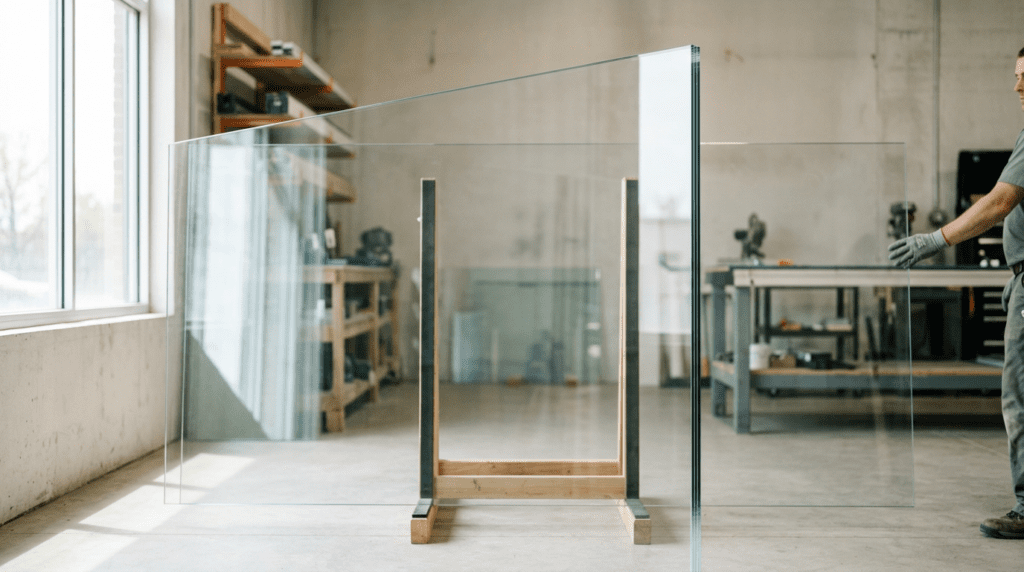
On its own, a plain float sheet is what the industry calls annealed glass. It is clear, flat, and inexpensive, but it is also fragile and breaks into large, sharp pieces, so most of it goes on to be processed into something tougher or more specialized. Almost every glass product you can name begins life as a float sheet and is then changed in a second step.
That second step is where the familiar names come from, and it is worth knowing them so a quote or a product label makes sense. The base glass is the same; the treatment is what differs.
- Tempered glass is reheated and quenched so it is far stronger and crumbles into small, dull cubes instead of shards when it breaks.
- Laminated glass bonds two sheets around a plastic interlayer that holds the pieces in place if the glass is struck.
- Insulated glass units seal two or more panes with a spacer and trapped gas to slow heat loss, the standard in modern new window installation.
- Low-E and tinted glass carry a thin coating or color that controls solar heat and glare.
- Mirrors get a reflective backing applied to the tin side of the float sheet.
This is why the glass in your double-hung, casement, or picture window is really float glass underneath the upgrades. If you want to see how those panes get paired with different frames and operations, our overview of the main types of windows connects the glass to the unit it sits in.
Float Glass Thickness and How It's Chosen
Float glass is made in a standard range of thicknesses, commonly from about 2 millimeters up to 19 millimeters or more for heavy-duty work. The line can be tuned to any of these by speeding up or slowing down the ribbon as it crosses the tin bath, so a single plant can supply everything from a thin picture-frame pane to thick glass for a commercial entry.
The right thickness depends on the job. A small fixed pane can be thin, while a large pane, a door light, or any glass exposed to wind and impact needs more body to resist flexing and breakage. Bigger sheets carry more load across their span, so size and thickness rise together.
In a climate like Ohio’s, thickness rarely works alone. Single thin panes lose heat fast and sweat with condensation through a cold winter, which is why homes here run double or triple insulated units instead. The float glass inside those units may be modest in thickness, but pairing two panes with a sealed gas gap is what actually holds heat in and keeps the freeze-thaw swings from driving moisture and ice into the frame.
Strengths and Limits of Float Glass
The strengths of float glass are exactly why it dominates. It is optically clean with no distortion, it is cheap to make at huge scale, and it is endlessly versatile because it accepts coatings, tints, lamination, and tempering. A material that starts as common sand and ends as a flawless windowpane is hard to beat on cost or clarity.
Its limits come from that same plain state. Untreated annealed float glass is brittle and breaks into long, sharp shards, which is dangerous in doors, low windows, and anywhere a person could fall against it. Building codes require tempered or laminated glass in those locations for that reason, so the raw sheet is rarely the final answer where safety matters.
Annealed glass is also prone to thermal stress cracks, where the center of a pane heats in the sun while a shaded edge stays cold and the strain splits the glass. Ohio’s sharp temperature swings make this a real failure mode, especially on older single panes and tight interior blinds that trap heat. When a pane cracks, fogs from a failed seal, or breaks at the edge, replacing it with the correct glass type and thickness is what keeps the window weathertight and safe.
Cracked, Foggy, or Failed Glass?
Knowing that nearly every pane starts as float glass is useful when something goes wrong, because the fix is about matching the right glass type, thickness, and coating to the opening. A clouded double pane, a cracked sash, or a chipped edge each call for a different solution, and guessing usually costs more in the long run.
Book a free, no-pressure glass assessment with our Columbus-area team and get a straight answer on whether your glass can be repaired or should be replaced.
FAQ: Float Glass Questions

Ready to fix your windows? Get a free quote in 30 seconds.
Family-owned, licensed & insured. Free, no-obligation quotes.