
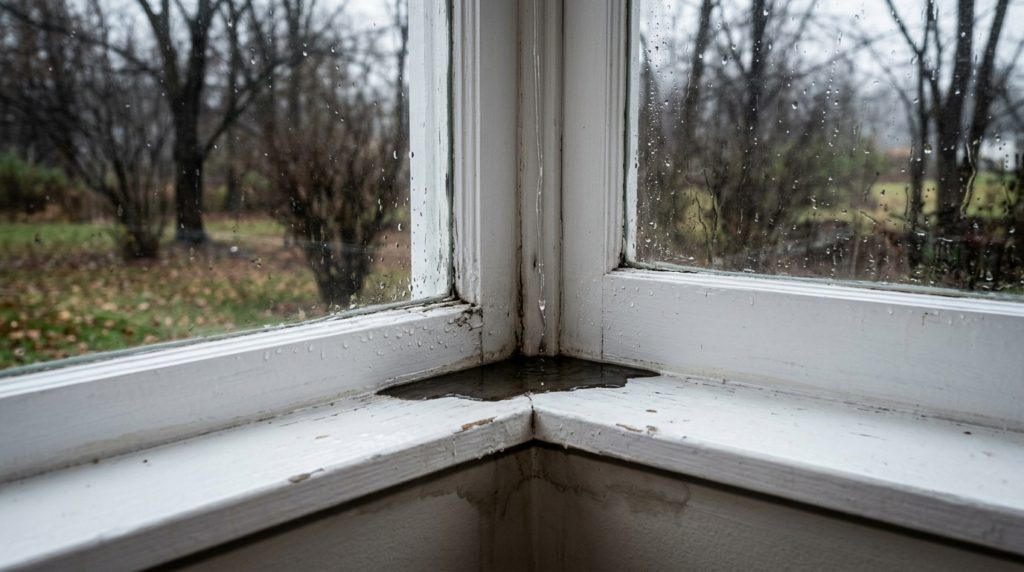
A window that leaks is one of the few home problems that gets worse fast. Water sneaking past a frame does not just stain the sill; it soaks into the wall, swells the trim, and feeds mold in the cavity where you cannot see it. In Ohio, where wind-driven rain in spring and freeze-thaw cycles all winter test every seam, a small leak in October can turn into a rotted frame by March.
The tricky part is that water rarely enters where it shows up. A puddle on the sill might trace back to a clogged drain hole, a cracked bead of caulk three feet higher, or even the gutter above the window. This guide explains how to read a leak by where it appears, the cause behind each one, and the fixes you can handle yourself before the damage earns a full window replacement.
Quick answer: Most window leaks come from failed caulk, worn weatherstripping, or clogged weep holes. Find where the water enters, clear the drain holes, reseal cracked caulk, and replace tired weatherstripping. If water still gets in, the flashing or installation is the likely culprit and needs a pro.
Where Is the Water Actually Coming From?
Before you buy a tube of caulk, figure out where the water is getting in, because the entry point usually points straight to the cause. Water obeys gravity, so it can travel a long way behind the wall before it appears, which is why the spot you see wet is often below the real failure. Reading the location first saves you from sealing the wrong joint and watching the leak come back with the next storm.
Water showing up at the top of the window almost always comes from above: failed flashing, a gap where the frame meets the wall, or runoff sheeting down from a clogged gutter. Wet sides usually mean the perimeter caulk or the flashing on that edge has split. Pooling at the sill or bottom corners most often traces to clogged weep holes or a worn sash seal that lets driven rain past the bottom rail.
Timing is the other clue. If the window only leaks during a hard, wind-driven rain, the problem is an exterior seal or flashing letting water in. If moisture shows up on dry days or cold mornings, you are likely looking at condensation rather than a true leak. To confirm the source, have someone run a garden hose over one section of the window at a time, starting low and working up, while you watch from inside for the first sign of water.
Common Causes Behind a Leaking Window
Once you know roughly where the water enters, the cause usually falls into a short list. Most leaks are not the glass itself failing but the seals and details around it giving out over years of sun, rain, and temperature swings. The same window can have two problems at once, so check each suspect rather than stopping at the first one you find.
The fixes for the items below range from a ten-minute job to a call for help, but identifying the culprit is the same process either way. Work through them in roughly this order, since the cheap, common causes sit at the top.
- Failed exterior caulk. The bead sealing the frame to the siding dries, cracks, and pulls away, opening a path for rain. This is the single most common cause.
- Worn weatherstripping. The flexible seal the sash presses against flattens and hardens, so the window no longer closes watertight.
- Clogged weep holes. The small drains at the bottom of the frame pack with dirt, so water that should exit pools and backs up onto the sill instead.
- Cracked frame or glass. A split in the frame or a cracked pane gives water a direct route inside, even a hairline one.
- Poor installation or flashing. If the window was set without proper flashing or shimmed out of square, water finds the gap no amount of caulk will close.
Outside Forces That Push Water to Your Window
Sometimes the window is fine and the house is sending water to it. These external problems are easy to overlook because the symptom appears at the window while the failure sits feet away, often up on the roofline. In an Ohio climate, where heavy spring storms and winter ice both load the building envelope, these outside forces cause more leaks than people expect.
Clogged gutters are the usual offender. When a gutter overflows, the sheet of water runs straight down the wall and is driven into the top of the window by wind. Short or missing overhangs leave the window face fully exposed to rain, and a downspout that dumps near the foundation can splash back and saturate a first-floor sill. Missing shingles, damaged siding, and poor grading that pools water against the wall all push moisture toward the nearest opening, which is your window.
Winter adds one more: the ice dam. When heat escaping the attic melts snow that refreezes at the cold eave, water backs up under the shingles and works its way down into the wall, often surfacing at the head of a window below. If a leak only appears during a thaw after heavy snow, look up at the roof, not at the window seal.
What You Need to Track Down and Seal a Leak
You do not need much to diagnose and handle the common leaks yourself, and most of it is already in the garage. The two jobs that fix the majority of window leaks are clearing the drains and renewing the seals, so the kit is built around those. Gather everything before you start so you are not hunting for a caulk gun with a wet window open.
Buy exterior-grade sealant rather than whatever tube is closest, because the wrong caulk will not flex through freeze-thaw and will crack again within a year. The short list below covers finding the leak and making the standard repairs.
- A garden hose to run the section-by-section water test that finds the entry point.
- A cotton swab, stiff wire, or compressed air to clear the weep holes.
- A utility knife and putty knife to cut out and scrape away the old caulk.
- Exterior-grade silicone or polyurethane sealant and a caulk gun for resealing the perimeter.
- Replacement weatherstripping sized to the channel, plus a clean rag and rubbing alcohol to prep the surface.
How to Find and Fix a Window Leak, Step by Step
The order here matters: confirm the source first, clear the drains, then renew the seals from the outside in. Working out of order, like caulking before you know where the water enters, is how people seal a window shut and still find a puddle after the next storm. Take it one window at a time on a dry day so fresh caulk has time to cure.
The step almost everyone skips is the weep holes, and it is often the whole fix. A window that seems to leak onto the sill is frequently just a window whose drains have packed shut.
On service calls around Columbus, a window that is leaking onto the sill turns out, more often than not, to be a clogged weep hole or failed perimeter caulk rather than a bad window. Clear the drain and renew the seal and the leak usually stops.
- Pinpoint where the water enters. Watch during a hard rain, or run a hose over the window low to high, to see if water shows at the top, sides, or sill.
- Clear the weep holes. Poke the small drain slots at the bottom of the frame clear with a swab or compressed air so trapped water can escape.
- Inspect the exterior caulk and flashing. Look along the outside perimeter for cracked, peeling, or missing sealant and gaps where the frame meets the siding.
- Remove old caulk and reseal. Cut out the failed bead, clean and dry the joint, then run a fresh line of exterior sealant and tool it smooth.
- Replace worn weatherstripping. Peel out the flattened strip, clean the channel, and press in new material so the sash closes tight.
- Reseal the glass gasket. If water sits between the glass and the frame, re-bed the glazing gasket or run clear silicone where the pane meets the sash.
- Look upstream or call a pro. If water still gets in, check the gutters, siding, and flashing above, or have the installation inspected.
Foggy Glass Between the Panes Is Not a Leak
One of the most common mix-ups is calling a foggy double-pane window a leak. When you see haze or moisture trapped between the two panes of glass, no water is getting in from outside. The sealed gas space inside the insulated glass unit has lost its seal, and humid air has worked its way in and condensed where you cannot wipe it away.
This is a real failure worth fixing, but the cause and the repair are different from a true leak. It will not stain your sill or rot the wall, yet it ruins the window’s insulating value, so the glass works harder against Ohio winters and your heating bill climbs. Caulking the frame does nothing for it, because the problem is inside the glass, not around it.
The fix is to replace the failed insulated glass unit while keeping the existing frame, which is far less involved than a full window swap. If the haze appears and disappears with the weather, the seal is on its way out. Our insulated and foggy glass repair service handles the failed unit without tearing the window out, so you keep the frame and lose the fog.
When DIY Caulk Won't Cut It
Plenty of window leaks are a weekend fix, but a few signs mean the water is past the point a tube of sealant can solve. If you have cleared the weep holes, renewed the caulk, and replaced the weatherstripping and the window still leaks, the water is getting in behind the frame, which usually means failed flashing or a window that was never installed square. Caulking over that only hides it while the wall keeps getting wet.
Stop and call a professional when you see stained or soft drywall around the opening, when the leak appears at the top of the window every storm, or when the frame itself is cracked, rotted, or out of square. Those point to a flashing or structural problem, not a surface seal, and chasing them with more caulk wastes a season while the damage spreads.
A pro can pull the trim, find the true water path, and decide whether the window needs a proper reseal, a sash and frame repair, or replacement. The cost of an inspection is small next to the framing and drywall repairs a hidden leak runs up over a winter.
Still Chasing a Leak You Can't Find?
If your window keeps leaking after you have cleared the drains and resealed the frame, the water is finding a path you cannot see from inside, and guessing only lets it spread. A quick look from someone who repairs these every week usually finds the source fast.
Book a free, no-pressure window assessment with our Columbus and Cincinnati team and get a straight answer on whether it is a simple reseal or something behind the wall.
FAQ: Leaking Windows

Ready to fix your windows? Get a free quote in 30 seconds.
Family-owned, licensed & insured. Free, no-obligation quotes.