Most homeowners start with the wrong question. “Replacement or new construction?” sounds like a coin flip, but for a house that is already standing the answer is usually settled before you call anyone. The label that matters is not the brand or the glass package. It is how the new window meets the wall around it.
New-construction and replacement windows are not better or worse versions of each other. They solve different jobs. One is built to attach to bare framing while the wall is open. The other is built to drop into an opening that already has siding, brick, and trim you would rather not tear off. Knowing which job you have makes the rest of the decision, including a sensible plan for new window installation, much simpler.
Quick answer: Choose replacement windows when your walls and exterior stay intact; they fit the existing opening. Choose new-construction windows when you are building, adding on, or stripping a wall to the studs, because their nail fin fastens to bare framing. For most standing homes the real choice is insert versus full-frame replacement.
The Real Question Is Three Choices, Not Two
The “versus” framing hides a third option that fits more homes than either headline choice. When your house is built and clad, you are rarely picking between new construction and replacement at all. You are picking between two kinds of replacement, with new construction sitting off to the side for the day you open a wall.
Sorting your project into one of these three lanes early saves you from comparing windows that were never meant to do the same job. Each lane has its own install method, its own cost pattern, and its own list of things that can go wrong in an Ohio winter.
- Insert (pocket) replacement nests a new window inside your existing frame, leaving the trim and siding alone.
- Full-frame replacement removes the old window down to the rough opening so the installer can inspect and reseal it, without disturbing the exterior brick or siding.
- New-construction windows fasten by a nail fin to bare framing and only fit when the wall is open to the studs.
The rest of this guide walks each lane in turn, but the short version is this. If the existing frame is sound, an insert is the fastest path. If water or age has gotten into the frame, full-frame is the honest fix. New construction belongs to a bigger project.
What New-Construction Windows Are, and When You Need Them
A new-construction window has a flat flange around its perimeter called a nail fin, or mounting flange. The fin lies flat against the wall sheathing and fastens straight into the framing, then gets taped into the home’s weather-resistive barrier before any siding goes back on. That integration is what makes the window watertight, and it is also why the wall has to be open to install one.
Because of that, these windows are the right call for a specific set of projects, not for swapping a tired window on a finished wall. Reach for them when you are building an addition, framing new openings, residing the whole house, or removing brick or stucco for a remodel. They are also the answer when you want a different size or shape, since changing the opening means new framing, a new header, and usually a permit.
The upside in this climate is the chance to fix what you cannot normally see. With the wall open, an installer can flash the opening correctly, add a sill pan, and air-seal around the frame so freeze-thaw water and winter drafts stop finding their way inside. On older homes that have leaked for years, that hidden detail work is often worth more than the window itself. A full new window installation on an addition is the moment to get it right.
What Replacement Windows Are
A replacement window is built to fit an opening that already has its siding, trim, and interior casing in place. There is no nail fin to tape into the wall, because nothing on the wall is coming off. That keeps the job inside the room and the exterior untouched, which is why replacement is the default for a finished house.
Under that one label sit two very different installs, and confusing them is where most homeowners go wrong. Which one you can use depends almost entirely on the condition of the frame you already have, so it is worth knowing both before you compare quotes.
Insert (Pocket) Replacement
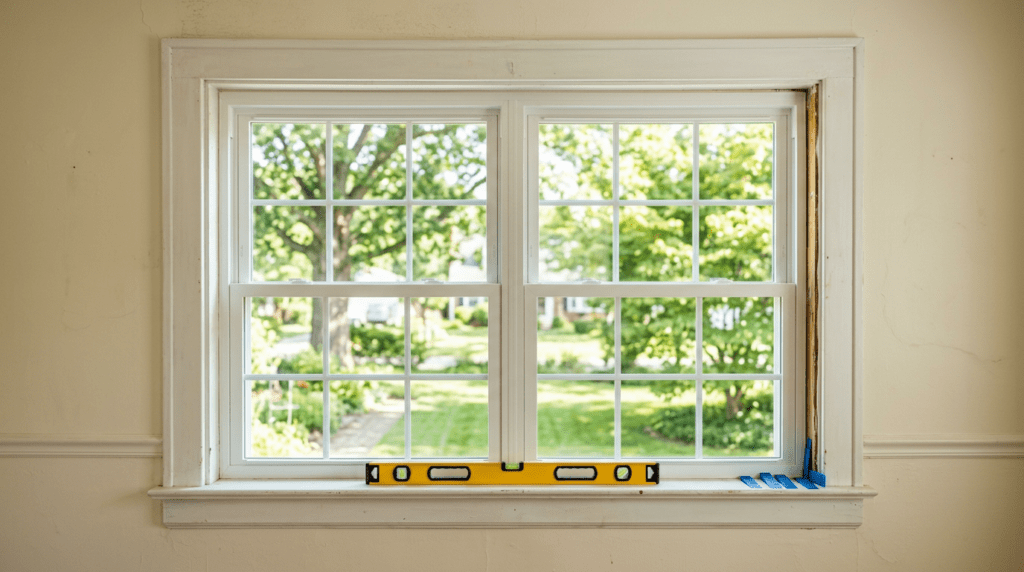
An insert window slides into your existing frame and fastens to it, leaving the exterior and most of the interior trim alone. It is the quickest and least invasive option, and on a sound frame it seals up tight and lasts for years. The catch is in the name: the new unit sits inside the old frame, so that original frame has to be square, solid, and dry. An insert over a rotted or out-of-square frame only hides a problem you will meet again.
Full-Frame Replacement
Full-frame replacement takes the old window out down to the bare rough opening, then sets a new window with its own frame, all from the inside without pulling off brick or siding. Because the opening is exposed, the installer can check the framing for rot, re-flash it, add a sill pan, and pack insulation around the frame. It costs more in labor than an insert, but it is the only replacement that actually fixes a leaking or weathered opening, which makes it the practical middle ground for a lot of older Ohio homes.
The Deciding Factor Most Guides Skip: Your Frame
Almost every comparison stops at “is your wall open or not,” then points you to an insert. The question that actually decides your project is one step deeper: is the frame you already have worth keeping? An insert leans on that old frame for its seal and its support. If the frame is failing, the new window fails with it.
In this climate, frames fail from the bottom up. Water sits in a worn sill, freezes, and pries the joints apart a little more every winter until the wood goes soft. From the inside the window can still look fine. The only way to know is to probe the sill and lower corners with a screwdriver before anyone orders a unit.
On older Columbus homes, a sill that looks painted and solid often gives way under a screwdriver at the corners, where years of meltwater have soaked the end-grain wood. Drop an insert into that and you have sealed a new window onto rot; full-frame is the only fix that lasts.
If the probe finds soft wood, the choice is made for you: the opening needs full-frame replacement so the bad wood comes out, or in a worse case a round of window sill repair before any new unit goes in. A sound, dry, square frame is what earns you the faster insert.
How Inserts Change the Glass and the Light
An insert buys speed and a clean exterior, but it costs you glass. Because the new frame nests inside the old one, the visible opening shrinks by an inch or more on every side. On a large picture window you may never notice. On a small older-home window, that lost border can trim a real share of the daylight and the view.
The shrink matters most where the opening is doing a code job. A bedroom or finished-basement window has to stay above the minimum clear opening for egress, the size a person can climb through in a fire. An insert that narrows an already-tight basement window can quietly drop it below that line. When egress is close, full-frame keeps more of the opening, and switching to a casement window nets more clear opening than a same-size double-hung.
There is a glass-condition angle too. If you are choosing replacement mainly because the panes fog up, the seal has failed, and on many units that is a glass problem rather than a whole-window one. A fogged sealed unit can sometimes be solved with insulated glass replacement instead of a new window, which is worth checking before you commit to either install.
What Drives the Cost of Each Option
Cost on this kind of job is less about the window on the shelf and more about how much wall has to move to install it. That is why the three lanes line up in a predictable order, even though the units themselves can be priced the other way around. The bigger the disturbance to the wall, the more the labor climbs.
An insert is the lightest on labor, since the trim and siding stay put. Full-frame adds the work of removing the old frame, inspecting, and resealing the opening. New construction sits at the top whenever it triggers siding or brick removal and exterior refinishing, plus any framing changes. A few specific things tend to swing the final number.
- Frame condition found mid-job, since hidden rot can turn a planned insert into a full-frame repair.
- Exterior material, because pulling and patching brick or stucco costs far more than vinyl siding.
- Size or shape changes, which add framing, a header, and usually a permit.
- Access and count, as upper floors, stairwells, and a whole-house order all change the labor.
- Glass package, where low-E coatings, argon fill, and double versus triple panes shift the unit price.
Because the hidden conditions matter so much, a firm number only comes after someone looks at the actual openings. That is the honest reason a good estimate starts with a visit rather than a phone quote.
Energy Efficiency Comes Down to the Install
It is easy to assume new-construction windows are automatically more efficient. The glass package is what carries the rating, and the same low-E, argon-filled, double or triple-pane unit can go into any of the three installs. On the label, an insert and a new-construction window can read identical.
What separates them in the real world is the seal around the opening, and that is where Ohio winters punish shortcuts. A window with a great rating still leaks heat if the gap around it was never insulated. An insert dropped into an older home often sits right over the old weight-and-pulley pockets, hollow channels beside the frame that act like little chimneys for cold air. Only full-frame or new construction opens those up to foam and seal them.
So the efficient choice is not a window type but a complete install. If your bills and your drafts are the real complaint, the air-sealing that comes with full-frame work usually does more than a small step up in glass. The rating on the sticker is the ceiling; the install decides how close you get to it.
Older Columbus Homes Change the Answer
Much of central Ohio’s housing stock predates modern windows by decades, and those homes break the tidy rules. A century-old opening has rarely stayed square. The frame has settled into a slight parallelogram, so an insert set perfectly square inside it leaves wedge-shaped gaps that have to be packed and hidden. Full-frame lets the installer reset the opening closer to true.
Two more wrinkles show up on these houses. Pre-1978 homes can have lead paint, which changes how the old window must be removed and contained, and it is a real reason to use a trained crew rather than a weekend. And on a partial project, replacing a few windows beside many originals, matching the sightlines matters; a full-frame or a careful double-hung window match blends in better than an insert with its thicker doubled-up frame.
None of this rules out an insert. It just means the older the house, the more the existing opening, not the brochure, should drive the decision. A quick look at the actual frames tells you far more than any general rule about replacement versus new construction.
How to Decide in Five Minutes
You can usually place your own project without a tape measure. Start with what is happening to the wall, then with the condition of the frames, and the lane tends to pick itself. The list below maps the common situations to the right install.
Use it as a starting point, not a final verdict, since a hidden soft sill or a tight egress opening can move you from one lane to the next. When two lanes seem possible, the frame’s condition is the tie-breaker almost every time.
- Sound, dry, square frame with only cosmetic or comfort complaints: an insert replacement is the fast, clean choice.
- Drafts, leaks, fogging, or soft wood at the sill: full-frame replacement, so the opening can be inspected and resealed.
- Building, adding on, residing, or changing an opening’s size: new-construction windows fastened to the open framing.
- Tight bedroom or basement egress: favor full-frame or a casement to keep the clear opening legal.
- A few windows next to many originals: match sightlines with full-frame rather than a bulkier insert.
Not Sure Which Your Home Needs?
The fastest way to settle replacement versus new construction is to have someone probe the frames and look at the openings, since that is what actually decides it. A ten-minute check separates a simple insert from an opening that needs more before any window goes in.
Book a free, no-pressure assessment with our Columbus-area team for a straight read on your windows and a plan for new window installation or a like-for-like replacement. Get your free quote and we will tell you which lane your project is really in.
FAQ: Replacement vs New-Construction Windows

Ready to fix your windows? Get a free quote in 30 seconds.
Family-owned, licensed & insured. Free, no-obligation quotes.