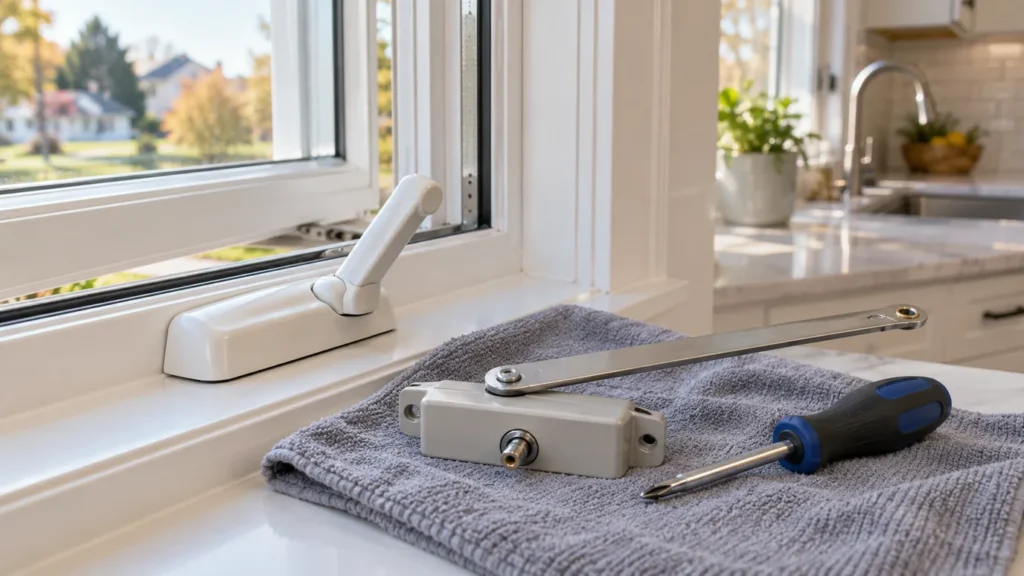
Window crank replacement on a casement window means swapping either the crank handle or the operator, the gearbox and arm that push the sash open. A handle that spins freely usually needs a new handle; gears that slip, grind or back out of the housing mean the whole operator has to go.
Getting that call right saves a wasted order. Handles are cheap and quick to swap. Operators come in dozens of arm styles and two hands, and a few window problems look like a bad crank while the real fault sits in a hinge or the lock.
Key Takeaways
- A spinning handle points to the handle or its stud; slipping or grinding gears point to the operator.
- Andersen states a worn operator cannot be repaired and should be replaced.
- Order by arm type, handing, arm length and screw pattern, and keep the old part for comparison.
- Handing is read from outside by the hinge side, or from inside by the lock side.
- A sash that binds or drags even with the arm disconnected has a hinge problem, not a crank problem.
Match the Symptom to the Failed Part
If the handle turns but the gears inside stay still, the handle has lost its grip on the stud. If the gears move and the sash still does not, the operator is worn out. The table matches the other common symptoms to the part behind them.
Swipe the table sideways to see every column.
| What you notice | Likely failed part | Next step |
|---|---|---|
| Handle spins, window does not move | Crank handle or its set screw | Tighten or replace the handle |
| Handle turns, gears click or slip | Operator gears worn or stripped | Replace the operator |
| Gears push out of the housing when closing | Operator | Replace the operator |
| Handle turns more than 3/4 turn once the window is closed | Operator (per Andersen) | Replace the operator |
| Crank is stiff all the way, sash scrapes | Hinge, sash sag or debris | Check hinges before buying an operator |
| Window will not open at all | Lock still engaged, or frozen operator | Release the lock, then test again |
| Cover cracked around the crank | Often a symptom of handle or operator wear | Check both before replacing the cover |
Andersen lists the same warning signs in its help article on stripped operators: a sash that will not open or close properly, gears that back out of the housing, gears that feel loose, and a handle that keeps turning more than three quarters of a turn once the window is shut. Its conclusion is short: a worn operator cannot be repaired, only replaced.
Awning windows open with the same kind of crank operator, and Andersen’s help article on worn operators covers casement and awning windows alike, so the symptom table applies to both.
Fixing a Crank Handle That Spins
A spinning handle is the cheapest repair on a casement window, and often the only one needed. Many handles slide onto a splined stud on the operator and are held by a small set screw on the side of the handle.

Pella’s instructions describe the routine that applies to most brands:
- Loosen the set screw with a small flat-blade screwdriver and pull the handle off.
- Look at the stud: if the ridges are rounded off, the operator is worn too, and a new handle will slip again.
- Slide the new handle onto the stud and tighten the set screw.
- Open and close the window, then fold the handle down and check that the knob lines up with its pocket in the cover.
Take the old handle with you when you buy a new one. Studs differ between brands and generations in size and in the number of splines, and a handle that almost fits can strip its splines quickly.
Read the Operator Before You Order One
A replacement operator has to match five things: the arm type, the handing, the arm length, the screw pattern on the frame and the stud for the handle. Miss one and the part will not bolt on or will push the sash at the wrong angle.

Arm types are the first split. A single or straight arm ends in a roller or slide that runs in a track under the sash. A dual arm has a second link for heavier or wider sashes. A split arm uses two linked arms; Andersen fits this style to many 400 Series and A-Series casements, alongside straight-arm operators. Truth Hardware, a maker of replacement operators, sells all three styles, from single-arm to dual-arm Entrygard and split-arm Dyad models. If your windows carry Truth hardware, our Truth Hardware repair page covers its operator arms, locks and hinges.
Handing is the second trap. Look from outside: the side with the hinges names the hand, so a sash hinged on the left is a left-hand unit, the rule Pella uses in its instructions. From inside, hardware suppliers read it from the lock side instead, and the two methods give the same answer.
For Andersen windows, the operator depends on the series and the year. The company publishes identification help and a product ID label guide, and for casements made before 1999 it asks owners to contact its support to pin down the part.
Swap a Casement Operator in About an Hour
The operator side of a window crank replacement takes basic tools and usually about an hour per window once the right part is in hand. The details of the arm release differ by brand, so keep the manufacturer’s sheet nearby; Andersen and Pella both publish model-specific instructions.
The sequence is the same on most casements:
- Open the sash partway and remove the handle.
- Take off the operator cover or the trim piece over the operator, if the window has one.
- Free the arm from the sash: slide the roller out through the notch in its track, or unclip the arm from its bracket.
- Remove the screws that hold the operator to the frame and lift it out.
- Set the new operator in place, drive the screws, and reconnect the arm to the sash.
- Refit the cover and handle, then run the window through a full open and close, including the lock.
Support the sash while the arm is disconnected. A casement sash hangs on its hinges, and on a windy day or a second floor it can swing wide open the moment the arm is free.
When the Crank Is Not the Real Problem
A crank that feels stiff from start to finish is often a victim, not the cause. Hinge tracks that are dirty, bent or rusted make the operator work harder, and a new operator on a bad hinge wears out the same way.

Test it directly: disconnect the arm and move the sash by hand. If it glides, the operator is at fault. If it binds, scrapes or drops at the latch corner, the hinges or the sash need attention first, and our casement window repair team handles that kind of adjustment.
Two more lookalikes are worth ruling out. A window that will not open at all may simply still be locked, since the lock and the crank are separate on most casements. And in winter, ice on the sash or in the track can hold the window shut; forcing the crank at that point is a quick way to strip a healthy operator.
Jobs Worth Handing to a Technician
A window crank replacement is a fair weekend job in most homes, whether it is the handle or the operator. A few situations are better handed off, because a wrong part or a loose sash can turn a small repair into a bigger one.
We usually recommend a technician in these cases:
- The operator is discontinued and a substitute has to be matched by measurement.
- The screws no longer bite because the wood around the operator is soft or rotted.
- The hinges need replacing, which means taking the sash off its frame.
- The window is on an upper floor, or several windows need the same repair.
Our window hardware repair service covers cranks, locks and balances. If the window is still under its hardware warranty, check that first; our guide to window warranties by brand shows which manufacturers include labor.
Frequently Asked Questions
Yes, the crank handle comes off on its own: loosen the set screw, pull it off the stud and slide a matching handle on. That only helps if the stud and gears are sound. If the ridges on the stud are worn smooth, replace the operator as well.
No, handles differ in stud size and spline count, and operators differ in arm type, arm length, handing and screw pattern. A handle made for one brand may slip on another. Bring the old part or clear photos with measurements when you order.
Stand outside and look at the hinges: a sash hinged on the left is left hand, hinged on the right is right hand. From inside, suppliers use the lock side instead, and both methods point to the same hand.
Check the lock first, because most casements lock separately from the crank. If the window is unlocked and the handle spins freely, the handle or its stud has stripped. If the gears move but the sash does not, the arm has come off its track or the operator is worn.
There is no fixed life span; wear depends on how often the window is used and how freely the sash moves. A sash that drags on dirty or bent hinges makes the operator work harder and shortens its life, so clean the tracks when you replace one.
The cost depends on the brand, whether the original part is still made, and how many windows need it. A handle is the least expensive fix, a matched operator costs more, and discontinued parts take extra time to source. We quote after seeing the window.
Ready to fix your windows? Get a free quote in 30 seconds.
Family-owned, licensed & insured. Free, no-obligation quotes.