If you have ever stood next to an old window on a January morning in Columbus and felt the cold pour off the glass, you have met a single-pane window. One thin layer of glass is all that separates your living room from a freezing yard, and it shows up on both your comfort and your heating bill. A double-pane window puts two layers of glass and a sealed pocket of gas in the same opening, and that small change does most of the heavy lifting on insulation.
This guide breaks down how single-pane vs double-pane windows compare on energy use, comfort, noise, and how long each lasts, plus the honest answer to whether you can upgrade without replacing the whole window. If your single panes lose heat every winter, modern double-pane replacements are usually the fix.
Quick answer: A single-pane window has one layer of glass; a double-pane window has two, with a sealed air or argon gap between them. That gap slows heat transfer, so double-pane glass keeps rooms warmer, quieter, and far less prone to condensation. Single-pane costs less up front but loses far more heat.
What Single-Pane and Double-Pane Windows Actually Are
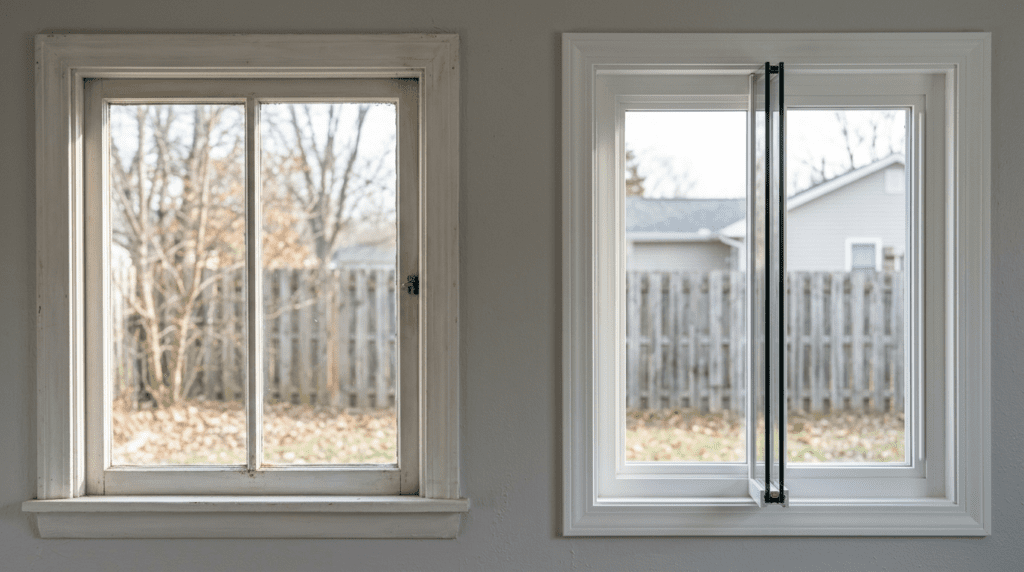
The difference comes down to how many layers of glass sit in the frame and what fills the space between them. A single-pane window is exactly what it sounds like: one sheet of glass held in a sash. It was the standard in American homes for most of the last century, which is why so many older Columbus and Cincinnati houses still have them.
A double-pane window, also called an insulated glass unit, seals two sheets of glass a small distance apart with a spacer around the edge. The gap is filled with dry air or, in better units, a dense inert gas like argon, and the whole assembly is sealed airtight. That trapped layer is the insulation, because gas conducts heat far more slowly than solid glass does. It slows the flow of warmth out of your house in winter and into it in summer. If you want the full anatomy of that sealed unit, our guide to the insulated glass unit walks through every part.
How to Tell Which Windows You Have
Plenty of homeowners are not sure what they already have, and it is worth knowing before you price out any change. The quickest check is the reflection test: hold a lit match or a phone flashlight a few inches from the glass at night and look at the reflections. A single pane throws back one set of reflected images, while a double pane shows two closely spaced reflections, one for each sheet of glass.
You can also look at the edge of the glass where it meets the frame. A sealed unit has a visible metal or plastic spacer bar running around the perimeter between the two panes, while a single pane has a clean, thin edge. Double panes also feel noticeably thicker and heavier when you operate the sash. If your windows date to before the 1980s and have never been replaced, they are almost certainly single-pane.
Energy Efficiency: Where Double-Pane Pulls Ahead
This is where the two stop being close. Energy performance is measured by U-factor, which rates how fast a window loses heat, and a lower number means better insulation. A typical single pane lands around 0.9 to 1.3, while a sealed unit usually falls between roughly 0.25 and 0.50. In plain terms, the double pane loses a fraction of the heat through the same opening.
Two upgrades push that gap even wider, and they matter more in a heating-dominated climate like Ohio’s. The first is a low-emissivity, or Low-E, coating: a microscopically thin layer that reflects heat back into the room while still letting light through. The second is the argon fill, which insulates better than plain air. Not every double-pane window carries both, so the label is worth reading.
When you check a window’s NFRC sticker, focus on these:
- U-factor: lower is better for our cold winters, so prioritize it over almost everything else.
- Low-E coating: confirms the glass reflects radiant heat, not just blocks a draft.
- Argon or krypton fill: a denser gas than air, for a measurable bump in insulation.
- Energy Star rating: a floor to clear, not a finish line, so compare U-factors even among rated units.
Comfort, Condensation, and Ohio Winters
Numbers aside, the difference you actually feel is comfort. Single-pane glass runs close to the outdoor temperature, so on a cold Ohio night the inside surface gets frigid. That cold glass pulls warmth off your body when you sit near it, which is why a room with old windows feels drafty even when no air is moving. It also chills the air against the glass, setting up the slow convection loop that makes a single-pane room hard to heat evenly.
Condensation is the other tell. Warm, humid indoor air hits cold single-pane glass and the moisture condenses, then freezes into the frost many older homes get on the inside of the window. A double pane keeps its inner sheet much closer to room temperature, so that interior surface stays warm enough to shed most condensation.
On winter service calls around Columbus, the homes with frost on the inside of the glass almost always have single panes. The window is not broken. It is just one thin layer of glass standing between a warm room and a freezing yard.
Noise Reduction and Security
Sound travels through glass, and a single thin sheet does little to stop it. Two panes separated by a sealed gap break up the path that sound waves take, so double panes noticeably soften street noise, barking dogs, and lawn equipment. Acoustic performance is rated as an STC value, and sealed units score higher than single panes, with laminated or unequal-thickness glass pushing the rating higher still for homes near busy roads.
Security and durability lean the same direction. A second pane, and especially a laminated one, is harder to break through than a single sheet, which adds a modest deterrent at ground-floor openings. Two layers of glass also hold up better against wind and flying debris, a real consideration during Ohio storm season. None of this turns a window into a vault, but the gap between one pane and two is meaningful here too.
The Double-Pane Weak Spot: the Seal
Sealed units have one failure mode single panes do not: the seal. The airtight gasket around the spacer keeps the insulating gas in and moisture out, and over years of expansion and contraction it can give out. When it does, humid air seeps into the gap and condenses between the panes, leaving the foggy, hazy look you cannot wipe away because it sits on the inside of the assembly.
Ohio’s freeze-thaw cycle is hard on these seals. The glass and spacer expand and shrink with every swing from a frigid night to a sunny afternoon, and that constant flex eventually fatigues the seal. A foggy unit has lost most of its insulating value, but it does not always mean the whole window is shot. Often the sealed glass can be replaced while the frame and sash stay in place, which is the focus of our foggy double-pane repair guide. Once the fog has set in, a foggy window repair is usually cheaper than a full replacement.
Can You Upgrade a Single-Pane to Double-Pane?
This is the question that trips up most homeowners hoping for a shortcut. You generally cannot turn a true single-pane window into a sealed double-pane unit by adding a second sheet of glass to the existing sash. A real insulated glass unit is built and sealed at a factory with a spacer and gas fill, the old single-pane sash was never designed to hold one, and the frame depth usually will not accept it.
There are honest middle paths. A storm window, mounted inside or outside the original, traps a layer of air and gets you part of the way to double-pane comfort without replacing anything, which is why it is a favorite for historic homes. Interior acrylic inserts do something similar. But if the goal is the real insulating and noise performance of two sealed panes, the practical route is a replacement window sized for the opening, covered in our guide to new window installation. And if you already have double panes with a blown seal, you usually replace just the glass through an insulated glass replacement, not the whole frame.
When Single-Pane Still Makes Sense
Double-pane is the right call for most living spaces, but single-pane glass still has its place. In a detached garage, a shed, or a three-season porch you do not heat, the insulating gap buys you little, and a simpler single pane is easier and cheaper to replace if a ball or a branch finds it.
Historic homes are the bigger exception. An original wood sash from a century-old Columbus home is often built from dense, slow-grown lumber that outlasts modern equivalents, and many preservation guidelines favor keeping it. Pairing that restored sash with a quality storm window can approach sealed-unit performance while keeping the home’s character and the old-growth wood intact. The choice is rarely about which window is better in the abstract. It is about the room, the house, and how long you plan to stay.
Mistakes People Make Comparing the Two
Comparing the two looks simple, but a few wrong assumptions cost homeowners money. Run through these before you decide, because each one quietly sends people toward the wrong fix. The most expensive mistake is treating a foggy double-pane window as a total loss when the glass alone can often be replaced.
- Assuming every double pane performs the same. Without a Low-E coating and gas fill, the upgrade over a single pane is modest, so read the label.
- Replacing a whole window over a blown seal. A foggy unit usually needs new glass, not a new frame.
- Judging only by U-factor. Air leakage around a sloppy install can undo a great glass rating, so installation quality matters as much as the spec.
- Ripping out sound historic sashes. Old-growth wood plus a storm window is often the smarter, cheaper path.
- Expecting two panes to be soundproof. They cut noise, but laminated glass is what you want near a highway.
Repair, Add a Storm, or Replace?
Not sure whether your drafty windows are worth upgrading or just need a repair? A quick look usually answers it: sometimes it is a failed seal you can fix, and sometimes single-pane glass is quietly costing you every heating season.
Book a free, no-pressure window assessment with our Columbus and Cincinnati team, and get a straight answer on whether to repair, add a storm, or replace.
FAQ: Single-Pane vs Double-Pane Windows

Ready to fix your windows? Get a free quote in 30 seconds.
Family-owned, licensed & insured. Free, no-obligation quotes.