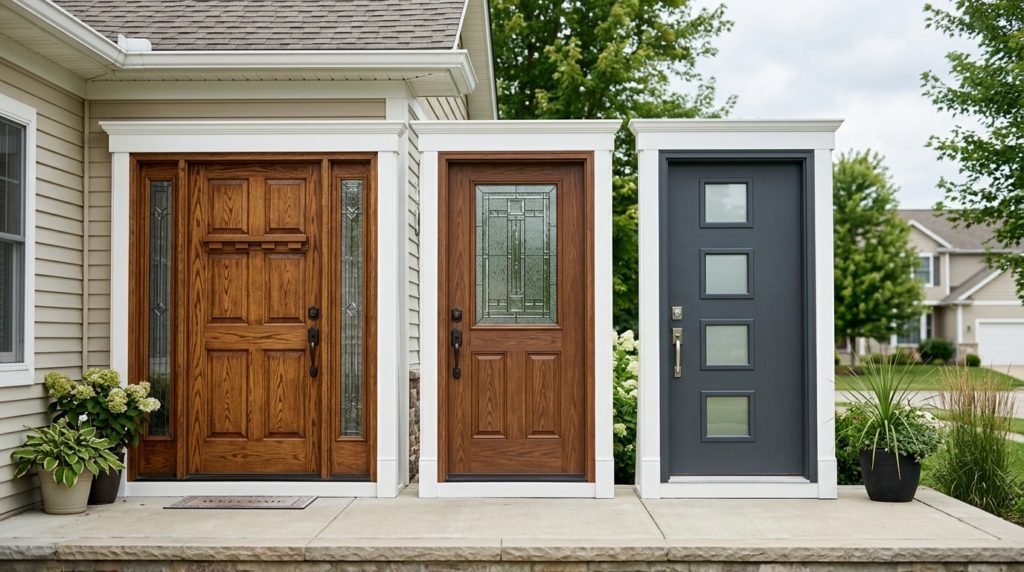
A front door has to do four jobs at once: keep weather out, keep intruders out, hold heat in, and make the house look like somewhere you want to come home to. Which material you pick decides how well it does each one. Nearly every entry door sold today is built from wood, fiberglass, or steel, and the three behave very differently once an Ohio winter goes to work on them.
This guide compares the three head to head on the things that actually matter: security, energy efficiency, upkeep, lifespan, looks, and the cost drivers behind the quote. If you already know you want help choosing or installing one, our team handles entry door replacement across the Columbus and Cincinnati area. If you are still deciding, read on.
Quick answer: Steel is the strongest and cheapest but dents and can rust. Fiberglass needs the least upkeep, insulates best, and can mimic wood grain. Real wood looks the richest but demands regular refinishing and is the most exposed to Ohio’s freeze-thaw swings. Most homeowners land on fiberglass for the balance.
The Three Materials at a Glance
Before going deep on each one, it helps to see how the three line up against each other. No single material wins every category, which is why the right pick depends on your budget, your climate exposure, and how much weekend maintenance you are willing to do. A south-facing door that bakes in afternoon sun has different needs than a sheltered one under a deep porch.
The short version is that each material owns a different strength. Steel leads on raw security and upfront price, fiberglass leads on durability and insulation with almost no maintenance, and wood leads on appearance and the ability to be customized or refinished for decades. Here is how they sort out across the factors most buyers weigh.
- Security: steel is hardest to kick in, fiberglass is close behind, solid wood is strong but can be split.
- Energy efficiency: fiberglass and steel both have insulated foam cores; a hollow or single-panel wood door insulates the least.
- Maintenance: fiberglass is nearly hands-off, steel needs occasional paint touch-ups, wood needs refinishing every few years.
- Curb appeal: wood looks the most authentic, fiberglass copies it convincingly, steel reads as the most utilitarian.
- Upfront cost: steel is typically the lowest, fiberglass sits in the middle, wood runs the highest.
Steel Entry Doors: Strong and Budget-Friendly
Steel is the value choice and the strongest material against a forced break-in. A steel door is built from a 24- to 26-gauge skin wrapped around a wood or steel frame and filled with a polyurethane foam core, so it resists kicking and prying better than the other two. For a side or back entry where security matters more than looks, steel is often the smart call.
The trade-off is cosmetic and climate-related. Steel dents, and a deep ding is hard to fix invisibly because the skin cannot be sanded out like wood. More important in this region, bare or scratched steel can rust where road salt, sprinklers, or standing snow reach it, so a chip in the paint has to be primed and touched up before winter rather than left. Steel also conducts temperature, which means an uninsulated unit can sweat with condensation on a cold Columbus morning.
Style options are the narrowest of the three. Steel takes paint rather than stain, and while embossed wood-grain patterns exist, they rarely fool anyone up close. If you want a clean, painted, no-fuss door and a tight budget, steel earns its place; if you want warmth or a stained finish, look elsewhere.
Fiberglass Entry Doors: The Low-Maintenance All-Rounder
Fiberglass is the door most installers recommend when a homeowner wants one material to do everything reasonably well. The skin is a molded composite over a foam core, and it shrugs off the things that wreck the other two: it will not rot, warp, rust, or swell, and it handles temperature swings without complaint. That makes it well suited to Ohio, where a door can face a humid August and a sub-zero January in the same year.
The surface is where fiberglass has quietly taken over the market. Modern molds copy real wood grain closely enough that a stained fiberglass door can pass for oak or mahogany from the curb, and it holds that finish for years without the cracking and graying that hit real wood. You can paint it or stain it, and dark colors hold up better than they do on wood because the material does not move as much underneath.
The catch is upfront price and impact resistance. Fiberglass costs more than steel to buy, and a hard, direct blow can crack the skin rather than dent it, though a quality door is tough in normal use. For most front entries, the near-zero maintenance and strong insulation make it the safe default, especially on an exposed elevation. If you are also rethinking the look of the whole entry, our guide to front door styles pairs well with the material decision.
Wood Entry Doors: Classic Looks, Real Upkeep
Nothing matches the depth and warmth of a real wood door, and for a historic home it is often the only material that looks right. Solid wood can be carved, paneled, stained, and re-stained to any finish you like, and a well-built one made from oak, mahogany, or fir feels substantial in a way the synthetics cannot fully copy. For a feature front entry where appearance is the priority, wood is still the benchmark.
That beauty comes with the most demanding ownership. Wood is hygroscopic, meaning it absorbs and releases moisture with the weather, so it swells in humid summers and can shrink and check in dry winters. Left unsealed, it warps, cracks, and eventually rots at the bottom rail where water sits. A wood entry door needs to be refinished or resealed every two to three years, and sooner on a sun- or storm-exposed face.
Ohio’s climate is hard on it. Freeze-thaw cycling, ice against the threshold, and big swings in humidity all accelerate the movement that opens finishes up. A wood door can absolutely thrive here, but only for an owner who will keep up the maintenance. Skip the refinishing for a few years and an expensive door turns into a sticking, graying liability.
Energy Efficiency and Ohio Winters
The material matters less for energy than people assume, because most of a modern door’s insulation comes from the foam core, not the skin. Both steel and fiberglass are built around polyurethane foam and post strong R-values, often in the R-5 to R-6 range, while a solid or hollow wood door without a core typically lands lower, closer to R-2 or R-3. If winter heating bills drive your decision, an insulated fiberglass or steel door has the edge over plain wood.
Where the door loses heat is rarely the panel itself. It is the perimeter: worn weatherstripping, a gap under the slab, a poorly adjusted sweep, or daylight at the corners of an old frame. A cheap door installed tight will outperform a premium one installed loose, which is why fit and sealing matter as much as the material spec.
On drafty-door calls around central Ohio, the cold air is almost never coming through the door itself. It is the weatherstripping and the sweep that have given out, or a frame that has racked out of square over the years. Reseal the perimeter and the room stops feeling cold long before you need a new slab.
For the best winter performance, look for a unit with a continuous compression seal, an adjustable threshold, and a Low-E glass insert if the door has glazing. Those details decide comfort more than the wood-versus-fiberglass-versus-steel debate does.
Security and Durability
All three materials can be made secure, but they fail in different ways. Steel resists impact best and is the hardest to kick or pry, which is why it dominates side and service entries. Fiberglass is not far behind, since its core and frame give it real rigidity, and it has the advantage of never rusting at a weak point. Solid wood is strong, but a single-layer or hollow-core wood door can be split along the grain or around the lock with enough force.
Durability over the years is a separate question from break-in resistance. Steel’s enemy is corrosion and denting, fiberglass’s is a rare cracked skin from a sharp impact, and wood’s is moisture and rot. In a security sense the lock, strike plate, and hinges matter as much as the slab: a strong door in a weak frame with short strike screws is still easy to force, regardless of material.
For a front entry that has to look good and stay secure, fiberglass or a well-built solid wood door with a deadbolt, a reinforced strike, and three-inch screws into the framing covers most homes well. Where security clearly outranks appearance, steel is the durable, hard-to-defeat choice.
Maintenance and Lifespan
How long a door lasts depends as much on upkeep as on the material itself, but the baseline workloads are very different. Fiberglass is the closest thing to install-and-forget: an occasional wash, a check of the weatherstripping, and a re-stain only once a decade or so if the finish dulls. A quality fiberglass door can serve well past fifty years with minimal attention, which is part of why it has become the default.
Steel sits in the middle. It needs little routine care, but any scratch or chip has to be sanded, primed, and repainted promptly so rust does not start, and a serious dent is effectively permanent. Wood is the high-maintenance end: plan on refinishing every two to three years, watching the bottom rail for water damage, and addressing swelling or sticking as the seasons change. Done faithfully, a wood door lasts decades; neglected, it can fail in a handful of years.
- Fiberglass: wash and inspect seals; refinish rarely. Longest practical lifespan with the least effort.
- Steel: touch up chips before they rust; live with dents. Long-lived if the finish is kept intact.
- Wood: reseal or refinish every few years and watch for rot. Rewards diligent owners, punishes the rest.
What Drives the Cost of an Entry Door
Material sets the starting point, but it is rarely the biggest line on the quote. The same fiberglass door can vary widely depending on how it is configured, and a fair comparison means looking at the whole installed package rather than the slab alone. Understanding the drivers helps you read a quote and see where the money goes.
The factors that move the price most are size and shape, glass, hardware, and how the door is installed. A standard 36-inch single door costs far less than a double door with sidelights and a transom. Decorative or insulated glass inserts, multi-point locks, and high-end finishes all add up. Whether you buy a bare slab or a prehung unit, and whether the old frame is sound or needs rebuilding, changes the labor substantially.
- Size and configuration: single vs. double, plus sidelights and transoms.
- Glass: amount, decorative glazing, and energy-efficient Low-E inserts.
- Hardware and finish: locksets, hinges, paint or stain grade.
- Installation: slab vs. prehung, frame condition, and threshold work.
Because every opening is different, the honest way to compare materials on price is a measured quote for your exact door. Our team handles new window and door installation and can break the cost down by driver so you see what you are paying for.
How to Choose the Right Material for Your Home
The best material is the one that matches your priorities and your willingness to maintain it. Start by deciding what the door has to do first. If a tight budget and security top the list, steel makes sense, especially on a side or back entry where looks matter less. If you want a handsome front door that you will not have to think about for years, fiberglass is the all-rounder that fits most homes.
Choose real wood when authenticity is the point: a period Columbus home, a craftsman or Victorian facade, or a custom entry where the grain and carving are the whole reason for the project. Just go in clear-eyed about the refinishing schedule, because the look only holds if you keep it up. Matching the door to the home’s age and style is part of getting it right, so it is worth browsing the full range of entry and patio door options before you lock in the material.
Two more factors tip the decision in this climate. How exposed is the opening, since a door under a deep porch can carry wood far more easily than one taking direct sun, rain, and snow. And how long do you plan to stay, because a low-maintenance fiberglass or steel door pays off over a long ownership, while a one-of-a-kind wood door may be worth the upkeep on a forever home.
Mistakes to Avoid When Buying an Entry Door
Most door regrets come from focusing on the slab and ignoring everything around it. The material is only part of a system that includes the frame, the seals, the hardware, and the install, and a great door in a poor setup disappoints. Run through these before you sign off on a quote.
None of these add much to the price. They are about matching the door to the climate and the opening instead of buying on the showroom floor alone.
- Buying wood for an exposed opening without committing to the refinishing it will need in Ohio weather.
- Choosing on slab price alone, ignoring glass, hardware, and installation that drive the real cost.
- Skipping insulation specs, such as the foam core and a Low-E glass insert, then wondering why the entry feels cold.
- Reusing tired weatherstripping or a racked frame, which leaks heat no matter how good the new door is.
- Under-spec’ing the lock and strike, since a strong door with short screws in a weak jamb is not secure.
Not Sure Which Door Material Fits Your Home?
Choosing between wood, fiberglass, and steel comes down to your exposure, your budget, and how much upkeep you want to take on, and a short conversation usually settles it faster than another afternoon of browsing. The right material in the wrong installation still underperforms, so the slab and the install matter together.
Book a free, no-pressure door consultation with our Columbus and Cincinnati team and get a straight recommendation for your exact opening, plus a quote broken down by what actually drives the cost.
FAQ: Choosing an Entry Door Material

Ready to fix your windows? Get a free quote in 30 seconds.
Family-owned, licensed & insured. Free, no-obligation quotes.