A patio door looks like one big sheet of glass in a frame, but it is really a small machine. One panel slides or swings, another usually stays fixed, and a set of rollers, seals, and locks let it move, latch, and keep Ohio weather out of the room. Knowing the names matters: telling a contractor that the rollers are shot is a far cheaper conversation than telling them the whole door is broken.
This guide labels every part of a patio door, from the track underfoot to the interlock where the panels meet, groups them so the anatomy makes sense, and points out which pieces fail first in a freeze-thaw climate. If a sticking or drafty door has you weighing a fix against a new one, naming the parts is where to start, and a quick patio door repair assessment usually settles it.
Quick answer: A patio door breaks into three groups. The frame (head, side jambs, sill, and track) surrounds the opening. The panels (fixed and operable, built from stiles, rails, and insulated glass) fill it. The hardware and seals (rollers, interlock, handle, lock, weatherstripping, and sweep) let it slide, lock, and seal.
Sliding vs Hinged: Two Different Doors
Before the part names, one fork in the road: not all patio doors work the same way, and the parts list changes with the type. The two common families are sliding (or gliding) doors and hinged French doors, and a few homes have folding or multi-slide walls that borrow from both.
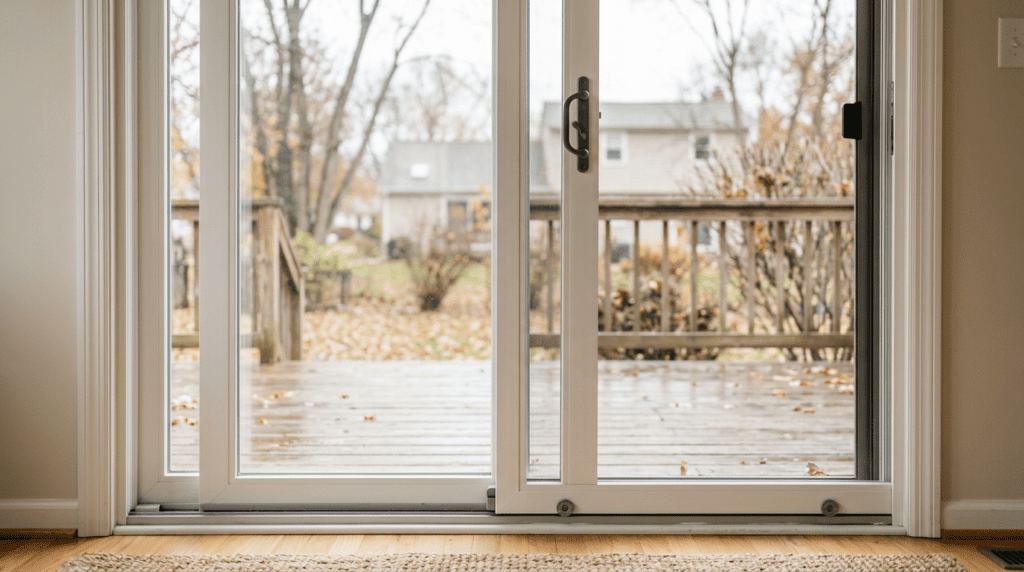
A sliding patio door has one panel that rolls sideways past a second, fixed panel along a bottom track. A French patio door has one or two panels on hinges that swing open like a regular door, with no track underfoot. The frame, glass, and weatherstripping carry similar names on both, but a slider adds rollers, a track, and an interlock, while a hinged door adds hinges, an astragal, and a swinging threshold. If you are still choosing, our guide to patio door types compares how each one fits a room.
This article focuses mostly on the sliding door, since it is the most common style on Columbus-area homes and the one with the most parts that move and wear. Where a French door differs, the section flags it, so the anatomy works no matter which kind you have.
The Frame: Head, Jambs, Sill, and Drainage
The frame is the fixed box anchored into the wall opening, and everything else hangs or rides inside it. Its top horizontal member is the head, the two vertical sides are the jambs, and the bottom is the sill. On a slider, the sill is not just a ledge: it carries the track the rollers run on, which makes it the hardest-working piece of the whole frame.
Outside, the trim that bridges the frame and the siding or brick is the brickmould or exterior casing, and a drip cap across the top sheds rain away from the head. Inside, plain casing hides the same gap. None of this trim is decorative filler. It is the first barrier against water trying to work its way behind the frame, and on a settled older home those joints are a common place for a slow leak to begin.
The frame also holds a drainage path most people never notice. Small slots at the bottom of the sill, the weep holes, let rainwater that gets into the track drain back outside. When they clog with grit, water pools on the track, and in an Ohio winter that trapped water freezes, stresses the sill, and can push past the seal into the floor. A clear sill and open weep holes are quiet but essential parts of the door.
The Track and Rollers: What Fails First
The track and rollers are the heart of a sliding door and the parts that fail first. The track is the raised rail on the sill that the operable panel rides along. The rollers are the small wheels mounted in the bottom of that panel, usually in pairs called tandem rollers, and they carry the full weight of a heavy glass panel every time it moves.
Grit is their enemy. Dirt, pet hair, and leaves pack into the track, the rollers grind through it, and over a few seasons they flatten, seize, or jump the rail. A door that drags, screeches, or needs two hands to move is almost never a broken door; it is a dirty track, worn rollers, or both. Most rollers are adjustable with a screw at the bottom edge of the panel that raises or lowers the wheel to level the door.
On service calls around Columbus, a patio door that will not open anymore turns out, more often than not, to be flattened rollers riding in a track full of packed grit. Clean the channel, swap the roller assembly, and a door that took two hands glides again with one finger.
Do not force a stuck slider. Heaving on a panel with seized rollers can bend the track and crack the corner of the glass, which turns a small roller swap into a full panel replacement.
The Panels: Fixed, Operable, Stiles, and Rails
A standard sliding patio door has two panels: one fixed in place and one operable that slides. The fixed panel is sometimes called the stationary panel, and it is anchored to the frame, not free to move, which surprises people who try to slide the wrong side. Each panel is built like a window sash, framed by vertical stiles and horizontal rails around a pane of glass.
The outer vertical edges are the stiles. On the operable panel, the handle stile carries the lock and handle, while the opposite stile meets the fixed panel. The horizontal members are the top rail and the bottom rail, and the bottom rail is where the rollers live. Because the bottom rail holds the rollers and takes the weight, it is also the part that bends if the door is forced or dropped during a move.
French patio doors swap the slider’s fixed panel for a second hinged leaf or a fixed sidelite, but the panel is still stiles, rails, and glass. One point of confusion is panel versus sash: on doors the moving leaf is usually called a panel, while the same assembly on a window is a sash. They mean the same kind of part.
The Interlock and the Astragal
Where the two panels overlap is a part most glossaries skip, and it does real work. On a slider, the meeting stiles of the fixed and operable panels nest together when the door is closed, and the channel that locks them together is the interlock. It pulls the two panels into line, blocks wind from whistling through the gap, and gives the lock something solid to grab.
The interlock is also a security feature. A panel that is not pulled tight into its interlock can be levered or lifted out of the track, which is why a worn interlock or a misadjusted panel is both a draft problem and a break-in risk. Keeping the rollers set so the panel sits square in the interlock matters for more than smooth sliding; it is part of how the door resists being forced. Our notes on securing a sliding door cover the add-ons that back it up.
On a French patio door, the equivalent part is the astragal, the vertical molding on the edge of one leaf that the other closes against. It carries its own weatherstrip and houses the strike for the lock, so a pair of French doors seals and latches like a single unit only when the astragal is sound.
Glass: Glazing, Low-E, and the Failed Seal
The glass in a modern patio door is not a single sheet but an insulated glass unit, the same construction as a quality window. Two panes are held apart by a spacer around the edge, the gap is often filled with argon gas, and a Low-E coating reflects heat to keep the room comfortable. A bead of sealant around the perimeter, the edge seal, locks the unit together and keeps moisture out.
Patio door glass is also tempered by code, because it is a large pane at body height. Tempered glass is heat-treated to break into small blunt pieces instead of long shards, which is why a modern door is far safer than an old single-pane slider if something hits it. The slim bars that split some doors into a grid pattern are grilles or muntins, decorative on most current units.
The part that fails is the edge seal. When it gives out, moisture creeps between the panes and the glass looks permanently foggy or hazy, a film no cleaning will touch. A fogged door does not mean a whole new unit: the insulated glass can often be replaced on its own, the same fix as a foggy window. Ohio’s freeze-thaw swings are hard on these seals, so a door in strong afternoon sun is a common place to see one fail early.
Locks, Keepers, and the Footbolt
The hardware is what turns a sliding panel into a door you can lock at night. The handle set sits on the handle stile, inside and out, and works a latch or hook that reaches into the frame. On the jamb side, the metal piece the latch catches is the keeper or strike, and the door only locks securely when latch and keeper line up. That is why a dropped panel that has lost its roller height often stops locking before it stops sliding.
Many sliders add a footbolt, a foot-operated pin near the bottom that drops into the track or sill for a second point of security. A vent lock or ventilation latch lets you hold the door open a few inches for air while blocking it from sliding further. French patio doors usually use a multipoint lock instead: one handle throw shoots bolts at the top, middle, and bottom of the leaf into the frame.
For any patio door, the keeper is the quiet weak point. A latch is only as strong as the metal it lands in, and a keeper held by short screws into a soft jamb gives way under a shove. Solid hardware, a properly aligned panel, and a footbolt together are what separate a door that looks locked from one that is.
Weatherstripping, Sweeps, and the Screen
A patio door can be solid and still leak air once its seals tire out. Weatherstripping runs around the frame and along the meeting stiles so the closed panel presses into a continuous gasket; on a slider it is often a fin or pile seal the panel brushes past. After years of sliding and cold-stiffening, it flattens and stops springing back, and that is when the draft at the edges starts.
Along the bottom of a hinged door, and on the rails of some sliders, a sweep closes the last gap to the threshold. Replacing tired weatherstrip or a worn sweep is one of the highest-value small jobs on a door: it is inexpensive, needs no special skill, and restores comfort far more than people expect. If a door felt tight when it was new and drafts now, the glass has not changed; the gasket has.
Most patio doors also include a sliding screen on its own outer track, framed in light aluminum with small rollers and a mesh panel. The screen is the part homeowners damage most, since the thin rollers jump their track easily, but it is also the cheapest to repair or rebuild and rarely a reason to touch the door itself.
Reading the Door When Something Goes Wrong
Naming the parts pays off the moment something stops working, because the symptom points straight to the group at fault. A door that drags or sticks is a track-and-roller problem: a dirty track, flat rollers, or a panel out of level. A door that drafts is a seal problem: flattened weatherstripping, a worn sweep, or a gap at the interlock. A door that fogs is a glass problem, the failed edge seal. A door that will not lock is an alignment problem, usually a dropped panel or a keeper out of line.
This is also how you read a repair quote. If someone proposes replacing a whole patio door for a draft, a fogged pane, or a latch that misses, ask which part actually failed. Rollers, weatherstripping, an insulated glass unit, a keeper, or a screen are small, targeted fixes. Replacement genuinely makes sense when the frame has rotted, the sill and track are damaged, or a settled opening has racked so far the panel no longer runs true.
For a slider specifically, the order of likely culprits is steady year to year: rollers and track first, then weatherstripping and the interlock, then the glass seal, then the lock. Working down that list, cheapest and most common first, solves the large majority of patio door complaints without a new door.
Patio Door Sticking, Drafting, or Won't Lock?
If your patio door drags, drafts, fogs, or will not lock the way it used to, the fix is often a single part, not the whole door. The hard part is knowing which one, and an honest look tells you fast. There is no sense fighting a heavy glass door every time you step outside.
Book a free, no-pressure patio door assessment with our Columbus-area team and get a straight answer on whether it is a simple repair or time for a replacement.
FAQ: Patio Door Parts

Ready to fix your windows? Get a free quote in 30 seconds.
Family-owned, licensed & insured. Free, no-obligation quotes.