
- Services
- New Installation
- Reviews
- Projects
- About Us
- Contacts
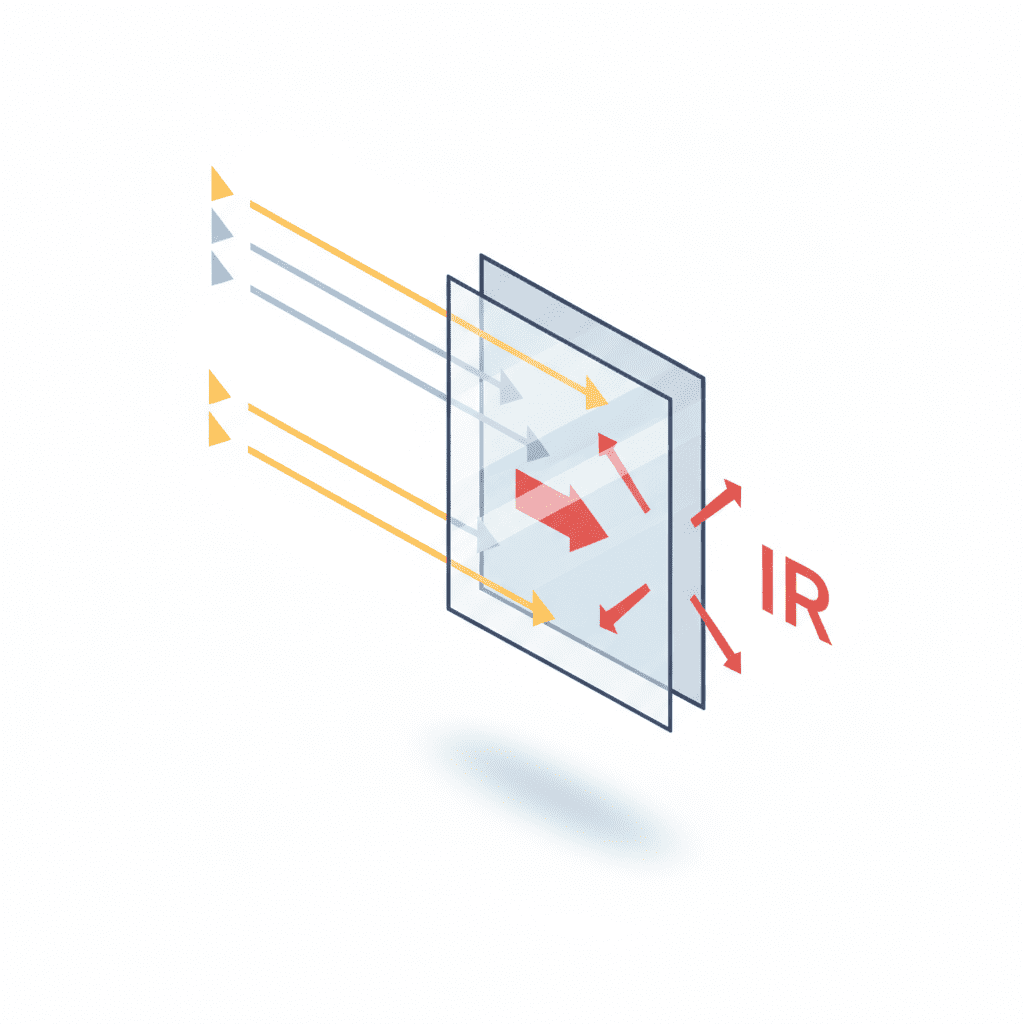
Glass coated with a microscopically thin, transparent metallic oxide layer that reflects infrared (heat) radiation while allowing visible light to pass through.
Glass coated with a microscopically thin, transparent metallic oxide layer that reflects infrared (heat) radiation while allowing visible light to pass through.
Low-emissivity (Low-E) glass has a nearly invisible metallic coating—typically silver or tin oxide—applied to one or more surfaces. This coating reflects long-wave infrared radiation (heat) back toward its source, keeping your home warmer in winter and cooler in summer without significantly reducing natural light.
All objects emit infrared radiation proportional to their temperature. Your home’s heated surfaces (floors, walls, furniture) emit IR toward the cold window glass. A Low-E coating on the interior glass surface reflects that heat back into the room instead of letting it escape through the glass. In summer, the same coating reflects solar IR from outside back outward.
For Ohio’s mixed climate, the ideal Low-E coating has a moderate Solar Heat Gain Coefficient (SHGC ≈ 0.25–0.40): enough to allow some passive solar gain in winter while still blocking peak summer heat. Energy Star recommends U-factor ≤ 0.27 and SHGC ≤ 0.40 for the North-Central region.
Low-E coating cannot be added to existing installed glass—it is factory-applied. However, Low-E window film can be applied to existing glass as a retrofit option, providing about 50–75% of the benefit at a fraction of the cost.

Contact us now for a free estimate and take the first step toward repairing your windows!
Please leave your contact details.
The manager will contact you shortly.

