
- Services
- New Installation
- Reviews
- Projects
- About Us
- Contacts
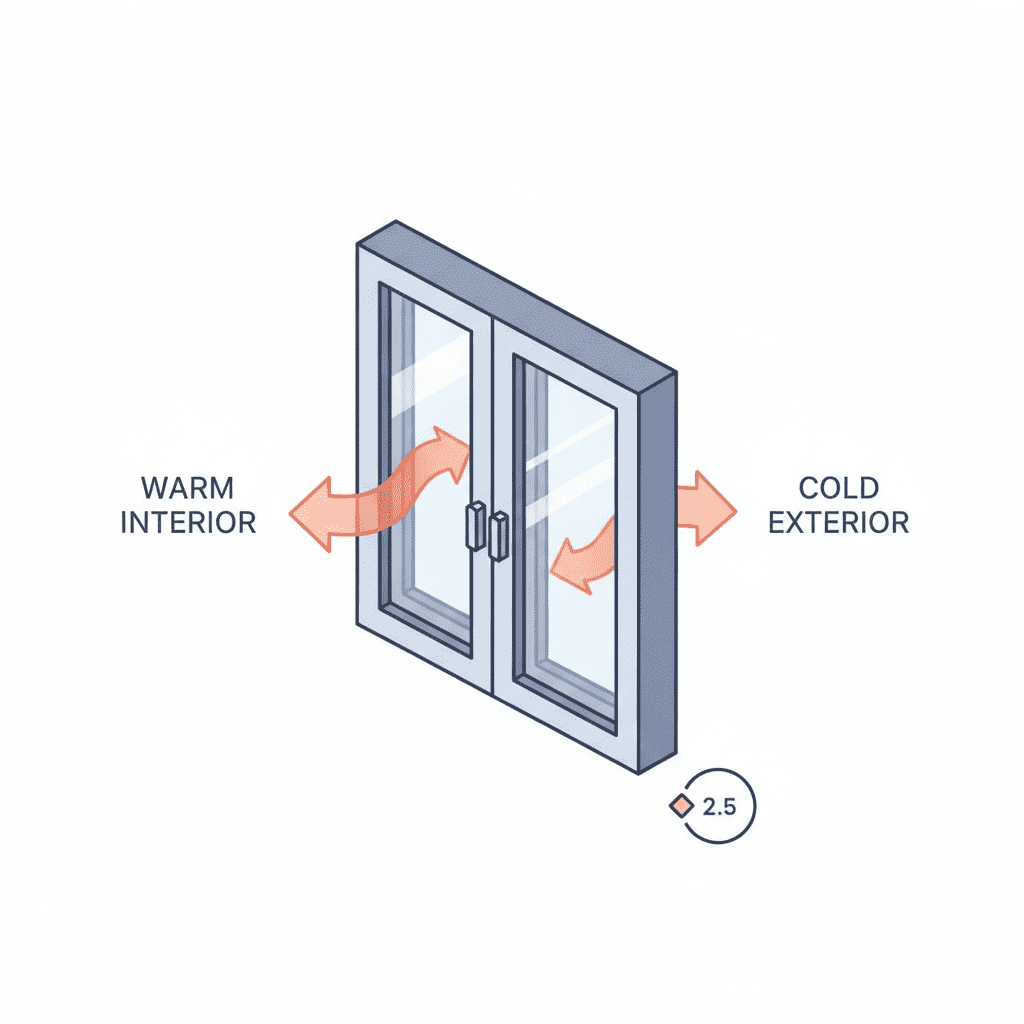
A rating that measures how much heat a window allows to escape — the lower the U-factor, the better the window insulates against heat loss.
A rating that measures how much heat a window allows to escape — the lower the U-factor, the better the window insulates against heat loss.
The U-factor (also called U-value) measures the rate of heat transfer through a window assembly — glass, frame, and spacer combined. It is expressed in BTU/(hr·ft²·°F). A lower U-factor means less heat escapes through the window, which is desirable in cold climates like Ohio.
You may be more familiar with R-value from insulation ratings — R-value is simply the inverse of U-factor (R = 1/U). A window with U-factor 0.25 has an R-value of 4.0. In the window industry, U-factor is the standard; R-value is more common for walls and roofs.
| Window Type | Typical U-Factor | R-Value Equivalent |
|---|---|---|
| Single pane, no coating | 1.04 | R-1 |
| Double pane, air-filled | 0.48 | R-2 |
| Double pane, argon + Low-E | 0.25–0.30 | R-3.3–R-4 |
| Triple pane, argon + Low-E | 0.15–0.20 | R-5–R-6.7 |
Ohio falls in the North-Central climate zone. Energy Star requires U-factor ≤ 0.27 for this zone. Windows meeting this threshold will appear on the NFRC label (small sticker on the glass).
Upgrading from U-0.50 (old double pane) to U-0.25 (new Energy Star double pane) essentially halves the heat loss through that window. For a typical Columbus home with 300 sq ft of window area, this can save $150–$400 per year in heating costs.

Contact us now for a free estimate and take the first step toward repairing your windows!
Please leave your contact details.
The manager will contact you shortly.

