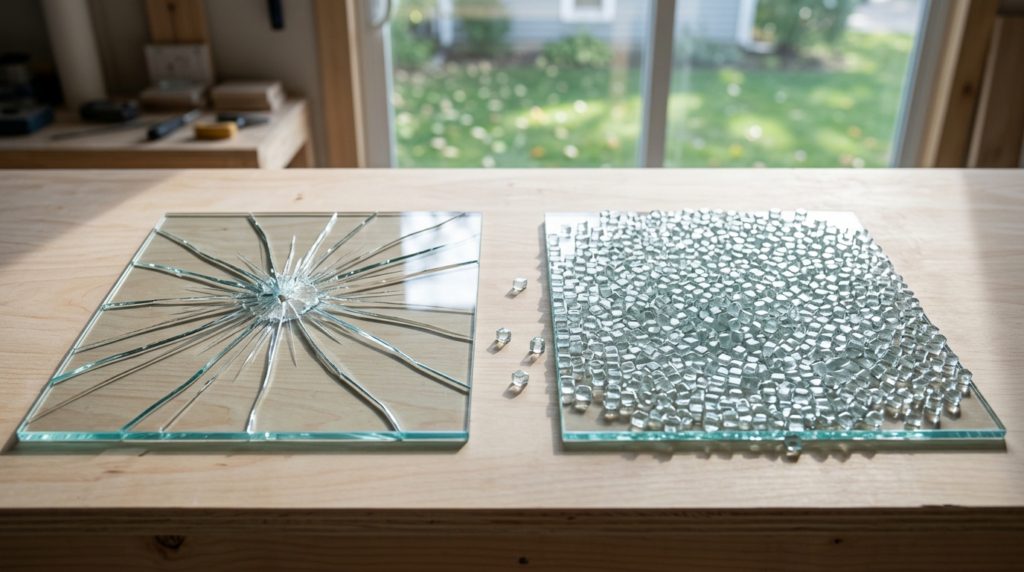
Two clear panes can look identical leaning against a wall, yet one shatters into long razor shards and the other crumbles into harmless pebbles. That difference is the whole story of annealed versus tempered glass, and it decides which pane is legal next to a door, safe in a shower, and likely to survive a hard Ohio winter. Most glass in an older home is annealed; most glass the building code now requires is tempered.
This guide explains how each type is made, how strong it is, how it breaks, and which panes in your house need to be one or the other. If a pane has already cracked, our team handles glass repair and replacement and can match the right type to the opening before you order anything.
Quick answer: Annealed glass is standard glass that cools slowly and breaks into sharp shards. Tempered glass is annealed glass reheated and rapidly cooled, making it about four to five times stronger and causing it to break into blunt pebbles. Tempered is safety glass; annealed is not.
Annealed vs Tempered Glass at a Glance
The simplest way to hold the two apart is to remember that one is the starting material and the other is what you get when you treat it. Every tempered pane begins life as annealed glass; the tempering step is added afterward to change how it behaves. So this is not really two unrelated products, but one piece of glass at two stages of strength.
That relationship explains most of the trade-offs. Annealed glass stays easy to work with but stays fragile. Tempering buys strength and a safe break pattern, but locks the size and shape in place forever. Keep that single idea in mind and the rest of the comparison follows from it.
- Annealed glass: standard, low-cost, easy to cut and drill, but breaks into long sharp shards and is not safety glazing.
- Tempered glass: about four to five times stronger, breaks into blunt pebbles, meets safety code, but cannot be cut or trimmed after it is made.
- The deciding question: could a person fall, walk, or slip into this pane? If yes, the code almost always wants tempered.
What Is Annealed Glass?
Annealed glass is the plain, everyday glass that nearly all flat glass starts as. It is made by the float process, where molten glass is poured onto a bed of liquid tin to form a perfectly flat sheet. Left to cool on its own, glass cools unevenly and traps internal stress that makes it warp or crack, so the sheet is run through a long oven called a lehr that brings the temperature down slowly and evenly.
That slow, controlled cooling is the annealing, and it is what relieves the internal stress. The result is a stable, optically clear pane with no built-in tension, which is exactly why it can be cut, drilled, notched, and edge-polished without exploding. Cabinet fronts, picture frames, mirrors, shelves, and the glass in many older windows are annealed.
The downside is right there in the break. With no surface tension to manage the failure, annealed glass snaps into long, jagged, knife-edged shards. That makes it cheap and workable, but a poor and often illegal choice anywhere a person could strike it.
What Is Tempered Glass?
Tempered glass is annealed glass that has been given a second heat treatment to make it far stronger. The pane is reheated in a furnace to roughly 600 to 620 degrees Celsius, then blasted on both faces with jets of cool air. The surfaces harden first and squeeze the still-soft center, leaving the finished sheet locked in a state of permanent surface compression.
That built-in tension is the source of every advantage tempered glass has. It makes the pane about four to five times stronger than the same thickness of annealed glass, helps it resist impact, and lets it take far more thermal stress before it fails. The same stored energy is what makes it shatter into a shower of small, blunt cubes instead of long blades, which is why codes class it as safety glazing.
The catch is that tempering is the last thing done to the glass. Once a pane is tempered it cannot be cut, drilled, or ground, because disturbing the surface releases all that stored tension at once and the whole sheet bursts. Every tempered pane has to be cut and shaped to its final size while it is still annealed, then tempered. We cover why in cutting tempered glass, but the short version is that you order it to fit, not trim it on site.
Strength and How Each One Breaks
Strength is where the two part ways most dramatically. Annealed glass is the baseline, and it is genuinely fragile: a thrown ball, a slammed door, or a stray elbow can put a crack through it. Tempered glass, with its surface in compression, absorbs four to five times the impact before it gives, which is why it survives daily knocks in showers, railings, and patio doors.
The break pattern matters even more than the raw strength. When annealed glass breaks, it splits into long, pointed shards with edges sharp enough to cause deep cuts, and those pieces tend to stay hanging in the frame. When tempered glass finally fails, the stored tension releases everywhere at once and the entire pane disintegrates into thousands of small, dull-edged pebbles that are far less likely to injure anyone.
That is the entire reason building codes call tempered glass safety glazing and require it in hazardous spots. Annealed glass can be made code-compliant for some of those locations only by laminating it, bonding two panes around a plastic interlayer so the shards stick to the film instead of falling. For most homeowners, though, the practical safety choice in a risky opening is a tempered pane.
Heat, Thermal Shock, and Ohio's Temperature Swings
Glass does not only break from impact. It also breaks from thermal stress, when one part of a pane is much hotter than another and the two zones expand by different amounts. The heated area pushes against the cooler glass around it, and if the difference is large enough the pane cracks on its own, with no one touching it. Annealed glass is the most vulnerable to this, because it has no surface compression to fight the stress.
This is a real concern in central Ohio, where a single winter day can swing from a hard freeze at dawn to bright afternoon sun on a south-facing window. A pane that is half in shadow and half in direct sun, or one that sits close to a radiator or a sunlit dark sill, sees exactly the kind of temperature gradient that starts a thermal crack. Tempered glass tolerates a far wider swing before it complains, which is part of why it shows up in storm doors, sunrooms, and large sun-facing openings.
A deep chip or a damaged edge makes either type worse, since stress concentrates at the flaw. If an annealed pane in your home has cracked from a corner with no impact behind it, thermal stress is the usual suspect, and the fix is a properly sized replacement rather than a patch. Knowing whether a given pane is annealed or tempered also tells you how much swing it can safely take.
Cutting, Drilling, and Sizing
The way each type is fabricated drives a lot of practical decisions, especially during a repair. Annealed glass is forgiving: a glazier can score and snap it, drill holes for hardware, notch it around obstructions, and polish the edges, all after the sheet is made. That flexibility is why it remains the default for custom shelving, table tops, and shapes that have to be fitted on the spot.
Tempered glass allows none of that. Because the surface is in permanent compression, any cut, drilled hole, or ground edge releases the tension and the pane explodes into pebbles. Everything, including the exact dimensions, every hole, and every cut-out, must be specified before tempering. If you measure a tempered opening wrong, there is no shaving it down later; the pane is scrap and a new one has to be made.
This is why measuring matters more for tempered work, and why a tempered replacement takes longer than swapping an annealed pane a shop can cut from stock. It is also why you cannot tell a tempered pane by trying to score it. To identify what you already have, look for the etched stamp in a corner and the faint surface distortion, which we walk through in telling whether glass is tempered.
Where Each Type Belongs in a Home
Most houses use both, each where it makes sense. Annealed glass handles the low-risk, often decorative spots where cost and workability matter and nobody is likely to fall into the pane. Tempered glass takes over wherever impact, heat, or a safety code raises the stakes, which in modern construction is a long list of named locations.
As a rough map of a typical home, the split looks like this:
- Usually annealed: cabinet and hutch doors, picture frames, interior shelving, mirrors, and the fixed panes of many older windows.
- Required tempered: entry and patio doors, the sidelights beside them, and shower and tub enclosures.
- Required tempered: windows close to the floor or within a set distance of a door, where a trip could send someone through the glass.
- Required tempered: glass railings, stair-adjacent panels, and many large or low fixed windows.
If you are putting in new openings, tempered safety glass is the standard for almost everything people live around, and most of the units we set during a new window installation rely on it. Annealed still earns its place, but mainly out of the path of daily traffic.
Which Panes in Your Home Must Be Tempered?
The honest answer is that it depends on where the pane sits, and the rules have tightened over the years. Building codes define hazardous locations, the spots where a person is most likely to hit the glass, and require safety glazing there. The list includes glass in and next to doors, in wet areas like showers, near the floor, and along stairs and landings. A home built decades ago may have plain annealed glass in places that today would have to be tempered.
On replacement jobs around Columbus, the low window right beside a back door is often the original annealed pane from when the house was built. Current code calls that a hazardous location, so the replacement has to go in as tempered safety glass. Homeowners are usually surprised the new pane costs and ships differently than a plain cut-to-size piece, but it is the correct and code-required swap.
The takeaway is to treat any glass you live close to, especially near a door, a tub, or the floor, as a candidate for tempered safety glazing when it is replaced. If you are not sure what a particular opening calls for, it is worth asking before you order, since the wrong glass either fails inspection or, worse, fails on impact later. Our overview of what tempered glass is covers the code locations in more detail.
Cracked or Wrong Glass? Get the Right Replacement
Whether a window pane finally cracked, a shower panel chipped, or you are not sure an old opening meets today’s safety code, the fix starts with matching the correct glass to the spot. Putting annealed where tempered belongs can fail inspection and put sharp shards where people walk, and a quick look tells our team which type and thickness the opening needs.
Book a free, no-pressure glass replacement quote with our Columbus and Cincinnati team and get the right pane cut to fit the first time.
FAQ: Annealed vs Tempered Glass

Ready to fix your windows? Get a free quote in 30 seconds.
Family-owned, licensed & insured. Free, no-obligation quotes.