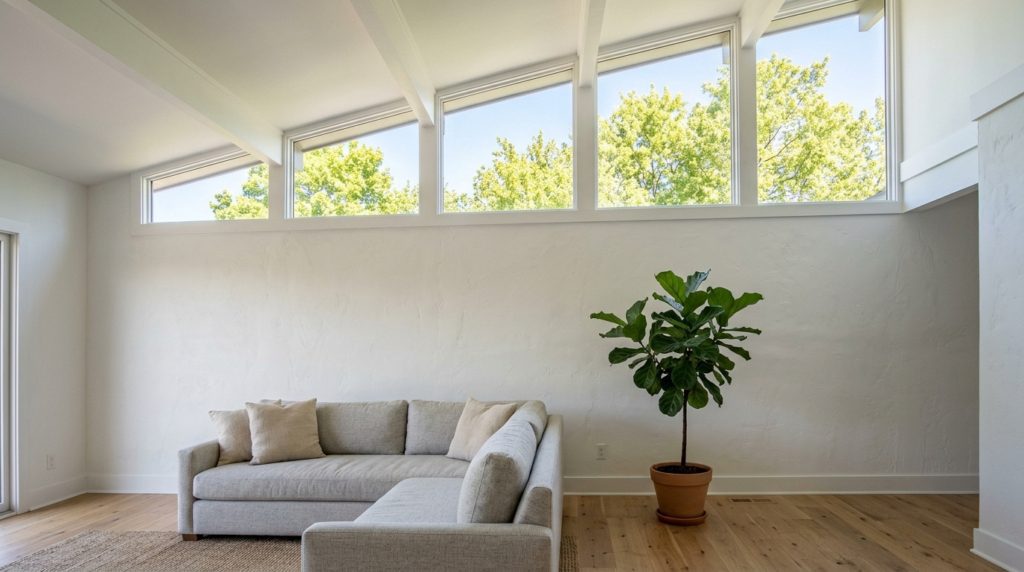
A clerestory window is a row of glass set high on a wall, near the ceiling or the line where the roof changes pitch. It sits well above eye level, so it pours daylight deep into a room without giving up privacy or the wall space below. You see the same idea in old churches and in modern open-plan homes for one reason: light from above reaches places a normal window cannot.
This guide explains what these high windows are, where they came from, and how they work as a daylighting and ventilation tool. It also covers the rooms they suit, how they compare with skylights, and what Ohio’s climate means for the glass and the flashing. If you are weighing them for a build or a remodel, they usually belong in a new window installation rather than a simple swap.
Quick answer: Clerestory windows are a band of windows mounted high on a wall, just below the roofline. They bring soft, even daylight far into a room while keeping privacy and freeing the lower walls for furniture. Most are fixed glass, but operable versions also vent hot air through the stack effect.
What Is a Clerestory Window?
The word is old and the spelling trips people up. It is clerestory, sometimes written clearstory, and it simply means a high section of wall lined with glass. In a house that band usually sits eight to twelve feet off the floor, tucked under the ceiling or along the tall wall where two roof slopes meet. The glass is generally wider than it is tall, run as a single strip or as a series of smaller panes.
What sets one apart from an ordinary window is its height on the wall, not its shape. A standard window fills the part of the wall you look through, while a clerestory sits above that line, lighting the room without becoming a view or a privacy gap. A transom is a close cousin, but a transom caps a door or another window, where a clerestory stands on its own high stretch of wall.
Most of these units are fixed picture glass, since reaching a latch twelve feet up is awkward. Operable versions exist and earn their place when you want the window to vent, opened by a long crank or a small motor. Frames come in the same materials as any window: vinyl, fiberglass, wood, or aluminum.
A Short History: From Temples to Open-Plan Homes
The idea is thousands of years old. Egyptian temples used high wall openings to drop shafts of light onto stone halls, and Roman basilicas raised their central naves above the side aisles so the gap could be lined with windows. The word itself comes from those raised church naves, the bright upper level that medieval builders filled with glass.
Gothic cathedrals turned the technique into art, stacking tall windows above the arcade so that light seemed to pour down from the heavens. Centuries later, mid-century modern architects borrowed the same move for ranch houses and open-plan living rooms, using a low band of high glass to brighten deep floor plans. The reason has never changed: when you cannot add a window at eye level, you add one near the roof.
How Clerestory Windows Work
A clerestory does three jobs at once, and the height is what makes each one work. Set near the ceiling, the glass throws daylight across the room and onto the far walls, where it bounces down as soft, even light instead of a harsh patch on the floor. Rooms that would otherwise need lamps at midday stay bright, which is the whole point of daylighting.
The same height drives air and heat. Warm air collects at the top of a room, so an operable high window lets it escape while cooler air is pulled in through lower windows or doors, a passive loop called the stack effect. On a south-facing wall, low winter sun slips in and warms the floor and the far wall, free heat at the time of year you most want it.
- Daylighting: light enters high and reflects deep into the room, cutting the need for lamps.
- Stack ventilation: when the unit opens, hot ceiling air vents out the top while cool air enters low.
- Passive solar: low winter sun on a south wall adds free warmth, an asset in a cold Ohio January.
The Benefits of Clerestory Windows
The headline benefit is light you cannot get any other way. Because the glass sits above sightlines, you get a flood of daylight with none of the privacy worry that comes with large windows facing a neighbor or a street. That matters most on tight lots and in city homes, which is why bathrooms and bedrooms are such common spots for them.
Height also frees the wall below. With the window up near the ceiling, the rest of the wall stays open for cabinets, shelving, art, or a tall headboard, a real gain in a small room. Then there is the look. A band of high glass draws the eye up, makes a ceiling feel taller, and pairs naturally with a vaulted or sloped roofline.
- Daylight with privacy: bright rooms without curtains or exposure to the street.
- Usable wall space: the lower wall stays free for furniture, storage, and decor.
- Lower lighting use: less reliance on electric light through the day.
- A sense of height: the eye travels upward, so the room feels larger and more open.
The Drawbacks to Plan For
None of this is free, and the trade-offs all come back to that same height. Glass loses and gains heat faster than an insulated wall, so a poorly specified band can bleed warmth on a cold night and bake a room on a summer afternoon. The right glazing solves most of it, but it has to be chosen on purpose rather than as an afterthought.
Reach is the other catch. A window twelve feet up is hard to clean, hard to open by hand, and harder still to service if a seal fails. Plan for that access before the wall goes up, not after the drywall is on.
- Heat transfer: winter heat loss and summer solar gain without the right low-E glass.
- Cleaning access: you will need an extension pole, a tall ladder, or a pro.
- Operating reach: operable units usually need a long crank or a motor.
- Flashing and leaks: the high wall-to-roof joint has to be sealed carefully to keep water out.
- Hard-to-reach repairs: a fogged seal or a failed opener up there is a lift call, not a quick fix.
Where to Use Clerestory Windows
These windows earn their keep wherever a room is deep, dark, or short on private wall space. The classic spot is a living or great room with a vaulted ceiling, where a band of high glass lights the whole floor and shows off the roofline. Kitchens are another favorite, with a strip of glass above the upper cabinets washing daylight down onto the counters.
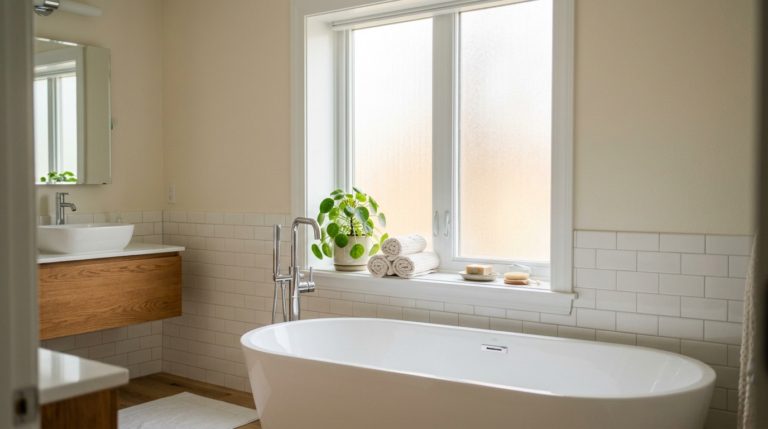
They also shine in the rooms where privacy matters most. In a bathroom, high glass brings light to the shower and vanity while no one outside can see in, and it helps vent steam if the unit opens. Bedrooms get soft morning light without a curtained window, and the darkest paths in any house, hallways and stairwells, come alive with a single high opening.
- Living and great rooms: light a deep, vaulted space and frame the ceiling.
- Kitchens: a strip above the cabinets brightens the counters.
- Bathrooms: daylight and venting with full privacy.
- Bedrooms: gentle light without exposure to the street.
- Hallways and stairwells: the darkest spots in a home, fixed in one stroke.
Clerestory Windows vs. Skylights
People often weigh a clerestory against a skylight, since both chase daylight from above. The difference is where the glass sits and what that costs you. A clerestory goes in a wall, so it gives soft, indirect light, keeps the roof intact, and carries a lower risk of leaks. A skylight goes in the roof, delivers brighter direct light and a patch of sky, but it opens a hole in the most weather-exposed surface of the house.
Neither is simply better. A skylight wins when you want maximum light or a view straight up and the room has no tall wall to use. A clerestory wins on privacy, on protecting the roof, and on glare, since its light arrives sideways and spreads evenly. In a climate with ice dams and heavy snow load, the lower leak risk of a wall window is worth real weight. If a roof opening is already giving you trouble, our skylight repair page covers the common fixes.
- Light quality: a clerestory is soft and indirect; a skylight is bright and direct.
- Privacy: a wall window keeps it; a roof window opens the room to the sky.
- Leak risk: lower for a wall opening, higher for a roof penetration.
- Surfaces: a clerestory leaves the roof intact; a skylight leaves the wall intact.
Orientation and the Ohio Climate
Which way a clerestory faces changes everything about how it behaves, and Ohio swings hard between a cold January and a humid July. A south-facing band catches low winter sun for free heat, but the same glass can overheat a room by mid-afternoon in summer. The fix is a roof overhang sized to block the high summer sun while letting the low winter sun in, paired with low-E glass tuned to control solar gain.
North-facing units do the opposite. They give steady, glare-free light all day with almost no heat gain, which is ideal over a workspace or a kitchen, though they add little winter warmth. East and west placements bring strong morning or evening sun and the glare that comes with it, so they want careful glazing and sometimes a shade.
The detail most homeowners never think about is the flashing where the clerestory wall meets the roof. That joint is the hardest waterproofing spot on the house, and the freeze-thaw cycles and ice dams of a Columbus winter test it every year. Water that backs up under shingles will find a sloppy head flashing or a missing kickout long before the glass itself ever fails.
On the clerestory leaks we see around Columbus, the water is almost never coming through the window. It is getting in at the flashing where the high wall meets the roof, and an ice dam in February is what finds the weak detail.
Fixed or Operable, and the Right Glass
The first choice is whether the band opens at all. Most clerestory units are fixed, because they exist for light rather than air, and fixed glass seals tighter and costs less to maintain. If you want the stack-effect ventilation, choose operable units, but plan the controls first: a tall hand crank for a reachable run, or a motorized opener with a wall switch or remote for glass near a high ceiling.
The glass package matters more here than on a normal window, because the unit is cold, high, and awkward to service. Spec a double or triple pane with a low-E coating and an argon fill, matched to the orientation so it controls heat without dimming the room. Skimping on the glass to save a little now means a fogged, out-of-reach pane later.
That last point is worth sitting with. When a sealed unit near the ceiling loses its seal and fogs, you cannot just wipe it down, and reaching it for an insulated glass replacement means a ladder or a lift. If you want real airflow rather than a fixed light, a reachable casement or awning window lower on the same wall pairs well with a fixed clerestory above it.
Adding Clerestory Windows to an Existing Home
Adding a clerestory to a house that does not have one is real construction, not a window swap. You are cutting a new opening high in a load-bearing wall, framing a header to carry the load above it, and tying the new glass into the roofline with proper flashing. On a single-story ranch it can mean raising part of the roof to build the wall the windows sit in.
Older Columbus homes add their own wrinkles. Walls are rarely plumb, framing is not always where you expect it, and matching a new high band to an existing roof pitch takes planning. This is squarely new window installation territory, where the opening, the header, and the weather detailing are engineered together instead of improvised on site.
One code point catches people off guard. A clerestory sits too high to count as an emergency exit, so it cannot serve as the required egress window in a bedroom. If a bedroom leans on a high band for its light, it still needs a code-compliant escape opening lower in the room. Sorting that out early keeps a handsome design from failing inspection.
Thinking About Clerestory Windows for Your Home?
A clerestory can transform a dark, boxed-in room, but the payoff depends on getting the orientation, the glass, and the flashing right for the way Ohio weather works. Those are the calls that separate a band of glass that performs from one that leaks or overheats.
If you are planning a build or a remodel and want it done right, book a free, no-pressure consultation with our Columbus and Cincinnati team. We will walk the space, talk through orientation and glazing, and give you a straight answer on what the opening really takes.
FAQ: Clerestory Windows

Ready to fix your windows? Get a free quote in 30 seconds.
Family-owned, licensed & insured. Free, no-obligation quotes.