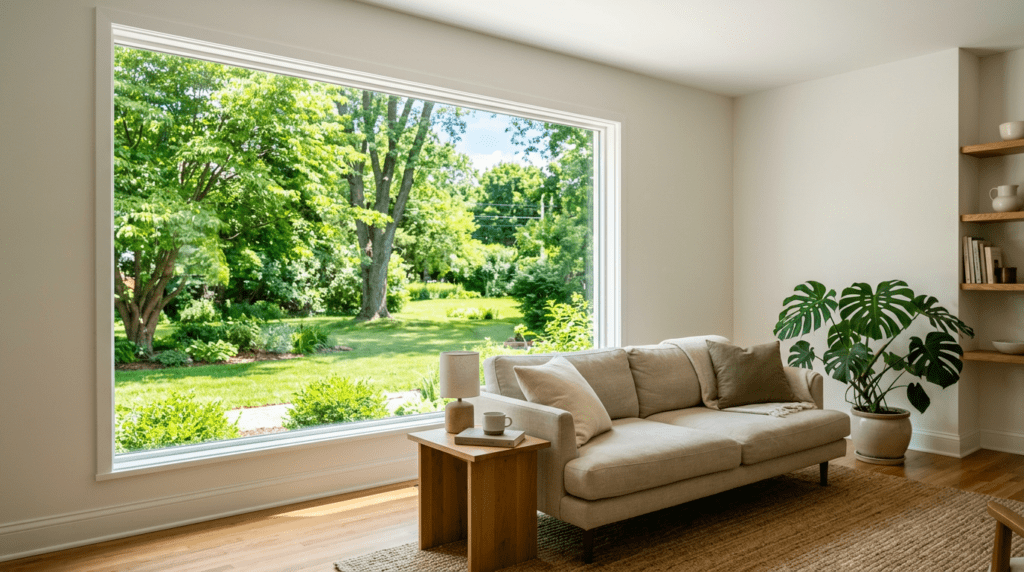
A picture window is the large, fixed pane that turns a blank wall into a framed view of the yard. It does not open, which is exactly why it can be bigger, clearer, and better sealed than a window that does. That same fixed design is also its main limit, so a picture window is the right choice in some rooms and the wrong one in others.
This guide explains what a picture window is, how it compares to windows that open, its real pros and cons, the rooms it suits best, and the Ohio-specific issues that show up later, like fogged glass and winter condensation. If a pane in your home has already clouded over, the fix is usually a picture window repair rather than a full replacement.
Quick answer: A picture window is a large, fixed pane of glass that does not open. It delivers wide views, plenty of daylight, and tight energy efficiency because it has no moving parts to leak air. The trade-off is no ventilation, so it works best paired with operable windows in living rooms, stairwells, and rooms with a view.
What Is a Picture Window?
A picture window is a single, fixed pane set in a slim frame, built to show off a view rather than to let in air. The name comes from the way it frames the outdoors like a picture on the wall. Because nothing slides, cranks, or tilts, almost the entire opening is glass, with only a narrow border of frame around the edge.
That fixed design separates it from the windows most people picture when they think of a window. There is no sash to raise, no crank to turn, and no lock to throw. The glass is sealed permanently into the frame, usually as an insulated glass unit with two or three panes and an inert gas like argon held between them.
Sizes run large by design. A picture window is often the widest single window on a wall, and many are built tall enough to reach from knee height to the ceiling. The point is an uninterrupted sightline, so manufacturers keep the frame as low-profile as the structure allows.
Picture Windows vs. Windows That Open
Here is a distinction that trips up a lot of homeowners: every picture window is a fixed window, but not every fixed window is a picture window. A fixed window can be any shape, including a circle, an arch, or a tall sidelite, and it is often sized to match the sightlines of the operable windows next to it. A picture window is the large, view-first rectangle with the thinnest frame the wall can carry.
Against windows that open, the contrast is about function. A casement window cranks outward and a double-hung slides up and down, both trading a little glass area and a thicker frame for airflow. A picture window gives up that airflow entirely in exchange for more glass, fewer parts, and a tighter seal.
That trade matters most where you would actually want to open a window. In a stuffy bedroom or a kitchen that needs to vent steam, a fixed pane alone falls short. In a two-story stairwell or over a kitchen sink with a view, the lack of an opening is no loss at all.
The Advantages of a Picture Window
The appeal of a picture window starts with what you can see through it. With no muntins, sashes, or hardware breaking up the glass, it delivers the widest, clearest view a single window can offer, and it pulls in more daylight than an operable window of the same size. For a room that looks onto a garden, a tree line, or an open field, that unbroken view is the whole point.
The benefits go past looks. A sealed, fixed pane has no moving joints for air to leak through, so a well-built unit is one of the most energy-efficient and lowest-maintenance windows you can install. With no balances, cranks, or rollers to wear out, there is simply less that can fail over the years.
- Unobstructed views and light: the thin frame means more glass and more daylight than any operable window of the same width.
- Strong energy efficiency: a sealed frame has no moving joints where cold air can leak in or warm air can escape.
- Low maintenance: no cranks, balances, or rollers means almost nothing mechanical to wear out or service.
- Lower cost than operable windows of the same size: with no hardware to build in, a fixed unit is usually the cheaper pick for a given opening.
- A clean, modern look: the slim sightlines suit both contemporary and traditional homes without dating quickly.
The Drawbacks to Weigh Before You Buy
No window is right for every wall, and a picture window has real limits that show up after the view wins you over. The biggest is built into the design: it does not open, so it brings in no fresh air and cannot vent heat, smoke, or cooking steam. In a bedroom, that fixed pane also cannot serve as the emergency exit that building codes require.
The large glass area cuts both ways. It pours in daylight, but on a south- or west-facing wall it can pour in summer heat and glare along with it. And while the inside is easy to wipe, the outside of a big fixed pane, especially on a second story or a stairwell, is genuinely hard to reach and keep clean.
- No ventilation: the pane cannot open, so it brings in no fresh air on its own.
- Not an egress exit: a fixed pane cannot meet bedroom egress code without an operable window beside it.
- Solar heat gain and glare: a large sun-facing pane can overheat a room in an Ohio summer.
- Harder exterior cleaning: tall or second-story panes need a long-reach tool, a ladder, or a pro.
- A bigger job to replace: a large pane costs more to swap out if it cracks or fogs than a small one.
Energy Efficiency Through Ohio's Seasons
On paper, a picture window is an energy winner, and in Ohio’s climate that holds up with one caveat. Because the glass is fixed and sealed, there are no gaps where a sash meets the frame for cold January air to sneak through. A double-hung window has two of those moving joints; a fixed pane has none, which is why it usually carries a lower air-leakage rating.
The caveat is the glass itself. A large pane is mostly glass and very little frame, and glass insulates worse than a solid wall. Through a Columbus winter you lose heat across that whole surface, and through a humid summer a sun-facing pane gains it. The fix is the right coating: a low-emissivity layer tuned to the window’s direction holds heat in during winter and turns solar gain away in summer.
On west-facing rooms around Columbus, the picture window is usually the reason a living room runs hot by late afternoon in July. The same glass that makes the view also makes the heat, and the low-E coating is what decides which one you get.
Condensation and the Fogged-Glass Problem
Here is the issue the glossy brochures skip. The sealed insulated unit that makes a picture window efficient can also fail, and on a large pane it tends to fail first. A bead of sealant around the edge keeps the inert gas in and moisture out. Over years of Ohio’s freeze-thaw swings, that seal hardens and cracks, the gas escapes, and humid air seeps in.
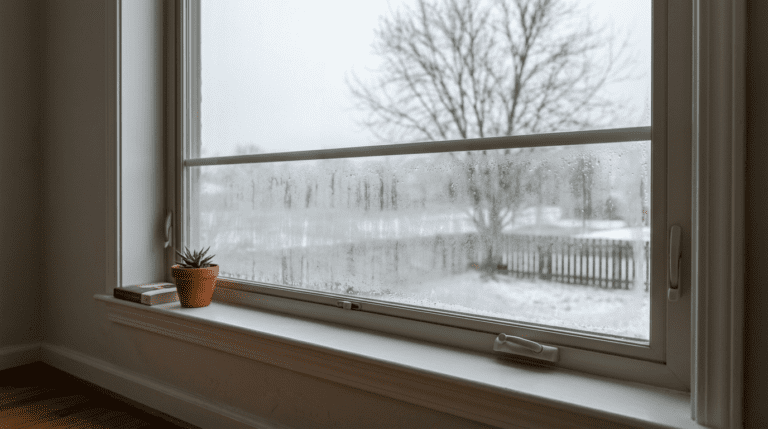
Once that happens, moisture condenses between the panes where you cannot wipe it away. You see a permanent haze or fine droplets inside the glass, worst on cold mornings. People assume a fogged window means the whole unit is ruined, but the frame is usually fine. The repair replaces the failed insulated glass unit, not the entire window, which is the heart of a fogged-glass replacement.
Large panes are also the most prone to thermal stress cracks, a crack that starts at the edge and runs across the glass with no impact at all. They come from sharp temperature differences across the pane, like winter sun striking frosted glass, and they are another reason the biggest windows in the house deserve a yearly look.
The Best Rooms for a Picture Window
A picture window earns its place wherever the view matters more than the airflow. Living rooms and great rooms are the classic spot, especially on a wall that looks onto the backyard, since the room is for sitting and looking rather than venting. Dining rooms that face a garden get the same lift.
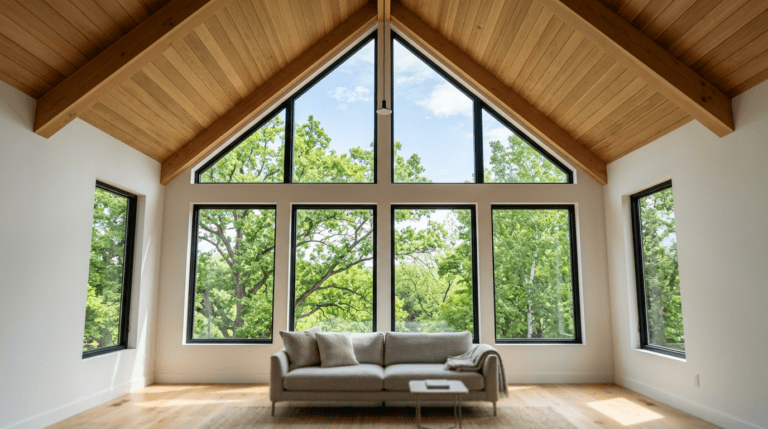
The shape also suits spots that are hard to reach or that you would never open anyway. A two-story stairwell, a vaulted gable above a row of operable windows, or a high wall over the kitchen sink all work well, because reaching up to crank a window there would be awkward at best. In a bathroom, a fixed pane of frosted or obscured glass brings in light while keeping privacy.
- Living rooms and great rooms with a backyard or tree-line view.
- Stairwells and tall, vaulted walls that are out of easy reach.
- Above a kitchen sink or counter, where you would rarely open a window anyway.
- Dining rooms that face a garden or open lot.
- Bathrooms, using frosted glass for daylight without losing privacy.
Pairing for Ventilation and Egress
Because a picture window cannot open, the common move is to pair it rather than use it alone. The classic layout puts a wide fixed pane in the center with an operable window on each side, often a casement or a double-hung. You keep the big unbroken view in the middle and get real airflow from the flanks.
That pairing is not only about comfort. In any room used for sleeping, Ohio building code requires at least one window large enough to climb out of in a fire, and a fixed pane does not count. If you want a picture window in a bedroom, it has to share the wall with an operable egress window. A casement window is a popular partner because it swings fully open and seals tightly when shut.
Awning windows, which hinge at the top, are another good companion, since they can stay open for a breeze even during a light Ohio rain. Mixing a fixed center with operable sides is how you get the view without giving up ventilation or safety.
Sizes, Shapes, and Frame Materials
There is no single standard size for a picture window, which surprises people shopping for one. Because the whole point is to fit a specific view and wall, most are built to order, ranging from modest squares to panes several feet across. Width is usually limited only by the glass the manufacturer can safely make and the header above the opening can support.
That structural point matters in older Columbus homes. A wide pane puts a long span of load on the wall above it, so cutting a big new opening often means adding or sizing a header to carry the weight, which is a job for a proper window installation rather than a weekend swap.
Frame material shapes both the look and the upkeep. Vinyl is the budget-friendly, low-maintenance default; fiberglass is stronger and holds paint well; wood looks warm but needs care; and aluminum gives the thinnest sightlines but conducts cold, which matters in a Midwest winter. The right pick depends on the room, the exposure, and how much maintenance you want to sign up for.
Cleaning and Long-Term Upkeep
A fixed pane is low-maintenance, not no-maintenance, and the upkeep is mostly about the glass. The inside wipes down easily since the whole surface sits flat in front of you. The outside is the catch: on a tall stairwell window or a second-story pane, you often need a long-reach squeegee, a ladder, or a pro to keep it clear.
Ohio’s hard water makes that worse. Mineral-heavy spray from a sprinkler or a summer storm dries into chalky spots that ordinary cleaner smears around, and a big pane shows every streak in direct sun. A quick rinse and a proper technique keep it clear, which our guide to cleaning windows streak-free walks through.
Beyond the glass, give the exterior sealant a look each year. The bead of caulk and the glazing seal around a large fixed pane take the full force of freeze-thaw, and catching a crack early keeps water and cold out before they reach the wall.
Thinking About a Picture Window?
Whether you are weighing a new picture window or staring at one that has fogged, cracked, or started letting in a draft, the right call depends on what is actually wrong, and that is hard to judge from the inside. A clouded pane is often a simple glass-unit swap, not a teardown.
Get a straight answer from our Columbus and Cincinnati team with a free, no-pressure window assessment. We will tell you whether it is a quick repair or worth replacing, with no upsell.
FAQ: Picture Windows

Ready to fix your windows? Get a free quote in 30 seconds.
Family-owned, licensed & insured. Free, no-obligation quotes.