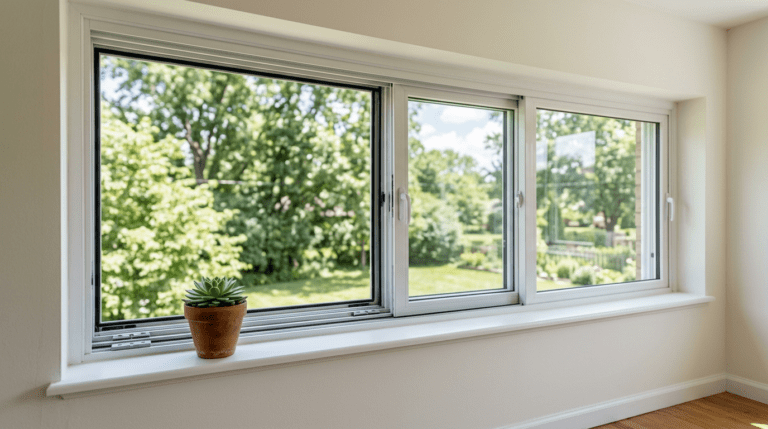

A retractable screen is the screen that is not there until you want it. Instead of a fixed panel bolted across your window or door all year, the mesh rolls into a slim housing along one edge and pulls out only when you open up for a breeze. When it is tucked away, you get the full glass and the full view, with nothing dividing the sky.
That disappearing act is the whole appeal, and it is a genuinely good fit for Ohio, where the screen season is short and the rest of the year you would rather not stare through gray mesh. Before you buy, it helps to know how these screens hold up, what they cost to put in, and where a fixed screen still wins. If a worn screen is part of a bigger window problem, a new window installation may be the better place to start.
Quick answer: A retractable screen is a mesh panel that rolls into a compact side or top housing and pulls across only when you need it, then retracts out of sight. It keeps bugs out and air moving without blocking your view, and works on windows, doors, and large patio openings in manual or motorized versions.
What Is a Retractable Screen?
A retractable screen does one job a normal screen cannot: it gets out of the way. The mesh lives rolled up inside a narrow cassette, usually aluminum, mounted along the side or the top of an opening. A small handle or bar lets you draw the mesh across the gap, where it latches to a strip on the far side. Let go of the catch and a spring inside the cassette reels the mesh back in.
Because the screen spends most of its life retracted, it is barely visible when you are not using it. On a window you see a slim bar at the top or one edge; on a door you see a thin post beside the frame. That low profile is why these screens turn up on big sliding doors, French doors, and front entries, where a clunky framed screen would look heavy and hide the glass.
They are not exotic anymore. Major window makers sell retractable units that fit their own patio and entry doors, and aftermarket systems can be cut to almost any opening. What separates a good one from a frustrating one is the quality of the housing, the mesh, and the spring, not the idea itself.
How a Retractable Screen Works
The mechanism is simple in principle and finicky in practice. Inside the cassette sits a roller wound with spring tension, much like a window blind or a tape measure. The mesh is fixed to a leading bar; when you pull that bar across the opening, the roller pays out the mesh and the spring loads up. A latch, magnet, or slide lock on the other side holds the bar in place so the screen stays taut.
To put the screen away, you release the bar and let the spring draw the mesh smoothly back into the housing. Better systems use a speed-reducing brake so the bar does not slam home and crease the mesh. The leading bar and the mesh edges ride in slim tracks top and bottom, which keep the screen flat and stop wind from peeling it out of the channel.
Most home screens are manual and pull by hand. Motorized versions add a small motor and a remote, which earns its keep on a wide patio span or a high transom you cannot reach, though it adds cost and one more part that can fail. Side-pull units roll horizontally and suit doors; top-down units drop from a header and suit windows. Either way, the moving parts are the heart of the product, so they are also the part most likely to need attention.
Types of Retractable Screens
The phrase covers a family of products sized for different openings, and picking the right body style matters as much as picking the mesh. A unit built for a single hinged door will not span a sliding wall, and a delicate window screen will not survive a busy patio door. Match the screen to how the opening is used and how often.
Mesh choice is the other half of the decision. Standard insect mesh is the default, but a sun-shading mesh cuts glare and solar heat on a west-facing room, a fine no-see-um mesh stops the tiny midges that come off Ohio creeks and ponds, and a heavier pet mesh resists claws. The main families:
- Door screens for single hinged or entry doors, where the mesh pulls from a side post.
- Sliding and French door screens sized for wide openings, often with a center latch or a double-draw pair that meets in the middle.
- Window screens that mount above the sash and pull down, or to one side on a casement.
- Large patio and motorized systems that span very wide openings and run on a remote.
- Pet and heavy-duty mesh options that trade a little visibility for tear resistance.
The Pros: Where Retractable Screens Shine
The headline benefit is the view. A retractable screen disappears when you are not using it, so your window or door reads as clean glass instead of a permanent gray panel. For a picture-worthy backyard or a front door you are proud of, that clarity is the reason most people choose one.
The practical upsides stack up from there. Because the mesh hides in its housing for most of the year, it is shielded from sun, snow, and grime, which tends to make it last longer than a screen left exposed every day. There is no swinging panel to find room for, and on a door you keep your full walkway. Where these screens earn their place:
- Unobstructed view and light whenever the screen is rolled away.
- No swing or storage, since the mesh tucks into a slim cassette rather than a separate panel you stash in the garage.
- Longer mesh life, because a retracted screen is protected from weather and UV.
- Airflow on demand, so you can cool a room with a breeze instead of the air conditioner on mild days.
- A clean, low-profile look that suits modern glass doors and historic entries alike.
The Cons: What to Watch For
The trade-off for that elegance is moving parts, and moving parts fail in ways a fixed screen never will. The spring can weaken, the mesh can jam or pull crooked in its track, and grit in the channel makes the whole thing drag. None of this is common on a well-made unit kept clean, but it is the reason a retractable costs more to own than a panel that just sits in a frame.
Weather and rough use are the other weak spots. The mesh is light, so a strong gust can bow it or yank the leading bar out of the track, and most makers tell you not to run the screen in winds above roughly twenty-five miles an hour. Pets that lean or paw at a deployed screen can tear it or knock it off its catch. Keep these limits in mind:
- Wind sensitivity: retract the screen before a storm rather than leaving it deployed.
- Jamming and tearing: the spring, track, and mesh need occasional cleaning to glide right.
- Pet damage: standard mesh dents and tears under claws, so choose pet mesh in a dog household.
- Lower security: a screen is for bugs and air, never a barrier against intruders.
- Alignment matters: a unit set even slightly out of square will bind or leave a bug gap.
What Drives the Cost
Prices for retractable screens cover a wide range, and the spread comes down to a handful of factors rather than the brand name on the box. The single biggest lever is size. A standard hinged door needs little material and goes in quickly, while a wide sliding wall or a tall transom needs a heavier frame, more mesh, and far more careful leveling.
After size, the mechanism and the materials set the price. A manual pull screen is the most affordable, and a motorized system with a remote sits at the top. There is no honest flat figure sight unseen, because the real number depends on the opening in front of you. The factors that move it:
- Opening size and configuration: a single door versus a multi-panel patio span.
- Manual or motorized: a motor and remote add the most to the total.
- Mesh type: solar, no-see-um, and pet meshes cost more than standard insect mesh.
- Frame material and finish: plain aluminum, stainless, or a custom color.
- Mounting and install complexity: a clean square opening versus a recessed track or an out-of-square historic frame.
For a straight answer on your own doors and windows, a quick measurement visit beats any online estimate, since the screen has to be sized to the actual opening.
Retractable vs Fixed Screens in an Ohio Climate
A fixed screen is cheaper, simpler, and has nothing to break, so it is fair to ask why anyone pays more for the retractable kind. In central Ohio, the answer is the calendar. The window season here is short, bracketed by a long heating season on one end and humid bug weather on the other, and a fixed screen sits out in all of it, hazing your view through snow, ice, and gray skies for more than half the year.
A retractable screen spends those months rolled into its housing, out of the weather and out of your sightline, then deploys when the first warm evenings arrive. You also skip the spring ritual of digging panels out of the garage and the fall ritual of putting them back. That seasonal fit, more than any single feature, is what makes the rolling type worth the premium for many Ohio homes.
On older homes around Columbus, the screen is rarely the first thing that fails. It is the opening behind it. A door frame that has racked a little over a hundred winters will not let the mesh seal cleanly to its magnet strip, and that small gap is exactly where the gnats get in.
That is the catch with this style’s biggest strength. It needs a square, true opening to seal and glide the way it should, which is easy to take for granted on new construction and easy to lose on a century-old house that has settled.
What a Retractable Screen Will Not Do
It is worth being clear about what you are buying, because a screen is sometimes sold as if it solves problems it cannot touch. A retractable screen manages bugs and airflow. It does nothing for a drafty window in January, and it is not insulation. The only energy it saves is summer solar heat, and only when a sun-shading mesh is deployed against direct sun.
If your real complaint is a cold room, a window that fogs between the panes, or a door that leaks air, the screen is not the fix. Those are sealing and glazing problems. A failed seal that has clouded the glass needs the unit reglazed or replaced, which our insulated glass replacement work handles, and a cracked or pitted pane is a job for glass repair. A screen in front of a tired window just hides the thing that needs attention.
Think of the screen as the warm-weather layer and the window itself as the year-round one. The two do different jobs, and a beautiful screen will not make a poor window perform. Get the glass and the seals right first, then add the screen for the breezy months.
Installation and Older Columbus Openings
A retractable screen lives or dies by its installation, far more than a screw-in panel does. The housing has to mount dead level, the tracks have to run true top and bottom, and the latch side has to meet the leading bar squarely so the mesh seals without a gap. Get any of that wrong and the screen drags, bows, or lets bugs slip the edge.
That is straightforward on a newer, square opening and trickier on the older housing stock around Columbus and Cincinnati. Decades of settling and freeze-thaw movement leave many door and window openings slightly out of square, so the surfaces a screen mounts to are not as plumb as they look. The sill is a common trouble spot, since a soft or worn sill gives the bottom track nothing solid to hold, so a quick window sill repair often has to come first.
On wide patio and exterior door openings the stakes are higher, because the spans are longer and any racking shows up as a screen that will not glide. None of this means a retractable cannot work on an older home. It means the prep, the measuring, and the squaring matter, and that is where a careful install separates a screen you forget about from one you fight every time.
Maintenance: Keeping It Gliding
A retractable screen asks for little, but the little it asks for keeps the mechanism from becoming the problem. Because the moving parts are the weak point, a few minutes a couple of times a season is what stands between a smooth glide and a jammed roller. The good news is that a retracted screen stays clean on its own, so there is far less to do than with an exposed panel.
Keep the channel clear and the mesh gentle, and resist the urge to force a screen that is dragging. The basic routine:
- Vacuum and wipe the mesh with mild soapy water when it is deployed, then let it dry before rolling it up.
- Clear the tracks of pollen, grit, and the hard-water dust that cakes in them, since debris is the usual cause of a sticky screen.
- Use a dry silicone lubricant on the track, never an oily spray that attracts more dirt.
- Retract before storms and before winter, so the mesh is not fighting wind or sitting under ice and snow.
- Stop and check when the screen drags, rather than yanking it and bending the leading bar.
Pollen season and Ohio’s hard water are the two things most likely to gum up a track here, so a wipe after the spring pollen drop and another before you put the screen away for winter cover most of the year. Treated well, a quality unit glides for many seasons.
Thinking About Screens and New Windows?
A screen is only as good as the window or door it rides on, so if your openings are drafty, sticking, or fogged, that is the place to start. The right move might be a fresh screen, or it might be a repair the screen was quietly hiding.
Book a free, no-pressure window assessment with our Columbus and Cincinnati team and get a straight read on whether you need a new screen, a window fix, or both, with no obligation either way.
FAQ: Retractable Screens

Ready to fix your windows? Get a free quote in 30 seconds.
Family-owned, licensed & insured. Free, no-obligation quotes.