Most homes are built from rectangles, so the moment a window breaks that rule it draws the eye. A half-round over the front door, a triangle filling a vaulted gable, a perfect circle on a stair landing: these are the windows that give a facade its character. They also solve real problems, pulling daylight into the awkward upper spaces a standard window can never reach.
This guide covers the main specialty window shapes, where each one earns its place, the difference between a fixed accent and an operable unit, and what actually drives the price of a custom shape. If you are planning a build or a remodel, it pairs naturally with new window and door installation, since odd shapes are far easier to get right before the wall is closed up.
Quick answer: Specialty window shapes are any windows that depart from the standard rectangle, including round, half-round, arched, eyebrow, triangle, trapezoid, octagon, and fully custom geometric designs. Most are fixed and built to order, prized for the architectural accent and high-up daylight they add to entryways, stairwells, and vaulted rooms.
What Counts as a Specialty Shape Window
A specialty window is any unit that leaves the standard rectangle behind, whether that means a curve, an angle, or a one-off geometric outline drawn to fit a single opening. Manufacturers group them under names like specialty, architectural, geometric, or simply custom shapes, but the idea is the same: the glass is cut and the frame is built for a shape a stock window cannot match.
Because each one is made to order, the category is less about a fixed catalog and more about a method. The same factory that builds a half-round can build an unequal-leg arch or a five-sided pentagon to match a roofline. That flexibility is the whole point. When an architect draws a triangle into a gable, a specialty shop builds the window to that exact angle rather than forcing the design back into a square.
One practical thread runs through almost all of them: most specialty windows are fixed, meaning they do not open. The shape that makes them striking, a circle or a sharp triangle, is hard to fit with a working sash and hardware, so the trade-off is usually a sealed picture-style unit in exchange for the look.
The Most Common Specialty Window Shapes
The shapes fall into a few families, and knowing the names helps when you talk to a builder or read a quote. Round and curved shapes soften a wall, while angled shapes follow a roofline. Most homeowners end up choosing based on the architecture they are matching rather than personal taste alone, because the shape has to agree with the lines already on the house.
Curves and angles each carry their own feel. A circle or oval reads as classic and formal; a crisp triangle or trapezoid reads as modern and architectural. Below are the shapes you will see most often on residential projects.
- Round and oval windows make strong focal points, and the circle and oval family works well on stair landings and gable ends.
- Half-round and eyebrow shapes sit above doors and rectangular windows, adding a gentle arch without a full circle.
- Arched and cathedral tops bring a traditional, church-like grace; our arched window guide covers true arches and quarter-rounds.
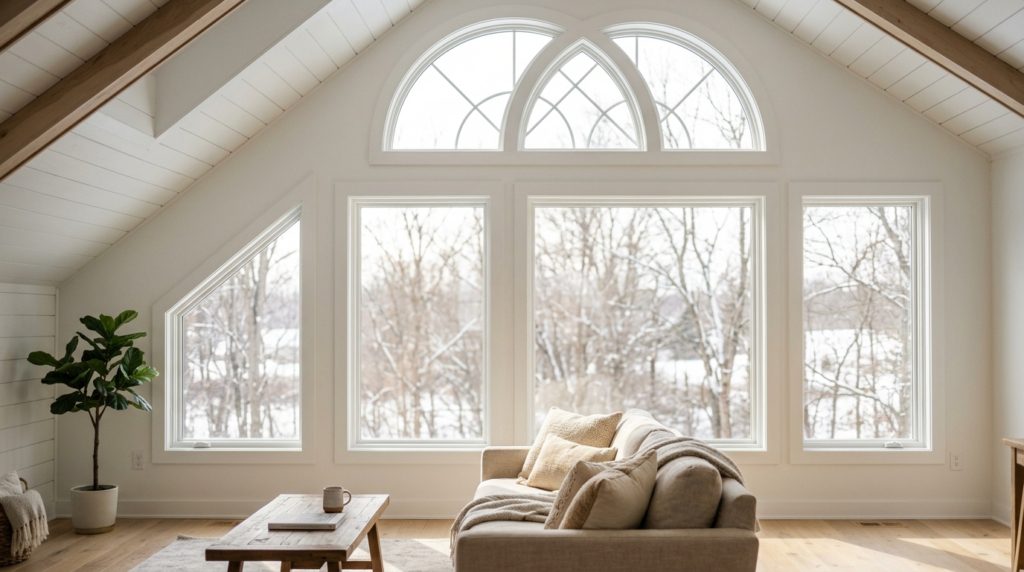
- Triangle and trapezoid units fill the slanted space under a vaulted ceiling, and triangle windows often crown a wall of picture glass.
- Octagon, hexagon, and pentagon shapes suit gables, bathrooms, and accent walls where a small geometric window adds interest.
Fixed or Operable: Which One You Need
The first real decision is not the shape but whether the window needs to open. Most specialty units are fixed, and that is often a feature rather than a limitation. A window with no moving parts has fewer gaps for air to leak through, so a sealed circle or triangle tends to be more energy efficient than a comparable operable window, which matters through a long Ohio heating season.
Fixed shapes also cost less, let in more uninterrupted light, and never wear out a crank or a balance. The catch is ventilation: if the window sits in a spot that needs fresh air, like a stuffy stairwell or a bathroom, a fixed unit cannot help.
Operable specialty windows do exist, usually as a shaped casement or awning that hinges open, but the options narrow as the shape gets more extreme. A true circle that opens is rare and expensive. A common compromise pairs a fixed shaped window on top with an operable rectangular window below it, so you keep the architectural accent and still get airflow where you stand.
Where Specialty Windows Work Best
Specialty shapes earn their cost in the spots a rectangle cannot reach. The classic placement is above a front door, where a half-round or eyebrow transom throws daylight into the entry without sacrificing privacy. The same trick lights a dim hallway or a windowless stair landing, pulling brightness down from high on the wall.
Vaulted and cathedral ceilings are the other natural home for these windows. The triangular space where a sloped ceiling meets the wall is dead area for a standard sash, but a triangle or trapezoid fits it exactly and turns a tall blank wall into a feature. Stacked above a row of picture windows, an arched or triangular top can create a dramatic floor-to-ceiling glass wall.
On vaulted-room jobs around Columbus, we see the same regret again and again: a beautiful gable triangle installed with no thought to how anyone will ever clean or cover it. Plan the access and the treatment before the glass goes in, not after.
Gable ends, accent walls, and oversized stairwells round out the list. The common thread is height and geometry. Wherever the wall is tall, sloped, or oddly cut, a specialty shape lights the space and finishes the architecture in a way no off-the-shelf window can.
What Drives the Cost of a Custom Shape
A specialty window costs more than a standard double-hung for one simple reason: it is built to order rather than pulled off a shelf. The frame has to be bent or mitered to the shape, the glass cut to match, and there is no economy of scale from a stock size. The more the outline departs from a rectangle, the more labor goes into it.
Several factors push the price up or down, and it helps to know them before you ask for a quote. Size is the obvious one, but the shape’s complexity often matters more. A clean half-round is straightforward; an unequal-leg arch or a custom curve traced from an existing opening takes more shop time. Glass choices stack on top, since a low-E coating, tempered safety glass, or a decorative pattern each add to the unit.
Installation access is the quiet cost driver people forget. A circle window two stories up a gable needs scaffolding or a lift, and that labor can rival the window itself. Rather than chase a single number, focus on these drivers, then get a measured quote for your exact opening, since the price only becomes real once a shape and a glass package are tied to your actual wall.
Materials and Glass for Shaped Windows
Specialty windows come in the same core frame materials as standard ones, though the selection narrows for the more extreme shapes. Vinyl is the most affordable and needs little upkeep, which makes it a common pick for circles and half-rounds. Fiberglass is stronger and holds a crisp shape over time, and many manufacturers reserve their cleanest geometric and triangular options for it. Wood offers the richest look for a historic or high-end home but asks for more maintenance.
Glass is where a shaped window quietly pays you back. Because most of these units never open, a quality insulated glass pane does the heavy lifting on comfort. A low-emissivity (low-E) coating reflects heat back where it belongs, keeping a sun-facing gable window from baking a vaulted room in July while holding warmth inside during a January cold snap.
For high or hard-to-reach shapes, this matters even more, since you will not be swapping that glass easily. Choosing tempered safety glass where code calls for it, and a good insulated unit everywhere else, means the window performs for decades. If a curved or angled unit ever fogs from a failed seal, that is a glass repair question rather than a reason to replace the whole shape.
Window Treatments for Odd Shapes
Covering a specialty window is the part homeowners underestimate, so it deserves a plan before the unit goes in. A standard blind does not fit an arch, a triangle, or a circle, which means you are choosing between purpose-made shaped treatments and simply leaving the window bare. Many people leave high accent windows uncovered on purpose, treating the glass itself as the feature and letting the light pour through.
When you do need privacy or shade, the options are real but specialized. Arched windows can take a fixed sunburst or fan shade, or a separate treatment on the rectangular window below while the arch stays open. Triangle and trapezoid windows accept custom angled shades, and a few cellular systems are cut to the exact slope. These are made to order, so factor the lead time and cost in alongside the window.
If the window also needs the occasional clean, think about reach now. A shaded gable triangle twelve feet up is a job for a pole tool or a pro, and knowing that ahead of time often shapes whether you treat it at all. For a broader look at how shapes fit into the full lineup, our overview of window types and styles puts the specialty options in context.
Mistakes to Avoid With Specialty Windows
Specialty shapes reward planning and punish guesswork, and the same few errors show up on job after job. Most are not about the window at all; they are about everything around it, the measuring, the access, and the covering. Run through this list before you commit to a shape, because each item is far cheaper to solve on paper than after the glass is set in the wall.
None of these are exotic problems. They are the ordinary details that get skipped when the focus is only on how the window will look.
- Measuring a custom shape yourself when an angle or radius is even slightly off, since a built-to-order unit cannot be trimmed to fit later.
- Ignoring how you will clean it on a high gable or stairwell, leaving glass you can never reach.
- Forgetting the window treatment until after install, then discovering no stock blind fits the shape.
- Choosing an operable shape that barely opens, paying for hardware that adds little real ventilation.
- Skipping low-E or tempered glass where sun exposure or safety code clearly calls for it.
Planning a Specialty Window for Your Home?
A custom shape is one of the few upgrades that changes how a whole room feels, but the details matter, from the exact angle of a gable triangle to the glass that keeps a sun-facing circle comfortable. Getting the measurements and the access right the first time is what separates a showpiece from a headache.
Book a free, no-pressure design and measurement consultation with our Columbus and Cincinnati team, and get a straight answer on which shape, material, and glass fit your space and your budget.
FAQ: Specialty Window Shapes

Ready to fix your windows? Get a free quote in 30 seconds.
Family-owned, licensed & insured. Free, no-obligation quotes.