Triangle windows fill the spots a rectangle cannot reach. They sit in the peak of a gable, follow the slope of a vaulted ceiling, or cap a stack of windows so the glass runs all the way to the ridge. Done well, they pull daylight into the highest, darkest part of a room and turn an awkward wall of drywall into a feature. Done poorly, they leak at the peak and fog up where nobody can see them.
This guide covers what triangle windows are, the shapes they come in, where they earn their keep, how to handle the privacy and ventilation questions, and the install details that matter in an Ohio climate. If you are weighing them for a new build or a remodel, a window installation conversation early saves headaches later, because the framing and flashing have to be right before the drywall goes up.
Quick answer: Triangle windows are angled, usually fixed panes built to fit gable peaks, sloped ceilings, and stairwells where a standard window will not go. They bring light into high spaces and add a sharp, modern look, but they rarely open, cost more to make and cover, and need careful flashing at the peak to stay watertight.
What Triangle Windows Are
A triangle window is exactly what it sounds like: a three-sided pane built to fill an angled opening instead of a square one. Most are fixed, meaning they do not open. The shape and the high placement that make them useful also make an operable version expensive and rarely worth it, so the glass is sealed in place to let in light and frame a view rather than to ventilate a room.
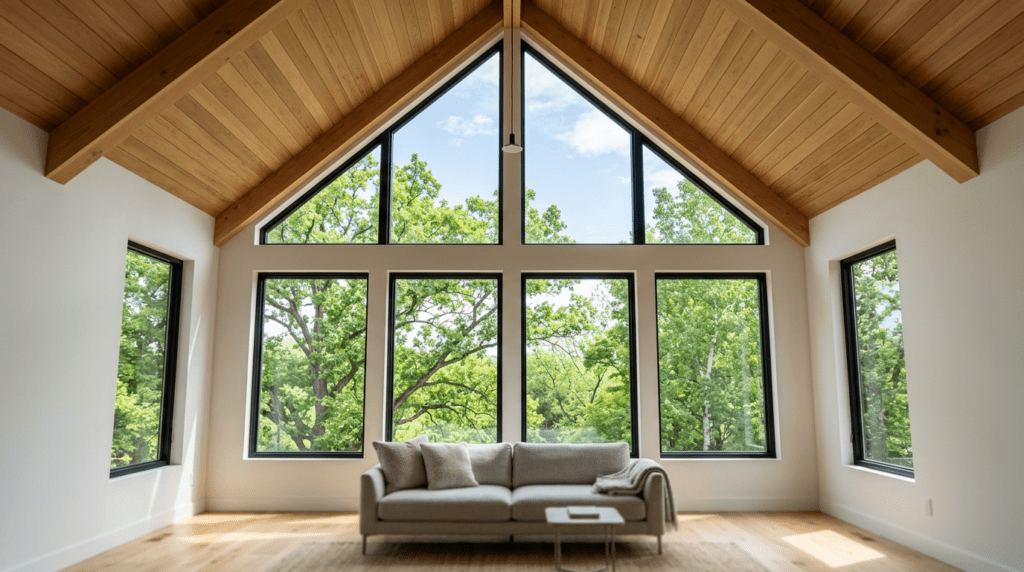
You will see them most often in the peak of a gable wall, under the slope of a cathedral or vaulted ceiling, and along stairwells that climb past a tall wall. Builders reach for them whenever a roofline cuts a wall at an angle and a rectangular window would leave a wedge of blank wall above it. Filling that wedge with glass is the whole point.
Because the shape is custom, a triangle window is built to the exact angle of your opening rather than pulled off a shelf. That is why planning matters more than with a standard unit, and why the type belongs in the same conversation as the other window styles you are choosing for the house.
Common Shapes and Configurations
Not every triangle is the same triangle, and the exact geometry follows your roofline. A right triangle, with one vertical side and one square corner, is the common choice where a sloped ceiling meets a flat wall. An isosceles triangle, symmetrical with its point centered at the top, suits a gable peak where the roof rises evenly to a ridge in the middle. Scalene shapes, with three unequal sides, handle the odd angles of a complex roof.
Triangles also rarely work alone. The most common layout pairs them with rectangular windows below, so a stack of operable windows handles the lower wall while the triangle caps the peak and carries the glass to the ridge. Two right triangles set point to point can mirror a full gable, and a triangle over a transom can top a door or a picture window.
- Right triangle: one square corner, ideal where a sloped ceiling meets a vertical wall.
- Isosceles triangle: symmetrical peak, the classic centered gable shape.
- Scalene triangle: three unequal sides for irregular or steep rooflines.
- Paired or stacked: a triangle above rectangular or picture windows to fill a wall top to bottom.
Where Triangle Windows Work Best
The strongest case for a triangle window is a tall space that goes dim toward the top. A great room with a vaulted ceiling, an A-frame, a loft, or a two-story foyer all have height that a standard window cannot use, and a triangle in the gable peak floods that upper volume with daylight. Light coming from up high spreads more evenly across a room than light from a low window, so the whole space feels brighter without glare in your eyes.
Stairwells are another natural fit. The wall beside a staircase rises and turns, often leaving a triangular slice of wall that a triangle window matches perfectly while lighting the stairs for safety. Attic conversions and bonus rooms tucked under a roof slope benefit too, since the kneewall and the rake of the roof leave angled openings that only a shaped window can fill.
One caution worth raising up front: a triangle window high in a gable is decorative and bright, but it is not a window you will open or reach easily. Treat it as a light source and a focal point, and plan ventilation and any required exit with other windows lower on the wall.
Design Ideas for Triangle Windows
The cleanest look comes from treating the triangle as part of a composition, not a one-off. Line up the vertical edge of the triangle with the rectangular windows below it so the whole assembly reads as one tall window wall rather than a window with a hat. Matching the frame color and the sightlines top to bottom does more for the look than any single dramatic shape.
Frame color sets the mood. A black or bronze frame turns the triangle into a graphic line against the ceiling and suits a modern or modern-farmhouse room. A white frame disappears into the wall and lets the view and the light do the work, which fits a traditional or transitional space. Grilles are optional and usually best left off a triangle, since clean glass keeps the shape sharp and the sightline open.
Think about what the window frames. A peak window aimed at tree canopy or open sky gives you a changing picture through the seasons, which is one of the quiet rewards of glass set up high. Where two roof slopes meet, a pair of triangles point to point can echo the ceiling line and make the architecture feel intentional rather than accidental.
Fixed vs. Operable: Ventilation and Egress
Almost every triangle window is fixed, and that is the single most important thing to understand before you fall for the look. Because they are usually mounted high and built to a custom angle, a hinge-and-crank mechanism is costly and the window is hard to reach anyway. A fixed pane also seals tighter and insulates better than any opening window, which matters when the glass sits in the hottest, highest part of the room.
The trade-off is real: a fixed window gives you no air and no exit. Building codes require a bedroom and most basements to have an operable window large enough to climb out of in an emergency, and a sealed triangle in a peak can never satisfy that rule. It is a light source, not an escape route, and it cannot be the only window in a sleeping room.
The fix is to pair it. Put the triangle up top for light and the view, and place operable windows below it for air and egress. A casement window cranks fully open for strong ventilation and pairs cleanly under a peak, while double-hung units suit a more traditional wall. If you want to dig into why sealed glass behaves the way it does, our guide to fixed windows covers the pros and cons in depth.
Energy Efficiency in Large Angled Panes
A custom shape does not have to mean a weak window. A well-built triangle uses the same glass package as any quality unit: two panes with a Low-E coating to reflect heat and an argon fill between them to slow heat transfer. The shape barely changes the math. What matters far more is the size of the pane and the quality of the seal around its edge, and triangles often run large.
That edge seal is where Ohio weather goes to work. The sealed unit in any double-pane window relies on a perimeter seal to hold the gas fill and keep moisture out. Through our freeze-thaw winters, water that works into a tired seal freezes overnight, expands, and widens the breach a little more each cold snap. When the seal finally fails, the gas leaks out and the glass fogs from the inside.
On a high gable triangle, that fog can sit unnoticed for a whole season because nobody is looking up there day to day. A foggy pane is not dirt and it will not wipe away; it means the seal is gone and the unit has lost its insulating value. The repair keeps your frame and swaps the sealed glass, which is why a fogged unit routes to insulated glass replacement rather than a whole new window.
How to Cover a Triangle Window
Most triangle windows are best left bare. They usually sit high enough that privacy is not a concern, and their whole job is to bring in light, so covering them works against the reason you installed them. When glare or afternoon heat genuinely becomes a problem, you have a few real options, and a sloped side rules out anything off the shelf.
The honest truth is that standard blinds do not fit an angled window, so any covering has to be custom-cut to the slope. For a window you cannot reach, a motorized shade is the practical answer, since it raises and lowers at the touch of a button instead of a ladder. A light-filtering fabric cuts UV and softens the sun without blacking out the room, which preserves the daylight you paid for.
- Leave it bare: the simplest and most common choice for a high, private peak window.
- Custom-angled shades: cut to the exact slope, since stock blinds will not fit a triangle.
- Motorized operation: the practical pick for any window too high to reach by hand.
- Low-E glass or exterior film: handle heat and UV at the glass instead of fighting it with fabric.
Install, Sealing, and Upkeep
The peak is the weak point on a triangle window, and it is where a sloppy install shows up first. The acute angle at the top concentrates stress and gives water a path to track along the roofline, so the flashing where the angled top edge meets the wall and roof has to be lapped correctly and tied into the home’s water barrier. Get that detail right and the window sheds water for decades; get it wrong and it weeps at the peak after the first hard season.
On gable windows around Columbus, the leaks we trace almost never come from the glass. They come from the flashing at the peak, where the angled top was never properly tied into the roof, and freeze-thaw finishes the job the bad detail started.
Maintenance is the other thing people underestimate. A high triangle is hard to clean and hard to inspect, so plan to check the exterior seal and the flashing line when you do other roof or gutter work. Keep an eye out for fog between the panes or staining at the peak, since both are early signs worth catching before they grow into a wall repair.
Thinking About Adding Triangle Windows?
Triangle windows reward careful planning. Getting the shape, the glass package, and the flashing right the first time is far cheaper than chasing a leak or a fogged pane out of a gable peak later. The decisions are easiest to make before the framing is closed in.
If you are planning a new build, a remodel, or replacing a tired peak window, book a free, no-pressure window assessment with our Columbus-area team and get a straight answer on the shape, the glass, and the install details that matter for your roofline.
FAQ: Triangle Windows

Ready to fix your windows? Get a free quote in 30 seconds.
Family-owned, licensed & insured. Free, no-obligation quotes.