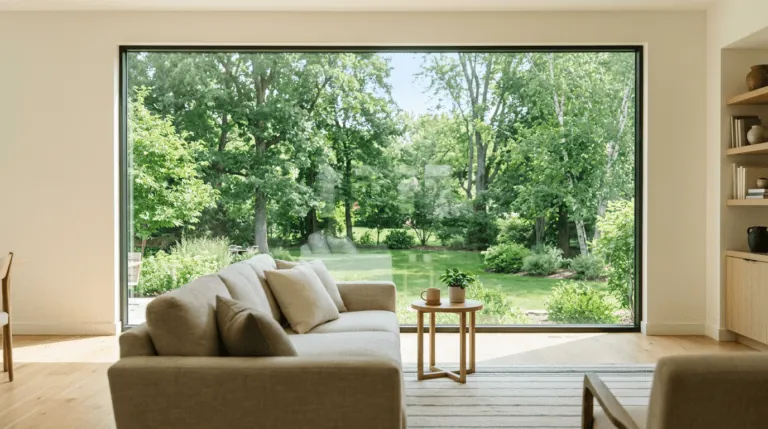
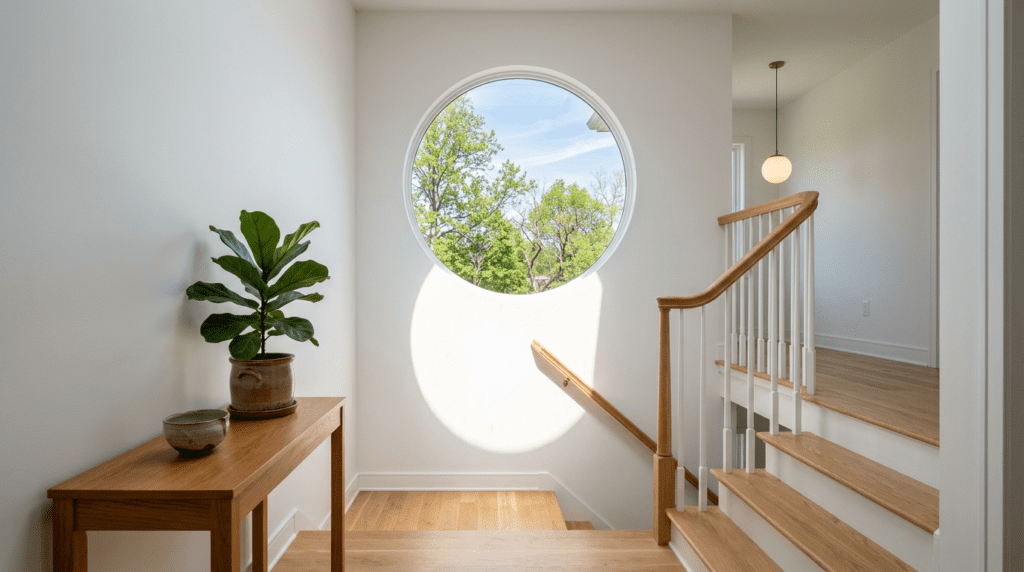
Round and circle windows are the accent that makes people stop and look at a house. They pull daylight into a stair landing, cap a gable, or sit over a front door where a plain rectangle would feel ordinary. Almost all of them are fixed glass, chosen for shape and light rather than airflow, and that one fact shapes every choice that follows, from where you put one to how you keep it from fogging.
This guide covers the main round and circle styles, where each earns its place in a home, the materials and glass that hold up to Ohio weather, and what installing a true circle actually involves. Because these are almost always custom, made-to-order units, the smart move is to plan the opening before you order, which is part of any new window installation that involves a curved shape.
Quick answer: Round and circle windows are fixed, decorative glass units shaped as a full circle, half-round, quarter-round, oval, or elliptical. They add light and curb appeal in gables, stairwells, bathrooms, and over doors. Most do not open, so pair one with an operable window when a room needs ventilation.
What Round and Circle Windows Are
The terms round window and circle window get used for the same thing: a window built around a curve rather than straight sides. A true circle is a full ring of glass, but the family also includes the half-round, the quarter-round, the oval, and the long, flat ellipse. What they share is a shape chosen for how it looks and how it throws light, not for how much air it moves.
You will hear a few old names for the full circle. Builders call it an oculus, from the Latin for eye, while sailors and anyone after a nautical look call it a porthole. Churches made the shape famous with rose windows centuries ago, and that decorative history is exactly why a single circle still reads as a deliberate design choice on a modern house.
It helps to separate round from arched, since people mix them up. An arched window is a rectangle with a curved top, so it keeps two vertical sides and a flat sill. A round or circle window has no straight run at all, which is what makes it harder to frame and to dress, and also what gives it that clean, eye-catching outline.
The Main Round and Circle Window Styles
Most of what gets sold as a round window is one of a handful of shapes, and knowing the names makes ordering far easier. They range from the full ring you picture first to partial curves that sit on top of a standard window to soften its lines. Each one suits a different spot and a different roof or wall shape.
The list below covers the styles you are most likely to be offered. A good supplier can build almost any of them as a custom unit, though the more unusual the curve, the longer the lead time and the more the framing has to be tailored to it.
- Full circle. A complete ring of glass, also called an oculus or porthole, used as a standalone accent in a gable or wall.
- Half-round. A half circle, flat side down, most often set over a door or a rectangular window to crown it.
- Quarter-round. A quarter of a circle, usually installed in pairs or tucked into a sloped corner under a roof line.
- Oval. A rounded shape stretched taller than it is wide, a traditional look for entries, baths, and cottage styles.
- Elliptical and half-elliptical. A wider, flatter curve than a half-round, often spanning above a double or triple window.
- Eyebrow. A low, gently arched sliver with no straight sides, a soft detail on dormers and upper walls.
- Octagon and hexagon. Angular cousins that read as round from the street while being simpler to frame.
Fixed or Operable, and the Ventilation Question
Nearly every round and circle window is fixed glass that does not open. The shape is the point, and a sealed unit keeps the design clean while cutting out the air leaks that moving parts can bring. For a high gable accent or a window over a door, fixed is usually the right call anyway.
A few manufacturers do offer operable versions that pivot on a horizontal axis, swinging open from a center point with a handle at the top or bottom. They cost more, the hardware is specialized, and the opening you get is modest. They make sense only when you genuinely need that spot to breathe and no other window can do the job.
The thing to plan around is that a fixed circle moves no air and can never serve as an egress exit. Put one high in a stairwell or a vaulted room and it will trap warm summer air against the ceiling with no way to vent it. That limit is not really a flaw, it is a reason to think hard about what the window beneath or beside it is doing.
Where Round Windows Work Best in a Home
A round window earns its keep in the spots where a rectangle feels wrong or simply will not fit. Gable ends and the wall above a front door are the classic homes for a full circle or a half-round, where the shape caps the elevation and pulls daylight into a two-story space. Stair landings are another favorite, since a circle lights the climb without eating the wall a larger window would need.
Smaller circles solve real problems in tight rooms. A bathroom, a closet, a pantry, or an entry hall often needs light and a sliver of view but has no room for a standard sash, and a high circle delivers both while keeping privacy intact. Designers also stack a half-round or elliptical over a group of windows to tie the whole composition together.
- Gables and over the front door, as a curb-appeal accent on the upper elevation.
- Stair landings and two-story foyers, for daylight high on the wall.
- Bathrooms, closets, and pantries, where light matters more than a view.
- Above a picture or double-hung group, as a half-round or elliptical crown.
- Attic and bonus rooms, to brighten a space that rarely gets a full window.
Frame Materials, Glass, and Grilles
Round windows come in the same frame materials as the rest of your house, and the choice matters more on a curve than on a straight window. Vinyl and fiberglass hold a molded circular shape well and shrug off moisture, which is why they dominate new accent installs. Wood and clad-wood suit historic and high-end homes where the trim profile is part of the look, while aluminum shows up mostly on commercial fronts.
Glass is where a circle gets its personality. Clear glass keeps a view, obscure or frosted glass buys privacy for a bath or entry, and leaded or stained patterns turn the window into a focal point. On any sunny wall, a Low-E coating earns its place by cutting heat and fading without darkening the room.
- Frame materials: vinyl, fiberglass, wood, clad-wood, and aluminum, each with its own upkeep and price band.
- Privacy glass: obscure, frosted, or reeded patterns for baths, closets, and entries.
- Decorative glass: leaded, beveled, or stained designs for a true centerpiece.
- Grilles: sunburst or cross-hatch bars that break the light and echo a home’s era.
- Low-E and argon: the energy package that keeps a sunny circle from cooking the room.
Energy Efficiency and the Curved Seal
A round window is about as energy efficient as any other fixed pane of the same size, and because circles tend to be small, the heat they lose is modest. The catch is not the amount of glass but the shape of the seal around it. The insulated glass unit in a circle has a spacer bent into one continuous ring, and that curved spacer carries a longer perimeter and more built-in stress than a straight one.
Ohio’s freeze-thaw swings work on that seal harder than almost anything. Every cycle expands and contracts the glass and the spacer, and a curved seal flexes at every point along its length. That is why a fixed circle or half-round is often the first unit on a house to fog up between the panes, sometimes years before the rectangular windows around it.
When a round unit clouds over, the glass itself is usually fine, it is the seal that has failed, and the fix is a fresh sealed unit rather than a whole new window. Matching the curve is the tricky part, so a foggy circle is a job for a shop that handles insulated glass replacement on custom shapes, not a stock-size swap.
What It Takes to Install a Round Window
Installing a true circle is a different job from dropping in a rectangle, and most of the work is in the opening, not the glass. A framer has to build a round rough opening out of straight lumber and sheathing, then pack and curve the edges so the unit seats evenly all the way around. Get that wrong and the window sits proud on one side, which strains the frame and opens a gap for water.
Flashing is the part DIYers underestimate. A rectangle has a flat head and sill that shed water in predictable directions, but a circle has neither, so the curved head needs a tailored flashing detail to keep wind-driven rain from tracking behind the trim. In a climate that throws sideways rain and then freezes it, a sloppy flashing job shows up as a stain on the wall within a season or two.
Because these are custom units, you cannot trim a circle on site the way you might shave a stock sash. The window is ordered to an exact diameter, so the opening has to be measured carefully, ideally checked at several points since older openings are rarely perfectly round. A measuring mistake means re-ordering, which is the main reason a round window is worth handing to a crew that has framed one before.
Pairing a Half-Round Over a Working Window
The cleanest way to get the look of a circle and still have a room that breathes is to pair a fixed curve with a working window below it. A half-round or elliptical set over an operable window gives you the architectural crown up top and real airflow at hand height, which is the combination you see on most well-designed elevations.
The window underneath does the practical work. A casement window cranks fully open and throws the most air for its size, which suits a tall stairwell or a kitchen wall where you want a strong draft. A double-hung window opens top and bottom and fits a traditional facade, and either one can satisfy the egress rule that a fixed circle never can.
This pairing also answers the summer heat problem from earlier. The fixed circle lights the upper wall, while the operable unit below vents the hot air that would otherwise stack against the ceiling. You get the daylight and the curb appeal without sealing the room shut.
Window Treatments and Privacy
Covering a round window is the part people forget until the unit is in. A circle takes no standard blind or shade, since every off-the-shelf treatment is built for a rectangle. That leaves a short list of real options, and for most accent circles the best one is to leave the glass bare and let the shape speak for itself.
When you do need privacy, handle it at the glass rather than over it. Obscure or frosted glass ordered with the unit gives a bath or entry permanent privacy with no hardware to fail. A removable film does the same on a budget, and a custom-cut interior shutter exists for the rare case that wants a covering, though it is a specialty order. On a bright south or west wall, a Low-E coating does more useful work than any fabric, since it blocks heat and glare while keeping the view clear.
Round Windows in Older Columbus Homes
Older Columbus neighborhoods are full of round and oval windows, and they ask for a different approach than a new build. Italianate and Queen Anne houses, and a lot of the brick in German Village, used a gable oculus or an oval in the stair hall as a signature detail, often with leaded or wavy original glass that is part of the home’s character and worth saving.
The trap is assuming an old circle is a true circle. A century of settling racks these openings out of round, so a replacement ordered to a perfect diameter will not seat, and the curve has to be templated from the actual opening instead.
On the older homes around Columbus, the round sash is almost never a clean circle anymore. We template the real opening before anyone orders glass, because the house has moved, and a perfect factory circle will fight an opening that settled out of round decades ago.
When the frame is sound but the decorative glass is cracked or a leaded panel has gone loose, the right move is often to restore the glass rather than scrap the whole unit. That kind of glass repair keeps the original look while making the window weathertight again.
Pros and Cons at a Glance
Round and circle windows are a trade between standout looks and practical limits, and seeing both sides plainly makes the decision easier. They are a styling tool first, so they shine where you want light and character and matter less where you need a working, opening window. For most homes one or two well-placed circles do more for the elevation than a row of them ever would.
Weigh the lists below against the spot you have in mind. If the location wants ventilation or an exit, the cons point you toward pairing the circle with an operable unit rather than dropping it in alone.
- Curb appeal and character that a rectangle cannot match, especially on a gable or over a door.
- Daylight in tight spots, lighting baths, closets, and landings that have no room for a full window.
- Low upkeep and good security, since a fixed unit has no moving parts and is hard to force open.
- No ventilation, because almost all of them are fixed glass.
- Higher cost, as a specialty shape that is custom-made and harder to frame.
- Treatment and seal headaches, from blinds that do not fit to a curved sealed unit that fogs sooner.
Thinking About a Round Window?
A round or half-round window can be the detail that lifts a whole elevation, but it lives or dies on the framing, the flashing, and a unit ordered to the right curve. There is no upside to guessing at a custom shape and watching it leak or fog a year later.
If you are weighing a circle window for a gable, a stairwell, or a remodel, book a free, no-pressure window assessment with our Columbus-area team and get a straight read on the opening, the glass, and the right pairing before anything is ordered.
FAQ: Round and Circle Windows

Ready to fix your windows? Get a free quote in 30 seconds.
Family-owned, licensed & insured. Free, no-obligation quotes.