Every window is really two products bolted together: the glass that lets light in and the frame that holds it, seals it, and decides how long the whole thing lasts. Most buyers focus on the glass and pick the frame almost by accident, then live with the consequences for thirty years. The frame material drives the price, the upkeep, the energy bill, and how the window looks from the curb.
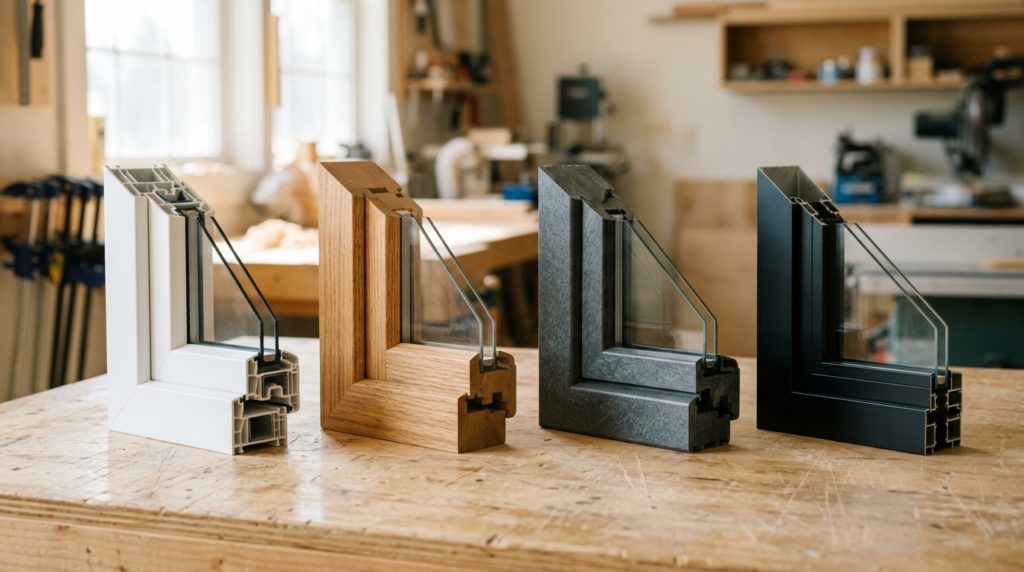
Four materials cover almost every replacement window sold today: vinyl, wood, fiberglass, and aluminum, with composite frames filling the gap between them. This guide compares all four on the things that actually matter, then adds the part most national articles skip: how each one holds up through an Ohio winter. Even the best frame is only half the equation, since the sealed glass unit inside it is what fails first when a window fogs.
Quick answer: Vinyl is the low-cost, low-maintenance default; wood offers the best looks but needs regular upkeep; fiberglass costs more but lasts longest and resists Ohio’s freeze-thaw swings; and aluminum gives slim, strong frames but conducts cold and sweats in winter unless it has a thermal break. Match the material to your budget, climate, and how much upkeep you will do.
The Four Frame Materials at a Glance
Before digging into each one, it helps to see how the four stack up, because they trade the same handful of qualities against each other. No single frame wins on everything. The one that costs the least asks for the least work; the one that looks the richest demands the most care; the one that lasts the longest costs more up front.
Here is the short version of how each material leans before we look closer:
- Vinyl: lowest cost, almost no maintenance, strong energy numbers, fewer color options.
- Wood: the warmest looks and great insulation, but regular sealing and a higher price.
- Fiberglass: the longest life and best stability, at a higher up-front cost.
- Aluminum: the slimmest, strongest frames, but the worst insulator unless thermally broken.
- Composite: a blend that aims for wood looks with vinyl-like upkeep.
Keep your own priorities in mind as you read. A rental property and a forever home pull toward opposite ends of this list, and the right answer for a sunny west wall is not the right answer for a shaded north one.
Vinyl Windows: The Budget-Friendly Default
Vinyl is what most replacement windows are made of, and for good reason: it is the least expensive frame that still performs well. Made from rigid PVC with hollow chambers inside, it traps air to slow heat loss, so its energy numbers rival frames that cost far more. For a homeowner who wants efficient windows without a premium price, vinyl is the sensible default.
Upkeep is its other strong suit. The color runs through the material, so it never needs painting, and a wipe with soap and water is the whole maintenance routine. It will not rot, peel, or attract insects, which matters on a humid Ohio summer day when wood is busy soaking up moisture.
The trade-offs are real, though. Vinyl is less rigid than the others, so very large windows can need bulkier frames that eat into the glass area. Dark colors absorb heat and can warp or fade in direct sun, and you cannot repaint it to change the look later. For the full breakdown, our guide to vinyl windows in depth weighs where it shines and where it falls short.
Wood Windows: Classic Looks, Real Upkeep
Wood is the original window frame and still the benchmark for looks. Nothing else matches the warmth of real timber, the crisp detail of milled profiles, or the way it can be stained or painted any color you like. On a historic Columbus home, a wood frame is often the only material that keeps the architecture honest, which is why many older neighborhoods favor it.
It also insulates well on its own, since wood is a natural barrier to heat and cold and adds a measure of sound dampening that the others lack. That makes it a quiet, comfortable choice for a bedroom facing a busy street. The catch is maintenance, and it is not optional.
Exposed wood needs sealing, painting, or staining every few years, or moisture works in and the frame rots. Ohio’s wet springs and freeze-thaw winters are hard on neglected wood, and a south- or west-facing window weathers fastest. Clad wood, wrapped in aluminum or vinyl on the outside, cuts that exterior upkeep sharply while keeping the wood interior. Our notes on caring for wood windows cover how to keep them sound.
Fiberglass Windows: The Long-Haul Performer
Fiberglass is the quiet overachiever of the group. Made from glass fibers set in resin, it is close kin to the glass it surrounds, which is the key to its biggest advantage: it expands and contracts at nearly the same rate as the pane. That keeps the seal tight for decades and is exactly why fiberglass windows tend to outlast every other material, often pushing past forty years.
It is also strong and stable. Fiberglass does not warp in heat the way vinyl can, does not rot like wood, and does not conduct cold like aluminum. The frames can be slim because the material is rigid, and unlike vinyl, most fiberglass can be painted, so you are not locked into one color forever.
The downsides are cost and availability. Fiberglass sits above vinyl on price and is sold by fewer manufacturers, so the choice of styles is narrower. Repairs are harder too, since you cannot easily patch it. For a homeowner planning to stay put, though, the longer life often offsets the higher price. Our look at whether fiberglass is worth it runs the numbers behind that decision.
Aluminum Windows: Slim, Strong, and Cold
Aluminum frames are built for strength and slim sightlines. Because the metal is rigid, the frames can be thinner than any other material while still holding large panes, which is why aluminum is the go-to for big modern windows, storefronts, and contemporary designs that want as much glass and as little frame as possible. It will not rot, rust, or warp, and it shrugs off weather for decades.
Its weakness is heat. Aluminum conducts temperature far faster than wood, vinyl, or fiberglass, so a bare aluminum frame leaks energy and turns into a cold bridge in winter. Quality aluminum windows add a thermal break, an insulating barrier inside the frame, to cut that loss, and in a climate like Ohio’s that thermal break is not optional.
On older Columbus homes with the original 1970s aluminum windows, we see the same thing every winter: frost and condensation running down the inside of the frame while the glass stays clear. The metal is pulling the cold straight through. A thermally broken frame, or a switch to vinyl or fiberglass, usually ends it.
Without a thermal break, aluminum sweats with condensation on cold mornings, and that moisture can stain sills and feed mildew. For a heated home in a cold climate, aluminum makes sense mainly when its slim look is the priority and the budget covers a properly broken frame.
Composite Frames: The In-Between Option
Composite frames are the newest entry and the hardest to pin down, because the term covers several recipes. Most blend wood fibers or sawdust with PVC or fiberglass resin, producing a material that aims to look like painted wood while behaving more like vinyl. The goal is the best of both: the solid feel and appearance of wood without the sealing and rot.
In practice, composite frames are strong, dimensionally stable, and low-maintenance, with energy numbers in the same range as wood and fiberglass. They resist moisture and temperature swings well, which suits Ohio’s climate, and they often come in deeper, richer colors than vinyl can hold. Some lines are sold under specific brand names, so availability varies by region.
The trade-off is cost and clarity. Composite usually prices near fiberglass, well above vinyl, and because every manufacturer mixes its own blend, quality is less predictable than the established materials. It is worth considering when you want a wood look without the upkeep and fiberglass is not offered in the style you want.
How the Materials Compare on Energy Efficiency
Energy efficiency is where the materials separate most clearly, and it comes down to how fast each one moves heat. The measure to watch is the U-factor: the lower the number, the better the frame resists heat flow. Vinyl, fiberglass, and wood all land in the efficient range, while aluminum trails unless it is thermally broken.
Fiberglass and quality vinyl lead the pack, with multi-chamber designs trapping insulating air inside the frame. Wood holds its own as a natural insulator. Aluminum is the outlier, conducting heat hundreds of times faster than the others, which is why a bare aluminum frame can feel cold to the touch in January even when the furnace is running.
In Ohio the frame’s performance matters more than in mild climates, because the freeze-thaw cycle stresses seals and the temperature gap between inside and out stays large for months. A frame that conducts cold also invites condensation, and repeated wetting shortens the life of the whole window. Pairing an efficient frame with a sound sealed glass unit is what keeps heating bills and fogging both in check.
Matching the Material to an Ohio Home
National comparisons treat every house the same, but the right frame depends heavily on where you live, and Ohio asks specific things of a window. Cold winters, humid summers, storm season, and wide freeze-thaw swings all punish materials differently, so the climate should weigh as much as the price tag.
Freeze-thaw is the big one. Water that works into a seam freezes, expands, and pries the gap wider, then thaws and lets more water in. Materials that stay dimensionally stable through that cycle, fiberglass and composite especially, hold their seals longest, while neglected wood and bare aluminum suffer most. Humid summers add rot pressure on wood and condensation risk on aluminum.
The housing stock matters too. Columbus and the older Cincinnati neighborhoods have a lot of historic homes where wood frames suit the architecture and may even be required in some districts, while newer suburban builds in Dublin, Westerville, or Powell lean toward low-maintenance vinyl and fiberglass. Before the frame, it is worth settling on the window style itself, since some materials suit some shapes better than others.
How to Choose the Right Frame Material
With the materials sorted, the decision usually comes down to four honest questions rather than a search for one perfect frame. There is no universal winner; there is only the best fit for your house, your budget, and how long you plan to stay. Walk through these before you call for quotes.
Weigh each one against your own situation:
- How long will you stay? A forever home rewards fiberglass or wood; a short-term hold leans to budget-friendly vinyl.
- How much upkeep will you do? Be honest, because wood punishes neglect while vinyl and fiberglass ask for almost nothing.
- What does the house call for? A historic facade wants wood or clad wood; a modern design suits slim aluminum or dark composite.
- What is the exposure? A sun-baked west wall is hard on dark vinyl, while a cold north wall punishes bare aluminum.
If two materials still tie, let the longer view break it. The frame that lasts longer and needs less work usually costs less over the decades you own it, even when it costs more on installation day. A professional new window installation is also where many frame problems start or end, so the install quality counts as much as the material.
Mistakes to Avoid When Picking a Frame
Most frame regrets trace back to a few predictable errors, and nearly all of them come from shopping on price alone or ignoring the climate. A little planning here saves a costly redo a few winters from now. Run through this list before you commit.
None of these are about spending more; they are about matching the frame to the job:
- Buying bare aluminum in a cold climate, then fighting condensation and cold frames every winter.
- Choosing dark vinyl on a sun-baked wall, where heat can warp or fade the frame over time.
- Picking wood without a maintenance plan, which leads to rot once the sealing slips a few years.
- Comparing only the sticker price, instead of the cost over the window’s full lifespan.
- Ignoring the glass package, since the best frame still fogs if the sealed unit fails.
Not Sure Which Frame Fits Your Home?
Choosing between vinyl, wood, fiberglass, and aluminum is easier with someone who installs all of them across Ohio’s climate and can tell you what actually holds up on a house like yours. The right frame depends on your exposure, your plans, and the window styles you are after, and a quick look settles it faster than any chart.
Book a free, no-pressure window assessment with our Columbus and Cincinnati team, and get a straight recommendation on the frame material that fits your home and budget.
FAQ: Window Frame Materials

Ready to fix your windows? Get a free quote in 30 seconds.
Family-owned, licensed & insured. Free, no-obligation quotes.