A bathroom window has a harder brief than any other in the house. It has to let in real daylight, screen you from the neighbor twelve feet away, vent the steam off a hot shower, and shrug off that moisture for decades without rotting or fogging. Most remodels treat it as an afterthought, then fight the result for years.
This guide covers the window types that work best in a bathroom, how to get privacy without blacking out the light, where to place the window, the safety glass the code requires near a tub, and the frames and glass that survive a steamy room through an Ohio winter. If your remodel is moving or enlarging the opening, that belongs with a proper new window installation so the unit sits square and sealed.
Quick answer: The best bathroom window pairs an operable style, usually a casement or awning, with obscure or frosted glass for privacy and a Low-E coating for light without heat loss. Place it above eye level or to the side of fixtures, use tempered glass near the tub, and pick a frame that ignores steam.
The Best Window Types for a Bathroom
The right bathroom window starts with how it opens, because the room is small, often crowded with a vanity or a tub, and always damp. You want a style that ventilates well, seals tight against that moisture, and fits a wall that may have only a narrow strip of space between fixtures.
Two styles lead for a reason. A casement swings out on a hinge and opens with a crank, so it clears steam fast and seals firmly when shut, which matters in a room that breathes water all winter. An awning hinges at the top and tips outward, so it sheds light rain and can stay cracked open during a shower without letting weather in. A high-mounted casement window or awning over a tub is the workhorse of most bathroom remodels.
The rest of the field fills specific gaps. A hopper, hinged at the bottom, suits a small basement bath. A double-hung or slider fits a traditional home and a tight reach, though both open only halfway for airflow. A fixed picture window or a panel of glass block brings in light where you need none of it to open. Pick the type to match the wall and the way the room has to breathe, not just the look.
Privacy Without Blacking Out the Light
Privacy is the whole reason a bathroom window feels different from any other, and the trick is getting it without turning the room into a cave. The aim is glass or a covering that scrambles the view from outside while still passing a soft, usable glow. You have two routes: build the privacy into the glass, or add it on top.
Built-in privacy lasts longest, because there is nothing to wear out or take down to clean. Add-on coverings cost less up front and let you change your mind later. Most bathrooms end up using a mix, with permanent glass for the daytime and a shade for after dark, when interior light turns a frosted window into a lit silhouette.
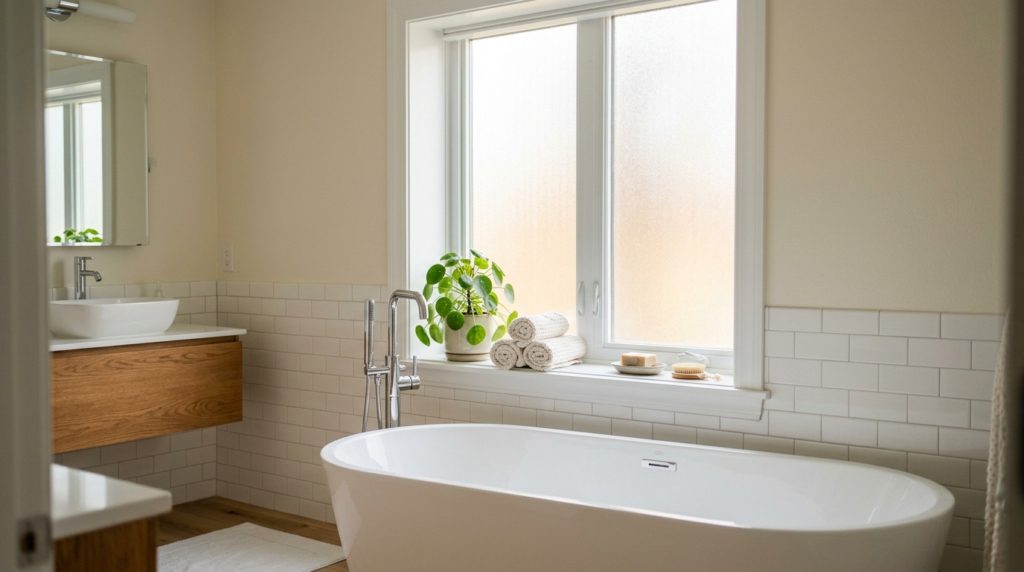
- Frosted glass is acid-etched or sandblasted to a matte finish that blurs shapes while keeping the room bright, the most popular bathroom choice.
- Obscure or textured glass carries a molded pattern, such as rain, reed, or glue chip, that distorts the view without dimming the light.
- Tinted or reflective glass cuts daytime visibility and glare, though it does little once the inside is brighter than the outside at night.
- Smart or switchable glass flips from clear to opaque with a switch, a premium option for a window with a view worth keeping.
- Glass block passes light through thick textured units no one can see through, a durable pick for a shower wall.
- Film, shutters, and between-the-glass blinds add adjustable cover to a clear window, with sealed in-glass blinds staying clean in the damp.
Where to Place a Bathroom Window for Privacy
Where the window sits decides how much privacy you get before you ever choose the glass. A window placed high on the wall, above standing eye level, lets in daylight and sky while keeping sightlines out of reach from the street or a neighbor’s yard. That is why so many bathrooms run a long, short window or a transom up near the ceiling.
Position matters around the fixtures too. A window set to the side of the toilet or vanity, rather than directly behind or in front of it, is far easier to keep private and to reach for venting. Over a tub, a high awning or an awning window mounted above the surround gives you light and a crack of fresh air without putting clear glass at eye level in the bath.
Think about the outside view in both directions before you commit. Stand where the window will go and look out at night with the lights on, then walk outside and look back. Older Columbus lots sit close together, and a window that feels private at noon can read like a lit stage after dark. Placement plus the right glass, not one or the other, is what actually keeps a bathroom private.
The Tempered Glass the Code Requires
One bathroom rule trips up more remodels than any other, and it has nothing to do with privacy. Building codes require safety glazing, meaning tempered glass, in and around wet areas where someone could fall against it. A window in or beside a tub or shower, or one set low to the floor, almost always has to be tempered.
Tempered glass is heat-treated so it is several times stronger than ordinary glass, and when it does break it crumbles into blunt pebbles instead of long shards. In a slick, hard-surfaced room where people move wet and barefoot, that difference is the whole point. An inspector will look for the small etched stamp in the corner of the pane that marks it as tempered.
The catch for a DIY remodel is that tempered glass cannot be cut or drilled after it leaves the factory, so the unit has to be ordered to the exact opening from the start. Get the size or the tempering wrong and the window fails inspection and has to be remade. This is one detail where measuring twice, or having the opening measured for you, saves a costly do-over.
Ventilation Is the Bathroom's Other Job
A bathroom window earns its keep clearing moisture as much as bringing in light. Every hot shower dumps a cloud of steam into a small room, and an exhaust fan only catches part of it. An operable window gives that humidity a fast way out before it settles into the walls, the grout, and the corners where mold starts.
This is the case for choosing a style that actually opens wide. A casement or awning scoops air from top to bottom and moves far more of it than a double-hung cracked a few inches. Run it alongside the exhaust fan during and after a shower, and the room clears in minutes instead of staying foggy for an hour.
The Ohio climate raises the stakes. Through a humid summer the outside air is already damp, and through a cold winter the warm, wet bathroom air condenses the moment it touches cold glass. A bathroom that cannot breathe stays wet, and standing moisture on a sill or in a corner is what feeds the mildew and the musty smell. A window that opens, used every day, is the cheapest mold control in the house.
Why Bathroom Windows Take the Hardest Beating
No window in the house lives in a tougher spot than the one in the bathroom. Day after day it takes steam, splashes, and the constant swing from warm and wet to cold and dry. That cycle is exactly what wears seals, sills, and hardware out faster than anywhere else in the home.
On bathroom jobs around Columbus, the window is almost always the part in the worst shape. The sill is soft from years of condensation running down the glass, and the sealed unit has fogged long before any other window in the house gave out.
Two failures follow from that constant moisture. The water rots the sill and the framing right under the window, usually hidden behind the trim until the wood turns soft, which makes a rotted sill repair one of the more common bathroom calls. The steam also drives sealed glass units to fail, hazing the pane with a fog that no wiping clears, because the moisture is trapped inside. That does not mean a whole new window; an insulated glass replacement swaps the failed unit and leaves the frame in place. Going in knowing this steers you toward a tougher window and a sill you keep dry.
Frames and Glass for a Wet, Cold-Winter Room
The frame has to live in steam and cold without swelling, warping, or rotting, which rules out some materials that work fine in a dry bedroom. For a bathroom the question is less about looks and more about how the material handles water and a wide temperature swing year after year.
Here is how the common frame materials hold up in a working bathroom in this climate:
- Vinyl shrugs off moisture completely and never needs paint, the low-maintenance default for most bathrooms.
- Fiberglass barely moves with temperature, so its seals survive freeze-thaw longer, a strong pick for an exposed wall or an in-shower window.
- Wood looks right in a period Columbus home and insulates well, but bathroom steam is exactly what rots it, so it needs sealing and watching.
- Clad wood gives a wood interior with a weatherproof skin outside, the warm look without the outdoor upkeep.
- Aluminum is slim and strong but conducts cold, so it sweats and frosts at the edges on a January morning, the weakest choice here.
The glass package matters as much as the frame. A double or triple pane with a Low-E coating and argon fill keeps the room comfortable and the inner surface warmer, which means less condensation on the inside of the glass during a cold, steamy shower. For a damp room in a freeze-thaw climate, that warmer inner pane is what keeps water from beading up and feeding mold along the frame.
Putting a Window Inside the Shower
A window right in the shower wall is a striking look and a real source of light, but it asks more of the materials than any other spot in the house. The unit sits in the direct path of hot water every day, so everything about it has to be waterproof and sealed for the long haul.
Start with the frame and glass. Vinyl and fiberglass are the safe picks, because they do not rot or corrode, while a bare wood frame in a shower is a leak waiting to happen. The glass has to be tempered for safety, and obscure or frosted is the usual call so the window does not become a fishbowl. The sill should slope slightly so water runs back into the shower rather than pooling on the ledge.
The part that separates a lasting job from a callback is the flashing and waterproofing behind the tile. Water that gets past the surround has to be stopped and drained, or it works into the wall and rots the framing from the inside. In a freeze-thaw climate any moisture trapped in that wall can freeze and push the assembly apart, so a shower window is one job where the hidden waterproofing is worth more than the trim you can see.
Planning a Bathroom Window for Your Remodel?
The right bathroom window comes down to how the room is laid out, how much privacy you need, and how the unit will handle a wet, cold-and-hot Ohio year. If you are weighing a frosted casement over the tub against a high awning, or wondering whether your old sill and seals have any life left, a set of eyes on the actual opening settles it quickly.
Book a free, no-pressure bathroom window assessment with our Columbus-area team and get a straight recommendation on the type, glass, and frame that fit your remodel.
FAQ: Bathroom Windows

Ready to fix your windows? Get a free quote in 30 seconds.
Family-owned, licensed & insured. Free, no-obligation quotes.