Your front door is the one part of the house that takes weather on both faces and gets used every single day. It has to seal out an Ohio winter, shrug off a humid summer, lock securely, and still look like the welcome of the home. That is a lot to ask of one slab, which is why the material and the build matter more than the color you paint it.
This guide covers the three materials nearly every entry door is built from, how each one handles freeze-thaw and humidity, the styles and glass that change how a door looks and performs, and the sizing and frame details that decide whether it seals tight. If you are weighing a replacement, our entry door options are a good place to see what fits your opening.
Quick answer: The best entry door for most Ohio homes is fiberglass, which resists the swelling, shrinking, and rust that our humid summers and freeze-thaw winters cause. Steel costs less and is hard to break through; real wood looks best but needs a covered porch and regular upkeep. Match the material to how exposed your doorway is.
The Three Materials Most Front Doors Use
Almost every entry door on the market is built from steel, fiberglass, or wood. Each comes as an insulated slab, each can be fitted with glass and panels, and from the curb they can look nearly identical. The real differences surface over years of weather and daily use, and in a four-season climate those differences are not small.
A few other materials sit at the edges. Aluminum and uPVC (vinyl) turn up on storm doors, some patio units, and a handful of modern entries, but for a main front door the choice comes down to the big three. What separates a door you never think about from one you fight every season is how well it holds up to a humid August and a frozen January.
- Steel. A foam core wrapped in a steel skin; strongest against forced entry and the lowest entry price.
- Fiberglass. A molded composite skin over a foam core; the lowest maintenance and best at holding its shape.
- Wood. Solid or engineered hardwood; the best looking and the most demanding to keep up.
Steel Entry Doors: Strong, Affordable, Cold to the Touch
Steel is the value pick and the security pick at once. A steel door is a polyurethane foam core wrapped in a 24- or 22-gauge steel skin, which makes it stiff, hard to kick through, and the least expensive of the three to buy and hang. It will not warp, crack, or shrink the way wood can, and an insulated one rates around R-5 to R-6, so it holds heat well for the money.
The weaknesses are specific. Steel dents, and a deep dent is hard to fix invisibly. If the finish gets scratched down to bare metal it can rust, so a steel door wants a quick paint touch-up when it gets nicked, or a covered entry that keeps rain off it. The detail that catches Ohio homeowners off guard is condensation: steel conducts cold straight through to the inside face, so during a hard cold snap a north-facing steel door can sweat or even frost on the interior, and that moisture is what starts rust at the edges.
For a door under a porch roof, on a budget, where keeping intruders out is the top concern, steel is hard to beat. It is the common choice on starter and rental homes around Columbus for exactly that reason.
Fiberglass Entry Doors: The Low-Maintenance All-Rounder
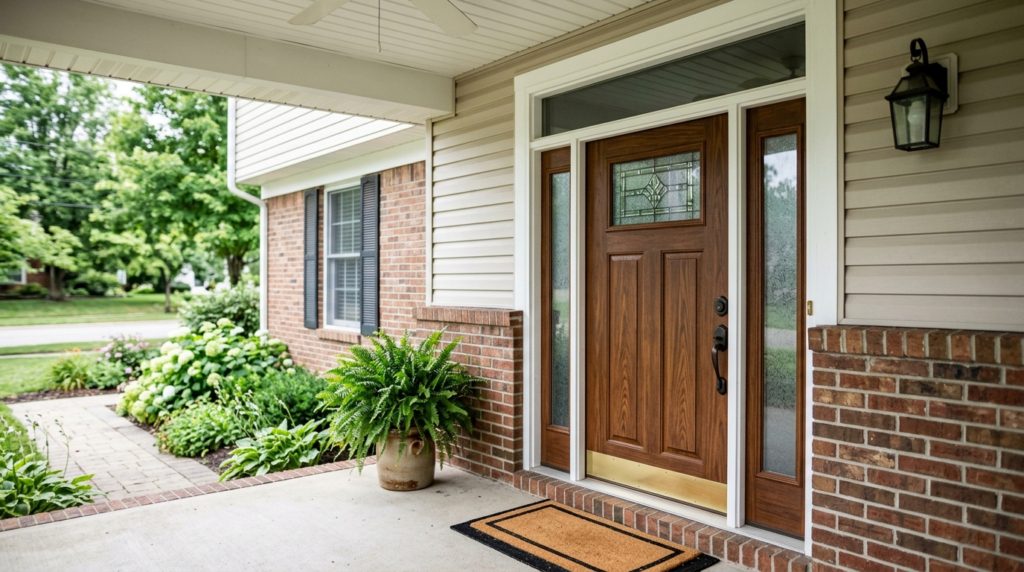
Fiberglass is the door that asks the least of you. It is a molded composite skin over a foam core, and it will not rust, rot, warp, or dent under normal use. It matches or beats insulated steel on energy, most rated doors in this class are fiberglass or insulated steel, and the surface can be smooth for a painted modern look or embossed with a wood grain deep enough to stain and pass for real oak.
Its real advantage here is dimensional stability. Wood swells in a humid summer and shrinks in dry winter heat; steel conducts cold; fiberglass barely moves through either, so the seal stays tight and the door keeps closing cleanly year after year. That stability is why it is the safest pick for an exposed doorway with no deep overhang, where a west or south wall takes sun, driving rain, and snow-melt in turn.
The trade-offs are cost and a wide quality spread. Fiberglass runs more upfront than steel, and a thin, cheap skin can look plasticky up close or crack under a hard impact. Buy a thicker skin from a maker that stands behind the finish, and a fiberglass door will likely outlast everything around it. If a sidelight or door-lite ever fogs, that is a sealed-glass failure rather than a door failure, and the glass can be swapped without touching the slab.
Wood Entry Doors: Beautiful, but Demanding in This Climate
Nothing else looks, feels, or sounds quite like a solid wood door. Real hardwood has a weight and depth the others only imitate, it can be refinished and re-stained as tastes change, and on a period or high-end home it lifts the whole facade. For a sheltered, dry entry, a well-built wood door can last for decades.
The catch is moisture and movement, and this climate hands wood a hard test. Wood is hygroscopic, meaning it drinks humidity and gives it back as the air dries, so a wood door swells and sticks in a muggy July and shrinks and drafts in a heated, bone-dry January. Left unsealed it warps, splits, and rots, especially along the bottom rail where rain and snow-melt collect. Wood also insulates the worst of the three, near R-2 to R-3.
If you want wood, give it real shelter. A deep porch or a storm door, a quality marine-grade finish, and a re-seal every couple of years are not optional here; they are the price of keeping a wood door looking and working right. Skip any of that on an exposed elevation and the door will tell you within a season or two.
How to Match the Material to Your Doorway
The smartest way to choose is to start with your doorway, not the showroom. Three questions sort most homeowners quickly: how exposed is the entry, how long will you stay, and what matters more, security or looks.
Exposure is the big one in Ohio. A door tucked under a deep covered porch can be almost anything, including wood, because the overhang keeps sun and water off it. A door on a flat wall facing west or south, taking afternoon sun and wind-driven rain, wants fiberglass that will not move, rust, or fade. The longer you plan to stay, the more fiberglass’s skip-the-maintenance math pays off; the shorter the stay or tighter the budget, the more steel’s low price wins.
On replacement calls around Columbus, the slab is rarely what failed. It is the weatherstrip gone flat, a door sweep worn to nothing, and a threshold sitting on a sill that freeze-thaw heaved out of square years ago. A good material on a bad frame still leaks, so we match the door to the opening and seal both.
If you are still torn, walk through the actual options on your opening. You can compare door styles and builds side by side and see how each one looks at your home’s size and trim before committing.
Styles and Glass: Light, Privacy, and Heat Loss
Once the material is settled, style and glass decide how the door looks and how it performs. Two looks dominate right now. Traditional doors carry raised panels and heavier detail; modern doors go flat and clean with simpler lines, fewer panels, and deliberate glass placement. Color has moved past plain white and black toward earthy greens, deep blues, and warm wood stains, and smart locks and video doorbells have shifted from a luxury to near-standard.
Glass is the real lever, because it trades three things at once: daylight, privacy, and heat. A full-lite door floods an entry with light but loses more heat and hands a burglar a reachable pane. A half-lite, or a small decorative lite set high on the door, keeps most of the light while protecting the lower half. Frosted, reeded, or textured glass buys privacy without going solid.
If you choose a glazed door for a cold elevation, ask for an insulated Low-E unit, and consider laminated or tempered glass for security. A failed seal will fog that glass over time, and when it does the sealed unit can be replaced on its own. Keep big glass for side and back entries, and keep street-facing glass small or set high.
Single, Double, and Sidelight Configurations
Entry doors come in more shapes than the single slab most people picture. The standard single door is 36 inches wide by 80 inches tall, with 30- and 32-inch widths for narrower openings and 84- or 96-inch heights for taller entries. That single 36-inch door is the cost-effective default and fits the vast majority of homes.
From there you can widen the whole entry. A double door uses two operable slabs, usually 30 or 36 inches each, for a 60- to 72-inch opening that suits a grand front or moving large furniture in and out. Sidelights are the narrow glass panels flanking the door, typically 10 to 14 inches each, on one or both sides; a 36-inch door with two 12-inch sidelights brings the opening close to 60 inches and pours light into a dark foyer. A transom is the fixed pane above the door, square, rectangular, or arched, that adds height and light.
Each added panel is more glass to insulate and seal, so the gain in light comes with a small cost in heat and a wider opening to keep weathertight. On an existing house, going from a single to a double, or adding sidelights, means reframing the opening and setting a new header, which is structural work rather than a slab swap.
The Frame and Threshold Decide Whether It Seals
A door is only as good as the frame it hangs in. You can buy two ways: a slab, which is just the door, or a prehung unit, which is the door already mounted in a new frame with the hinges and weatherstrip fitted. A slab makes sense when the existing frame is square, sound, and dry. A prehung unit is the better choice when the old frame is rotted, racked, or leaking, which is common in older Columbus and Cincinnati housing stock.
The reason matters here. Most of a door’s air leakage happens at the edges, not through the slab: the weatherstrip around the jamb, the sweep at the bottom, and the threshold where the door meets the sill. Freeze-thaw cycles heave and rot sills and can rack an opening out of square, so a brand-new door hung in a tired frame still whistles and drafts. Replacing the frame and threshold, sealing the rough opening, and tuning the sweep is what actually stops the draft.
If the opening is out of square or the sill is soft, a full-frame replacement is the honest fix. Our installation team rebuilds the opening back to square and flashes it so the new door seals the way it should, instead of papering over a problem that comes back next winter.
Security and the Hardware Behind It
The slab is only part of keeping a door secure; the hardware does most of the work. A solid deadbolt with a one-inch throw, a reinforced strike plate screwed into the framing rather than just the jamb, and long screws in the hinges turn an average door into a hard target. Many newer entry systems add a multi-point lock that bolts the door at the top, middle, and bottom, which also pulls the slab tight against the weatherstrip for a better seal.
Glass changes the security math. A pane within arm’s reach of the lock lets someone break it and turn the thumb-latch, so a glazed door should use laminated or tempered glass, or keep the glass out of reach. Smart locks and video doorbells, now close to standard on new builds, add convenience and a record of who came to the door, but they do not replace good mechanical hardware behind them.
Match the lock to the door. A heavy wood or steel slab deserves better than a builder-grade deadbolt, and even the best door is undone by a strike plate held in with short screws.
Ready to Replace Your Entry Door?
The right entry door comes down to your opening: how exposed it is, how the old frame has held up, and whether you want the lowest price, the least upkeep, or the best looks. A quick look in person sorts it faster than any spec sheet, and it catches the frame and threshold issues that decide whether a new door actually seals.
Book a free, no-pressure door assessment with our Columbus and Cincinnati team, and get a straight read on the right material, size, and build for your home.
FAQ: Choosing an Entry Door

Ready to fix your windows? Get a free quote in 30 seconds.
Family-owned, licensed & insured. Free, no-obligation quotes.