
- Services
- New Installation
- Reviews
- Projects
- About Us
- Contacts
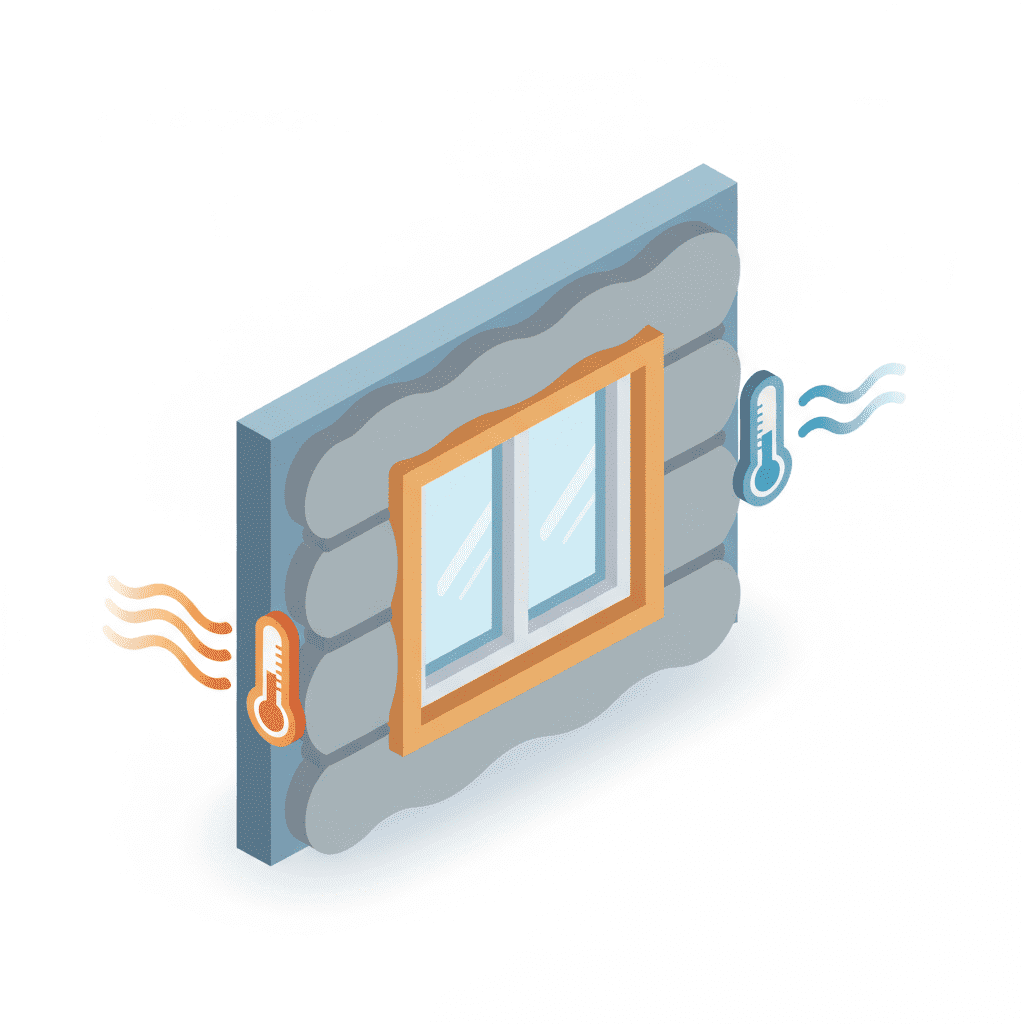
A measure of thermal resistance — how well a material resists heat flow. Higher R-value means better insulation. For windows, R-value is the inverse of U-factor (R = 1/U).
A measure of thermal resistance — how well a material resists heat flow. Higher R-value means better insulation. For windows, R-value is the inverse of U-factor (R = 1/U).
The R-value measures a material’s resistance to heat flow — the higher the R-value, the better the insulation. It is the standard rating used for wall insulation, attic insulation, and building materials in the United States. For windows, R-value is mathematically the inverse of U-factor: R = 1 ÷ U. A window with U-factor 0.25 has an R-value of 4.0 (1 ÷ 0.25 = 4).
The window industry uses U-factor as its standard rating (not R-value) because U-factor accounts for all three modes of heat transfer — conduction, convection, and radiation — that occur in a window assembly, not just conductive resistance. Wall insulation primarily resists conduction, making R-value straightforward. A window’s thermal performance involves glass, gas fill, frame, and edge effects interacting in complex ways that U-factor captures better.
That said, R-value is familiar to most homeowners from insulation discussions, so it’s useful as a rough comparison:
| Window Type | U-Factor | R-Value |
|---|---|---|
| Single pane, no coating | ~1.04 | ~R-1 |
| Double pane, air fill | ~0.48 | ~R-2 |
| Double pane, argon + Low-E | 0.25–0.30 | R-3.3–R-4 |
| Triple pane, argon + Low-E | 0.15–0.20 | R-5–R-6.7 |
Even the best windows (R-5 to R-7) are far below typical wall insulation values (R-13 to R-21). This is why windows are always the weakest thermal link in any wall assembly, regardless of quality. However, improving from R-1 (old single-pane) to R-4 (quality double-pane) cuts heat loss through the glass by 75% — a dramatic improvement even if the absolute R-value is still low compared to insulated walls.

Contact us now for a free estimate and take the first step toward repairing your windows!
Please leave your contact details.
The manager will contact you shortly.

