Few features say ‘Victorian’ as loudly as the windows. The era’s builders treated a window as ornament first and an opening second, so the houses that survive today carry tall, narrow sashes, deep bay fronts, and pops of colored glass that no modern tract home tries to copy. On a Victorian, the window is where the style lives or dies.
This guide walks through the main Victorian window styles, the glazing patterns and trim that make them read as period-correct, and the practical question every owner of an older home eventually faces: how to keep the look while a single-pane sash fights an Ohio winter. Whether you are restoring an original or planning a new window installation in the same spirit, the details below are what set the era apart.
Quick answer: Victorian window styles are defined by tall, vertical proportions and ornate detail: two-over-two sash windows, projecting bay and bow windows, side-hinged casements with diamond panes, and decorative stained or leaded glass. Carved wood frames, hood molds, and corbels finish the look.
What Makes a Window 'Victorian'?
The Victorian period ran from roughly 1837 to 1901, and it was never a single look. It swept up Italianate, Gothic Revival, Second Empire, and Queen Anne influences, so a Victorian street can show pointed arches on one house and round-headed sashes on the next. What ties them together is attitude: the window is meant to be seen.
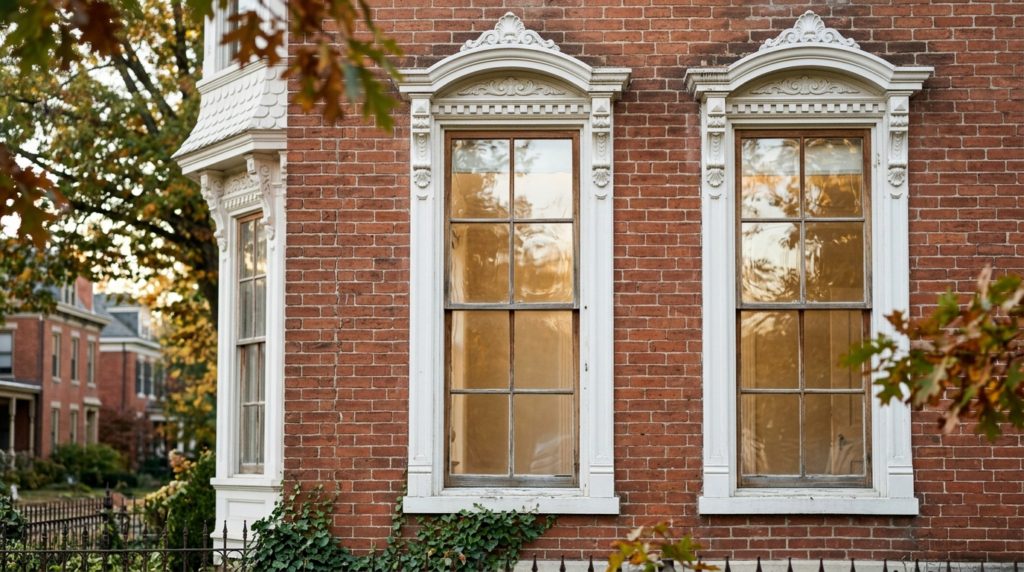
Two traits show up again and again. The first is vertical proportion. Victorian windows are tall and narrow, often grouped in pairs or threes to stretch a facade upward. The second is the glazing pattern. As glassmaking improved, builders could use larger panes, so the busy six-over-six grid of the Georgian era gave way to a cleaner two-over-two layout, two tall panes over two more, split by a single slim muntin.
Around that glass sits the ornament that finishes the style: carved wood, molded surrounds, and color. Strip those away and a tall sash is just a tall sash. Keep them and the period reads instantly.
Sash Windows: The Victorian Workhorse
The double-hung sash window is the backbone of Victorian housing. Two sashes sit in a frame, each able to slide past the other, counterbalanced by cast-iron weights hidden in the jambs and hung on a cord over a pulley. That weight-and-pulley system is why an original Victorian sash glides with a fingertip when it is in good order.
The giveaway detail is the two-over-two glazing, often finished with small projecting horns where the upper sash stiles extend past the meeting rail. Look closely at truly original glass and you will see faint ripples and the odd bubble, the signature of cylinder glass made before float-glass technology arrived. That wavy light is part of the charm and is nearly impossible to fake.
Because the sashes are wood and the glass is single-pane, these windows are also the ones that age hardest. Sash cords snap, sills soak up water, and the glazing putty dries and falls away. None of that means the window is finished, but it does mean an old sash usually needs attention by the time you buy the house.
Bay and Bow Windows
If the sash window is the everyday Victorian, the bay window is its showpiece. A bay projects out from the wall in flat, angled sections, usually three, creating a bright interior nook and a strong vertical accent on the facade. On Queen Anne homes the bay often climbs two stories and is capped with its own little roof.
A bow window does the same job with a gentler geometry, using four or more narrow units to sweep out in a smooth curve rather than sharp angles. Both flood a room with light from multiple directions and add usable floor space, which is why they anchored so many Victorian parlors. The trade-off is more frame, more glass, and more weatherproofing to keep right.
If you are weighing one for a project, our deeper guides to bay windows and bow windows break down the angles, the structural support each needs, and where they work best.
Casements, Oriels, and Specialty Shapes
Beyond the sash and the bay, the Victorians borrowed freely from older architecture and from their own imagination. Side-hinged casement windows, often filled with small diamond-shaped panes called quarrels held in lead, nodded to Elizabethan and Tudor design and turned up in studies, stairwells, and Gothic Revival cottages.
Higher on the wall, the era produced some of its most distinctive shapes. An oriel window juts from an upper story on carved brackets or corbels, appearing to float above the floor below. Gable ends became a canvas for cameo windows, small elliptical openings set horizontally, and for eyebrow dormers that curve gently out of a sloped roof. The list below covers the specialty shapes you are most likely to spot.
- Pointed-arch and lancet windows borrowed from Gothic Revival, common in gable peaks and on church-influenced facades.
- Oriel windows projecting from an upper floor on decorative corbels or brackets.
- Cameo windows elliptical panes set sideways into a gable for a touch of polish.
- Eyebrow dormers low, curved roof windows that soften an otherwise steep roofline.
- Round and porthole windows small fixed accents used in gables, attics, and stair landings.
Stained and Patterned Glass
Color is the Victorian flourish that survives in even modest homes. Stained and leaded glass, made of cut pieces held in lead cames, appeared in entry transoms, front-door sidelights, and the tall windows lighting a staircase. The point was partly status and partly storytelling, with floral, geometric, and scenic patterns reading like a signature on the house.
Not all decorative glass was colored. Frosted, etched, and textured patterned glass did quieter work, screening a bathroom or a service room while still letting light through. That trick is just as useful now as it was then, and the period patterns are easy to match.
If a panel cracks or a seal around leaded glass loosens, it is worth repairing rather than replacing with plain glass, which erases the detail. Our overview of the types of glass used in windows covers the modern options that mimic these looks while performing better against an Ohio winter.
The Trim and Surrounds That Read 'Victorian'
The window opening was rarely left plain. Around the glass, Victorian builders layered the same ornament they used on porches and cornices, and that framework does as much for the style as the sash itself. A modern window dropped into a bare hole will never look right on a Victorian unless the surround comes back too.
The vocabulary is worth knowing when you talk to a contractor or a preservation board. Hood molds, sometimes called drip caps, arch over the top of a window to throw rain clear of the glass while adding a crown. Corbels and brackets support projecting bays and oriels. Pilasters and decorative casings flank the sides, and a keystone or carved apron can finish the top or base.
Keep these details, or rebuild them faithfully, and even a window with new energy-efficient guts will still belong to the house.
Victorian Windows in Ohio's Older Homes
Ohio has more genuine Victorian housing than most people expect. Columbus alone holds German Village, Victorian Village, and Italian Village, where brick Italianates and Queen Annes line block after block. Cincinnati’s Over-the-Rhine and Dayton’s older districts add thousands more. If you live in one, the windows you have are likely original or close to it.
That heritage comes with a climate problem. A single-pane sash that was fine in a milder era now faces hard freeze-thaw winters and humid summers. Wood sills and lower rails are the first to go, soaking up water and rotting where the paint film fails, and the rope-and-pulley balances seize after decades of grit and paint.
On older homes around Columbus, the part that has failed is almost never the whole window. It is usually the bottom rail and sill that have taken on water, while the upper sash and the wavy glass above it are still perfectly sound and worth saving.
Many of these neighborhoods also sit in historic districts with guidelines on what you may change, so the look of a replacement is not only a matter of taste.
Restore or Replace? Keeping the Look
The honest answer for most Victorian windows is that you can often do both: save what is sound and upgrade what is not. An original sash with solid joinery is usually worth restoring, since the old-growth wood outlasts much of what is sold today, and a re-corded, re-puttied sash glides like new.
For the efficiency gap, the gentlest fix is a storm window. An interior storm panel or a discreet exterior storm cuts drafts and adds an insulating air layer without touching the historic sash, which keeps a preservation board happy. Where a window is truly past saving, modern units can replicate the two-over-two pattern with simulated divided lites and slim profiles, so the upgrade reads correct from the street.
Before ordering anything, check your local historic-district rules and look closely for failed seals or fogging on any later replacements, a sign the insulated glass has given out. Matching the proportion, the muntin width, and the trim matters more to the final look than the brand on the frame.
Want Victorian Character Without the Drafts?
Old windows and a warm house are not a contradiction. The right mix of sash restoration, storm panels, and period-correct replacements can keep your home looking every bit as Victorian while it finally holds the heat through an Ohio February.
Book a free, no-pressure consultation with our Columbus-area team, and we will walk your windows, tell you honestly what is worth saving, and lay out the options that fit the house and the district rules.
FAQ: Victorian Window Styles

Ready to fix your windows? Get a free quote in 30 seconds.
Family-owned, licensed & insured. Free, no-obligation quotes.