
- Services
- New Installation
- Reviews
- Projects
- About Us
- Contacts
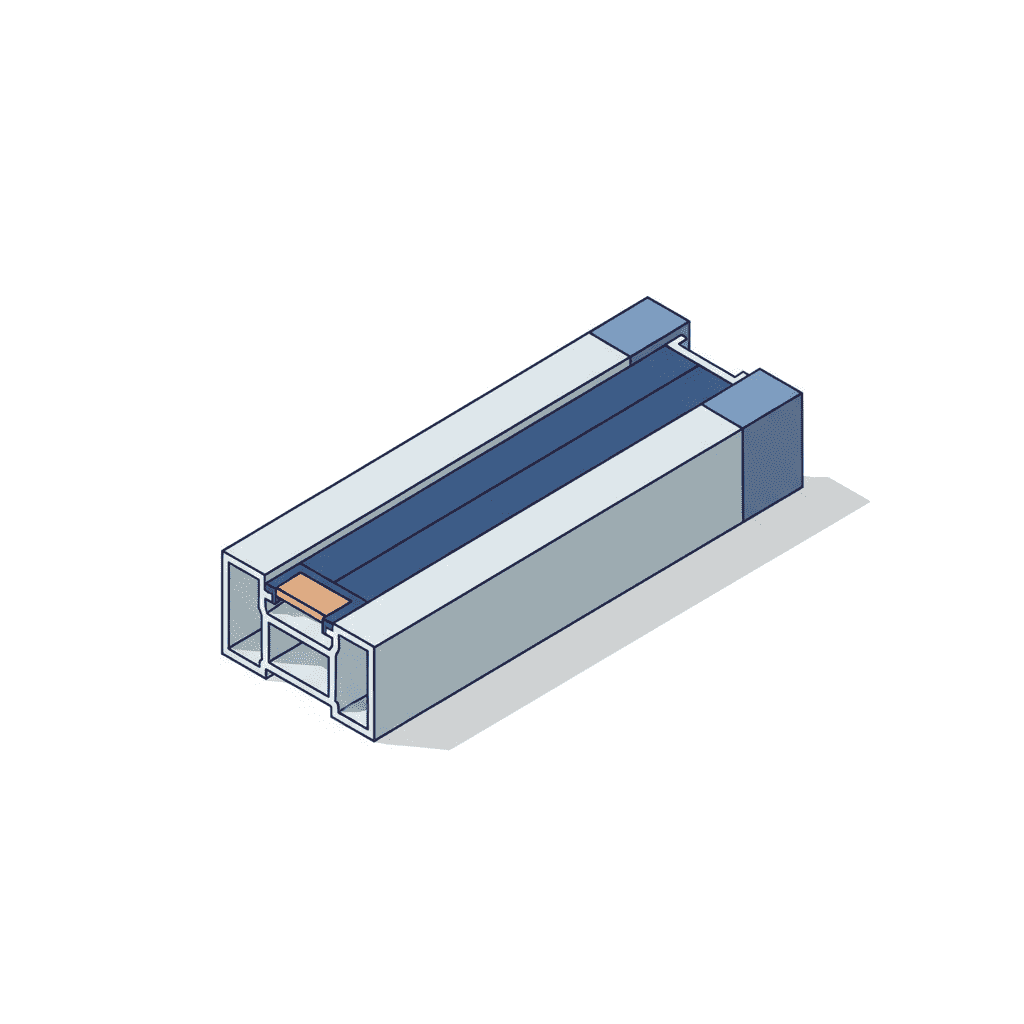
An insulating barrier incorporated into metal window frames that interrupts the conductive path between the cold exterior and warm interior surfaces, preventing heat loss and condensation at the frame.
An insulating barrier incorporated into metal window frames that interrupts the conductive path between the cold exterior and warm interior surfaces, preventing heat loss and condensation at the frame.
A thermal break is an insulating material — usually rigid polyamide (nylon) or polyurethane foam — inserted into the cross-section of an aluminum or metal window frame to interrupt the direct conductive path between the cold exterior metal and the warm interior metal. Without a thermal break, an aluminum frame conducts heat (and cold) almost as efficiently as a solid aluminum bar, making it a major source of energy loss and a condensation point.
Aluminum is an excellent conductor of heat — about 1,000 times better than the argon gas in an IGU. An aluminum frame without a thermal break has an effective U-factor around 1.9–2.4, worse than single-pane glass. A thermally broken aluminum frame drops to U 0.4–0.6, making it comparable to wood or vinyl. The thermal break is what makes modern aluminum-framed windows energy-efficient.
Vinyl and wood frames are inherently poor heat conductors, so a separate thermal break material is not needed. The frame material itself acts as the thermal barrier. This is why vinyl-framed windows consistently outperform aluminum-framed windows of similar glass specifications on whole-window U-factor ratings.

Contact us now for a free estimate and take the first step toward repairing your windows!
Please leave your contact details.
The manager will contact you shortly.

