A bedroom window carries more weight than any decorating list admits. It has to pull in morning light, black out for sleep, screen you from a neighbor’s window, give you a legal way out in a fire, and do all of it through Ohio’s cold winters and damp summers. Pick for looks alone and you fight one of those jobs for years.
This guide runs through the window styles that suit a bedroom, how to get privacy without losing the daylight, the night-time silhouette problem most people learn the hard way, the treatments that actually deliver a dark room, and the one code rule a bedroom window has to meet. If you are moving or enlarging an opening, that belongs with a proper new window installation so the unit sits square and sealed.
Quick answer: The best bedroom window pairs an operable style, usually a casement or double-hung, with Low-E glass for light without a cold draft. It has to meet egress code so you can climb out in an emergency. Add obscure glass or layered treatments for privacy, and blackout shades for sleep.
Start With the Rule No Idea List Mentions: Egress
Before any style or treatment, a bedroom window has one job the inspiration galleries skip: it has to be a legal exit. Building codes treat a bedroom as a sleeping room, and most require at least one window large enough to climb out of in a fire, mounted low enough to reach. That rule quietly removes a lot of pretty ideas from the table.
The code sets minimums for the clear opening width, height, and total area, plus a maximum sill height off the floor. The practical upshot is simple. A window that does not open, or one mounted too high or too small, cannot be the room’s only window. A fixed picture window, a skylight, or a sealed floor-to-ceiling pane can look stunning, but on its own none of them satisfies egress.
This is why the operable styles below matter more in a bedroom than anywhere else in the house. A casement window is the egress champion, because cranking it open clears the entire opening, so even a narrow wall can still meet code. A double-hung works when the sash is big enough. If you are finishing a basement bedroom, an egress well and an enlarged opening are usually part of the job. When in doubt, the opening gets measured against the local code before anyone picks a frame color.
Window Styles That Suit a Bedroom
With egress handled, the choice comes down to how the window opens, how much wall it takes, and the feel you want in a room you wake up in. Bedrooms reward styles that ventilate well for sleep and frame a view without turning the wall into a fishbowl.
The operable workhorses each have a place. A casement swings wide for the most airflow and the tightest seal when shut, ideal over a nightstand you do not want to reach across. A double-hung suits a traditional Columbus home and slides up or down without intruding into the room. A slider fits a wide, low wall and a short reach. An awning, hinged at the top, can stay cracked for night air even in a light rain, since it sheds water away from the opening.
The fixed and shaped styles bring drama where egress is met by a second window in the room. A picture window or a wall of glass frames a backyard or treeline and floods the space with light. A bay or box window pushes out to make a reading nook. Arched and corner units add architecture. The point is to lead with how the room has to breathe and exit, then let the look follow.
Ideas to Bring In More Natural Light
If a second window already covers egress, the rest can chase light and view, and a bedroom that wakes with the sun feels larger and calmer. Big glass is the fastest way there, but where it works depends on which way the wall faces.
A few ideas carry the most impact. Floor-to-ceiling glass or a tall picture window turns a wall into a view and pulls daylight deep into the room; our look at floor-to-ceiling windows covers what to weigh before committing. Corner windows wrap two walls of glass around the bed for an open, airy feel. A skylight or a high transom adds overhead light to a room hemmed in by neighbors, where wall windows would only trade glances across the lot.
Orientation decides how that light behaves through the day. South- and west-facing bedrooms catch strong afternoon sun that warms the room and can wash out a nap, so they pair best with Low-E glass and a shade you can draw. North-facing rooms get soft, even daylight with little heat. East-facing windows deliver gentle morning light, the kindest wake-up of the four. Knowing the wall’s direction shapes both the glass and the treatment you choose.
Bay Windows and Reading-Nook Window Seats
Few bedroom upgrades earn their keep like a bay or box window. By pushing the glass out past the wall, the unit creates a pocket of floor space that did not exist before, and a bedroom is the perfect place to turn it into a window seat or a reading nook. The extra glass on three sides also pulls in light from more than one angle.
A bay angles its side panes outward for a wide, panoramic feel, while a box or garden bay projects straight out with square corners for a deeper shelf. Either way, the space below becomes storage or a cushioned bench with a view. Set the flanking sashes as operable casements and the nook ventilates the room while doubling as the egress exit, so the feature earns its spot twice over.
The trade-off is that a projecting window has more exposed surface to lose heat through, and the small roof of the bump-out has to be flashed and insulated properly. Done right in this climate, that means a well-sealed unit and an insulated seat base. Skip those and the cozy nook becomes the coldest corner of the room by January.
Privacy Without Losing the Daylight
Privacy is where a bedroom window differs from the rest of the house, because you want the morning light without the feeling of being on display. The cleanest answer is glass that scrambles the view while still passing a soft glow, so you are not reaching for a blind every time you change.
Obscure and frosted glass build the privacy right into the pane, with nothing to wear out or take down to clean. Frosted glass is etched to an even matte haze; textured obscure glass carries a molded pattern like rain or reed that distorts shapes without dimming the room. Both come in privacy levels, so you can order just enough screening for a ground-floor window facing the street and less for an upper room.
Built-in glass is not the only route. A removable privacy film delivers the same blur for a rental or a trial, and it peels off later. The real skill is matching the screening to how exposed the window actually is. Stand at the glass and look out, then walk to where a neighbor would stand and look back, before you decide how much privacy the room truly needs.
The Night Privacy Problem Nobody Warns You About
The detail that catches people out has nothing to do with daytime privacy. After dark, the math flips. Any glass that relies on reflection, including one-way mirror film and lightly tinted panes, only works while it is brighter outside than in. The moment you switch on a bedside lamp, the mirror disappears and the lit room turns into a stage for anyone in the yard or on the street.
Frosted and obscure glass dodge part of this, since they blur shapes in both directions, but a backlit frosted window still shows a moving silhouette. There is no single pane that delivers full daytime light and full nighttime privacy on its own, whatever a product page implies.
The honest fix is to layer. Keep the permanent glass or film for the day, and add a blackout shade or a lined curtain you draw at night for the hours that matter most in a bedroom. That combination, not a miracle coating, is what gives you real privacy around the clock.
Treatments That Give You a Truly Dark Room
A bedroom is the one room where blocking light matters as much as letting it in. Good sleep depends on darkness, and the right treatment also covers the nighttime privacy that glass alone cannot. The aim is to layer function, not just hang one thing that looks nice at noon.
Build from the inside out: a darkening layer first, then softness and control over it. A north-facing room may need less blackout than a bedroom that takes the morning sun full in the face. The common options each fill a role, and most bedrooms end up combining two of them.
- Blackout shades or lined drapes block almost all outside light for a genuinely dark room and the deepest sleep.
- Sheer curtains over blackout panels let you soften daylight by day and seal the room at night.
- Roman shades give a clean, tailored look with solid light control in a single pull.
- Plantation shutters tilt for precise light and privacy and add lasting value, a strong fit for a period home.
- Venetian or wood blinds angle to trade light for privacy without closing the window off entirely.
- Between-the-glass blinds sit sealed inside the unit, so they never gather dust; see our take on between-the-glass blinds.
Motorized shades on a remote or a schedule are worth a look for a hard-to-reach window over the bed or a high transom, where a manual cord becomes a daily nuisance.
Black Frames and the Modern Bedroom Look
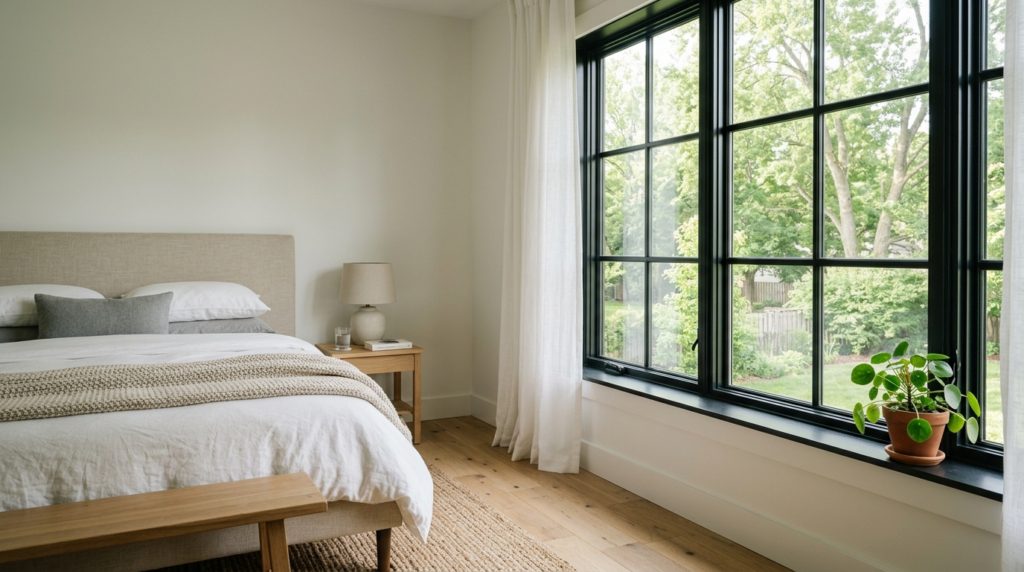
The fastest way to modernize a bedroom window is the frame, not the glass. Matte black frames have become the defining look of the last few years, turning an ordinary window into a sharp graphic line against a white wall. The dark sightline makes the view read like a framed picture and pairs with almost any decor.
The look comes with two honest caveats in this climate. A dark frame on a south- or west-facing wall absorbs more solar heat, so it should carry a finish rated to hold its color through years of Ohio sun rather than fade or chalk. And black suits a clean, gridless modern pane; on a traditional home, slim grids or a divided-light pattern keep it from clashing. Our deeper look at black windows covers the upkeep and styling.
Shape adds the other layer of character. An arched window over a bed crowns the wall, a transom band above a headboard pulls in light without sacrificing privacy, and slim grids dress a plain sash for a period room. These are finishing moves. Settle the style, glass, and egress first, then let the frame and shape carry the look.
Frames and Glass Built for an Ohio Bedroom
The window you sleep beside has to handle a wide temperature swing without becoming a problem you notice every cold morning. In a bedroom the comfort details matter more than usual, because you spend hours right next to the glass while you sleep.
The glass package does most of that work. A double or triple pane with a Low-E coating and argon fill keeps the inner surface warmer, which kills the cold draft that pools off a single-pane window and rolls onto the bed. That warmer inner pane also resists the condensation that forms when warm, humid bedroom air, heavy with a night of breathing, meets cold glass.
On bedroom calls around Columbus, the complaint is almost always the same: water beading on the inside of the glass on a January morning and a damp, musty sill under the curtains. Nine times out of ten it is a tired single pane or a failed seal, not a leak from outside.
That condensation is worth taking seriously, because the moisture it leaves feeds mildew along the sill and behind the trim. If an older bedroom window has fogged between the panes, the seal has failed, and the fix is usually an insulated glass replacement that swaps the sealed unit and leaves the frame in place. For the frame itself, vinyl and fiberglass shrug off moisture and need no paint, while wood looks right in a period room but wants sealing and watching through the freeze-thaw months.
Planning a New Bedroom Window?
The right bedroom window comes down to how the room faces the sun, how exposed it is to the neighbors, and whether the opening meets egress for a safe way out. If you are weighing a casement against a double-hung, or wondering whether your old sash and seals have a winter left in them, a set of eyes on the actual opening settles it fast.
Book a free, no-pressure window assessment with our Columbus-area team and get a straight recommendation on the style, glass, and frame that fit your bedroom.
FAQ: Bedroom Windows

Ready to fix your windows? Get a free quote in 30 seconds.
Family-owned, licensed & insured. Free, no-obligation quotes.