A scratch across a window you look through every day is hard to ignore, and the first question is always the same: can it be buffed out, or does the glass have to come out? The honest answer depends on one thing you can check in seconds, which is how deep the scratch actually goes.
Light, hairline scratches usually polish out at home. A groove deep enough to catch your fingernail rarely does, and some glass should never be polished at all. This guide shows how to tell which camp your scratch falls into, what a shallow scratch repair really involves, and when replacing the pane or the whole unit is the smarter call. If the window is older and the frame is tired too, a fresh window installation can be better value than chasing one scratch.
Quick answer: Scratched glass can be repaired when the scratch is shallow enough that your fingernail glides over it without catching. Those marks polish out with a cerium oxide compound. Deep scratches that catch a nail, plus cracks, chips, and coated or double-pane glass, usually call for replacing the pane instead.
Not All Scratches Are Equal
Glass scratches fall into a few rough categories, and where yours lands decides everything that follows. The shallowest are surface or hairline scratches, the kind you only notice when light hits the window at a certain angle. They sit on the very top layer of the glass and have displaced almost no material, which is exactly why a mild polish can level them.
The next step up is a true surface scratch you can see straight on in normal daylight. These are deeper, and while a careful hand can sometimes improve them, they sit right at the edge of what home polishing can fix. Past that point are sub-surface scratches and gouges, where something hard has dug a real trench into the glass. These do not buff out, and worse, they create a stress line a pane can eventually crack along, especially on a window that swings through Ohio’s temperature extremes.
Knowing the tier matters because the repair only works on the top two, and even then only on the shallow end. Spending an afternoon polishing a gouge will not close it. It will only frost the glass around the mark and make the damage more obvious than before.
The Fingernail Test Tells You Most of It
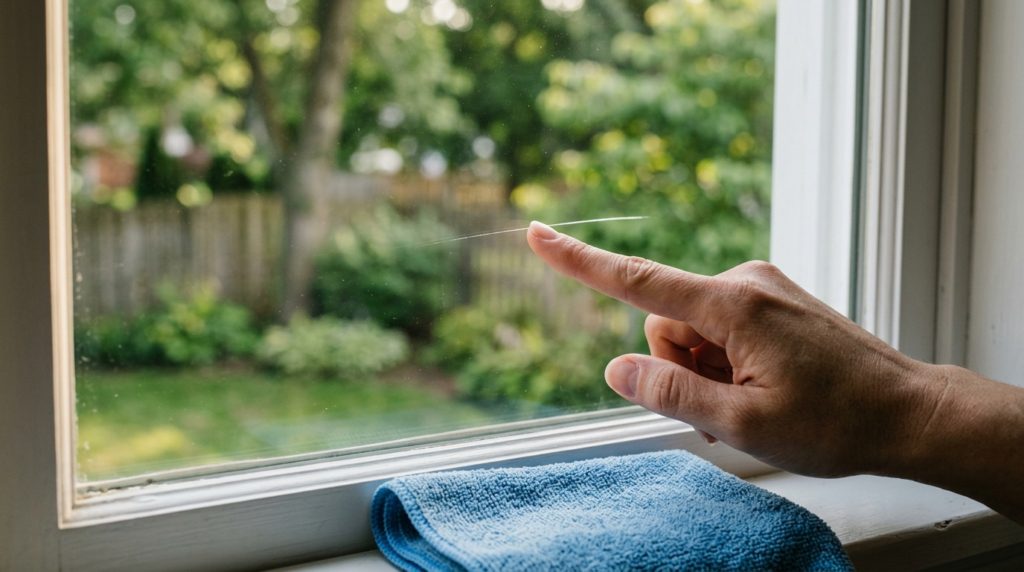
Before you buy a single product, run the test the pros reach for first. Drag a fingernail slowly across the scratch at roughly a forty-five degree angle. If your nail glides over the mark without snagging, the scratch is shallow and there is a real chance it will polish out. If your nail drops into the line and catches, the groove is too deep for a home repair.
This works because polishing does not fill a scratch. It removes a whisper-thin layer of glass from the high edges on either side of the mark until the surface is level again. A shallow scratch has very little depth to chase, so leveling it is quick. A deep one would mean grinding away so much surrounding glass that you would distort the view through it, which is why even a glass shop steers a deep scratch toward replacement.
Do the test in good light and clean the glass first, because a smear of grime can feel like a scratch and send you down the wrong path. Check from both sides too. A mark that catches your nail on the inside face but not the outside tells you which surface to work, and sometimes that the damage is not where you assumed.
How a Shallow Scratch Actually Gets Polished
For the scratches that pass the fingernail test, the repair is straightforward but slow, and patience matters more than muscle. The working material is cerium oxide, a fine white polishing powder mixed with water into a slurry. It is the same compound glass shops use, and it is mild enough to lift hairline scratches and water etching without clouding the surrounding glass when handled correctly.
The basic sequence is to clean the glass, mark the scratch with a grease pencil on the opposite side so you can find it, then work the slurry over the area with a felt pad on low speed, keeping everything wet. You check progress often, because the goal is to stop the moment the scratch fades, not to keep grinding. The full method, including how to keep the glass cool and avoid swirl marks, is laid out in our guide to removing scratches from glass at home.
A word on the kitchen-cabinet fixes you will read about. Toothpaste, baking soda, and metal polish get repeated all over the internet, but they are far milder than cerium oxide and rarely touch anything beyond the faintest haze. They are worth a try on a barely-there mark, yet on anything you can clearly see they tend to waste an afternoon. Skip them and start with the right compound.
When Replacing the Glass Is the Right Move
Polishing has limits, and pushing past them usually makes a window look worse than the original scratch did. Several situations call for replacing the pane, or the sash that holds it, from the start. Recognizing them up front saves you the frustration of a failed repair and a second attempt.
Run through the list below before you reach for any polish. If your scratch matches one of these, the time and money are better spent on new glass than on a fix that will not hold.
- The scratch catches your nail. A deep groove will not polish out and can become a crack line over time.
- There are many scratches clustered together. Polishing each one removes enough glass to leave a visibly dished or wavy area.
- The damage includes a chip, gouge, or crack. These are structural, not cosmetic, and only grow.
- The scratch sits in your main line of sight. Even a near-perfect polish can leave faint distortion that is maddening dead center in a window.
- The glass is coated or sealed. Low-E coatings and double-pane units, covered next, change the math entirely.
Glass You Should Never Try to Polish
Some glass is off-limits for home polishing no matter how shallow the scratch looks, and ignoring that is how a small cosmetic problem turns into a shattered pane or a ruined window. Two types deserve a hard stop before the drill comes out.
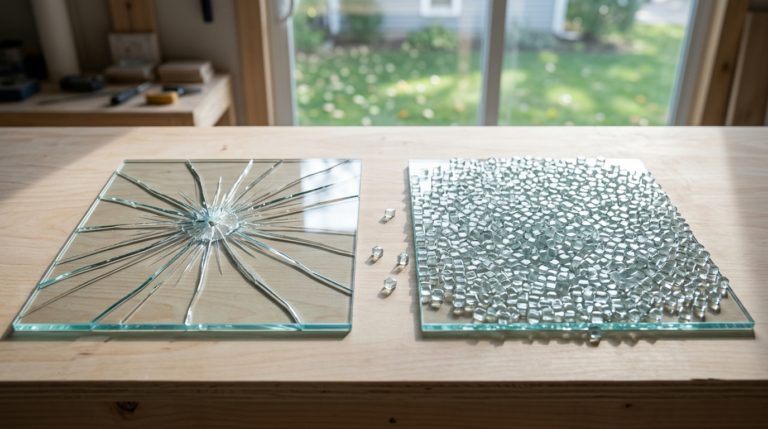
Tempered glass is held under constant internal tension, which is what makes it break into small pebbles instead of long shards. Aggressive polishing builds localized heat and friction, and that stress can trigger the whole pane to let go without warning. You will find it in doors, large windows, and anything near the floor, usually with an etched stamp in one corner. If you are not sure what you are looking at, our explainer on what tempered glass is covers how to identify it.
Low-E and tinted glass carry a microscopically thin metallic coating that does the energy-saving work, and it lives on one specific surface of the glass. Polishing scrubs that coating right off, leaving a permanent clouded patch that looks far worse than the scratch and quietly downgrades the window’s efficiency. On coated glass, what reads as a scratch is sometimes a scuff in the coating itself, which no amount of polishing will fix. Both belong with a glass professional, not a felt pad.
Double-Pane Windows: Where the Scratch Lives Matters
Most windows in modern Ohio homes are double-pane insulated units: two sheets of glass sealed around a spacer with an inert gas in the gap. That construction changes the repair question, because a sealed unit has four glass surfaces and you can only reach two of them.
If the scratch is on an outer face, the fingernail test and a careful polish still apply, with the coating caution above. If it sits on one of the two inner faces, sealed inside the unit, there is no reaching it without breaking the seal, and at that point the whole insulated unit has to be replaced rather than repaired. The same holds the moment a double-pane window starts to fog between the panes, which signals the seal has already failed. Our guide on fixing foggy double-pane windows walks through why a failed unit is replaced, not resealed.
There is a small silver lining here. When a sealed unit needs replacing for a scratch you cannot reach, the fix is usually just the glass pack or the sash, not the entire window and frame. A glass pro can tell you which, and whether the existing frame is sound enough to keep.
Is It Even a Scratch? Hard Water and Ice-Scraper Marks
Plenty of windows that look scratched are not scratched at all, and the difference decides whether you can clean the problem away or have to address the glass itself. Two lookalikes are common in this climate.
Hard water is the first. Sprinklers, runoff, and Ohio’s mineral-heavy water leave calcium deposits that bake onto glass in the sun and etch faint cloudy lines that mimic scratches. The tell is that mineral etching spreads across a broad area in a film or spotty pattern, while a true scratch is a single defined line. Mineral haze often responds to the very same cerium oxide polish, so it is worth ruling out first.
Half the scratched windows we get called about in winter turn out to be ice-scraper marks. Someone grabs a metal scraper, or a snow brush with grit caught in it, to clear frost and drags it straight across the glass. The repair is the same as any scratch, but the lesson is to never take a hard edge to a frozen window.
So before you decide on repair or replacement, clean the glass thoroughly, look at the pattern, and confirm you are dealing with an actual scratch in the glass rather than a deposit sitting on top of it. It is the cheapest diagnostic step there is.
Fix or Replace: Making the Call
With the tests done, the decision usually makes itself. A single shallow scratch on plain, uncoated, single-pane glass is a strong candidate for a home polish or a quick professional buff. Anything deeper, clustered, coated, sealed, or cracked points toward replacing the glass, and the only real question left is how much of the window goes with it.
Cost comes down to the drivers, not a flat number: the size of the pane, whether it is plain or coated, single or insulated, how easy the sash is to access, and how quickly you need it done. A small uncoated pane is an easy swap. A large Low-E insulated unit on a second floor is a bigger job, which is exactly when it pays to compare repairing the glass against the value of a newer, more efficient window. A glass professional handling the glass repair can price both paths so you are not guessing.
One more factor tips the scale: the age of the rest of the window. If the frame is drafty, the hardware is worn, or the unit already fogs, sinking effort into one scratch is patching a window that is on its way out anyway. In that case the scratch is just the nudge to plan a replacement on your terms instead of after a failure.
Still Not Sure Whether to Fix or Replace?
Not sure whether your scratched glass is a quick polish or a sign the pane needs to go? A two-minute look usually settles it, and you do not have to make that call alone.
Book a free, no-pressure window and glass assessment with our Columbus and Cincinnati team, and get a straight answer on whether to repair the glass or replace the unit.
FAQ: Repairing Scratched Glass

Ready to fix your windows? Get a free quote in 30 seconds.
Family-owned, licensed & insured. Free, no-obligation quotes.