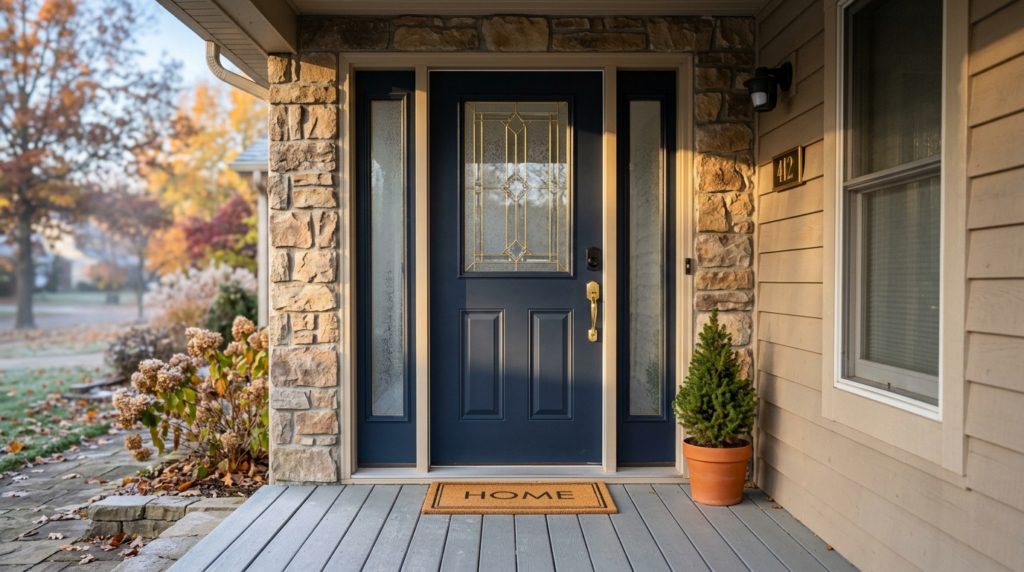
A front door is a small part of your wall, but it can leak heat out of all proportion to its size. The slab itself, the glass in it, the seal around its edges, and how squarely it was hung all add up, and a weak link in any one of them shows up as a cold draft in January and a higher heating bill all winter. Picking a door that actually saves energy means looking past the finish to how it is built.
This guide breaks down what makes a door efficient, how to read the U-factor and ENERGY STAR ratings, how fiberglass, steel, and wood compare, and why the install matters as much as the door. If you are weighing a full replacement, our door replacement service page lays out the options, but the choices below apply whether you buy one slab or a full entry system.
Quick answer: Choose an ENERGY STAR door with a low U-factor (around 0.20 or lower for Ohio), an insulated fiberglass or foam-filled steel core, and Low-E dual-pane glass if it has any glazing. Then have it installed plumb, square, and fully air-sealed, because even the best door leaks if the frame around it does not seal.
What Makes a Front Door Energy Efficient
Efficiency is not one feature but four working together. The first is the slab itself: a hollow or solid-wood door insulates poorly, while a door built around a foam core resists heat flow far better. The second is any glass in the door or its sidelights, since plain single-pane glass is the weakest spot in the whole assembly. The third is the weatherstripping and sweep that close the gap between the door and its frame. The fourth, and the one most people skip, is the installation that ties all of it into the wall.
A door can score well on paper and still waste energy if even one of these is off. A premium fiberglass slab hung in a frame that was never sealed to the rough opening will let cold air pour in around its edges, and no rating accounts for a sloppy install. That is why a smart buyer weighs the product and the installer together rather than chasing a single number.
It also helps to think in terms of where heat actually escapes. Through the door, heat conducts across the slab and glass; around the door, it leaks through gaps and worn seals. A good energy efficient front door addresses both paths at once, which is why the rest of this guide treats the slab, the glass, the seals, and the fit as one connected system.
Decoding the Ratings: U-Factor, SHGC, and ENERGY STAR
Doors sold for efficiency carry an NFRC label, the same independent rating you see on windows, and learning to read it takes the guesswork out of shopping. The number that matters most in a heating climate is the U-factor, which measures how fast heat passes through the door. Lower is better, and unlike R-value it counts the whole assembly, glass and frame included. For Ohio, a U-factor at or below roughly 0.20 marks a genuinely efficient door.
Two other figures round out the label. Solar Heat Gain Coefficient (SHGC) describes how much of the sun’s heat the door lets in, which matters mainly for doors with large glass panels. Air leakage rates how much air passes through the assembly itself. Together these tell you far more than a marketing phrase like “energy saving” ever will.
The simplest shortcut is the ENERGY STAR label. The program sets performance thresholds by climate region, and Ohio sits in the Northern zone, which calls for a low U-factor to hold heat in. An ENERGY STAR door certified for the Northern zone has already cleared the bar for our winters, and it may qualify for a federal energy-efficiency tax credit, which is worth confirming with the manufacturer before you buy.
- U-factor — how fast heat escapes; lower is better; the key number for Ohio.
- SHGC — how much solar heat comes in; matters most for glass-heavy doors.
- Air leakage — how leaky the assembly is on its own, before install.
- ENERGY STAR (Northern zone) — the quick certification to look for in this climate.
Door Materials Compared: Fiberglass, Steel, and Wood
The material sets the ceiling on how well a door can insulate, because it determines what fills the core. The three common choices behave very differently, and the right pick depends on your budget, your exposure, and how much upkeep you want to do. None of them insulates well as a hollow shell; the performance comes from the foam inside.
Fiberglass is the strongest all-around performer. A fiberglass skin over a solid polyurethane foam core delivers the highest insulating values of the three, and it shrugs off the warping, denting, and rust that plague other materials through Ohio’s wet, swinging weather. It can also be finished to mimic real wood grain, so you rarely give up looks for performance. Steel comes next: a foam-filled steel door insulates well and costs less, though the skin can dent and, on an exposed entry, eventually rust where the finish fails.
Solid wood is the most beautiful and the weakest insulator of the three, since dense wood conducts heat more readily than foam and has no insulating core. A heavy wood door on a sheltered, covered porch can still be a reasonable choice, especially when it carries protective cladding, but on a fully exposed entry it pays an efficiency penalty. If you are comparing specific styles and how they read on a home, our guide to front door styles walks through the look of each.
- Fiberglass — highest insulation, stable in freeze-thaw, low maintenance; the default efficiency pick.
- Insulated steel — strong insulation and security for less; watch for dents and surface rust over time.
- Solid wood — best looks, weakest insulation; best on covered, sheltered entries.
The Glass in the Door Matters as Much as the Slab
Any glass you add is the easiest place to lose the efficiency you paid for in the slab. A door with a large single-pane light, or sidelights and a transom that are not insulated, can undo the core’s advantage. The fix is the same glazing technology that makes a good window efficient, applied to the door.
Look for dual-pane glass at a minimum, with a Low-E coating and an argon-gas fill between the panes. The Low-E coating reflects heat back into the room in winter, and the inert gas slows heat transfer through the gap, so the glazed section keeps pace with the insulated panel instead of dragging it down. The same logic that governs a whole-house upgrade applies here, which our overview of choosing energy-efficient windows covers in depth.
This is also where you balance light against performance. A fully glazed entry floods an entryway with daylight but gives up some efficiency to the larger glass area, while a solid panel with a small decorative light holds heat better. Decide how much glass you actually want, then make sure every pane of it is insulated rather than letting a pretty but single-pane sidelight quietly bleed heat all winter.
Weatherstripping, the Sweep, and the Threshold
The gap between a door and its frame is a continuous slot to the outdoors, and the seal kit is what closes it. Compression weatherstripping lines the frame so the door squeezes against it when latched, the sweep at the bottom blocks the gap over the threshold, and an adjustable threshold lets you fine-tune that contact as the house settles. When these are fresh and properly fitted, you can run a hand around a closed door on a windy day and feel nothing.
On older Columbus homes, the draft people feel at the front door almost never comes through the panel itself. It is the worn sweep and a compression seal that has gone hard and flat after a few freeze-thaw winters, so the door no longer seals even when it is shut tight.
When you shop, check that the weatherstripping is a replaceable type rather than a glued-in strip you cannot service later, because seals are wear items that stiffen and shrink over years of cold. A quality door makes its sweep and threshold easy to adjust and eventually swap, which keeps the assembly tight for the life of the door instead of just its first season.
Why Installation Makes or Breaks Efficiency
The most efficient door in the catalog will still waste heat if it is hung badly, because the rough opening is always larger than the frame and the gap between them has to be sealed. A door set out of plumb or square will not seat evenly against its weatherstripping, leaving spots where the seal never fully closes. And if the cavity around the frame is left empty or stuffed with the wrong material, cold air tracks straight through the wall around the door.
Proper installation means shimming the frame plumb and square, then air-sealing the perimeter with low-expansion foam and backing it with flashing so water drains out rather than soaking the framing. In Ohio’s freeze-thaw cycle, any moisture trapped in that cavity expands as it freezes and slowly works the seal loose, so the air and water seal have to be done right the first time. This is the step most likely to be rushed, and the one that quietly determines whether the door performs to its rating.
If you are tackling a swap yourself, our walkthrough on how to install a front door covers the squaring and sealing in detail. For a structural opening, a settled frame, or a door that has to be watertight on an exposed elevation, having it set by a crew that does it daily is cheap insurance against a callback.
Choosing the Right Door for Ohio Winters
Putting it together for this climate, the priority order is clear: certification first, then core, then glass, then the seal and the install. Start with an ENERGY STAR door rated for the Northern zone, which already targets the low U-factor that matters when the goal is holding heat in. From there, an insulated fiberglass or foam-filled steel core gives you the most performance for the money, with any glass kept to dual-pane Low-E.
A storm door can add a useful second layer on a fully exposed entry, trapping a buffer of still air ahead of the main door and shielding it from wind-driven rain and snow. It is not a substitute for an efficient primary door, but on a north- or west-facing entrance that takes the brunt of a Columbus winter, the extra barrier earns its keep. Weigh it against the look you want, since a storm door changes the face of the entry.
None of this means giving up curb appeal for efficiency. Today’s fiberglass doors come in finishes and panel styles that suit everything from a 1920s bungalow to new construction, and the broader range of entry door options shows how style and performance now go together. The efficient choice and the good-looking choice are usually the same door.
Ready to Upgrade a Drafty Front Door?
If your current entry leaks cold air, sticks in winter, or just looks tired, the smartest first step is a straight read on whether it needs a new seal kit or a full replacement. There is no point heating the porch through a worn-out door all winter.
Book a free, no-pressure door assessment with our Columbus and Cincinnati team, and we will walk you through the efficient options that fit your home and your entry.
FAQ: Energy-Efficient Front Doors

Ready to fix your windows? Get a free quote in 30 seconds.
Family-owned, licensed & insured. Free, no-obligation quotes.