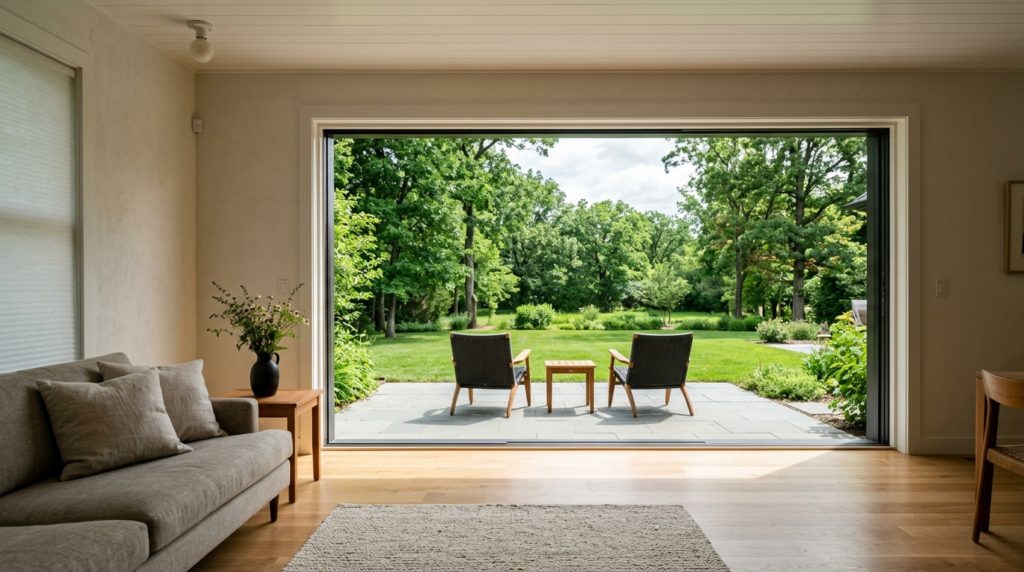
A pocket patio door is the trick behind those photos where a whole glass wall just stops existing. Instead of one panel sliding behind another, every panel rolls sideways and vanishes into a hollow channel built inside the wall. What you are left with is an opening with no frame down the middle and nothing between the living room and the deck. It is the boldest way to open a house to the yard.
It is also the most demanding door here to build and to live with, especially in a climate that runs from humid August afternoons to January ice. This guide covers how the system works, how it differs from an ordinary slider, the honest pros and cons, and the few details that decide whether it performs for decades or turns into a draft you regret. If a panel ever drags or sticks later on, that is usually a sliding door repair, not a reason to open the wall back up.
Quick answer: A pocket patio door has glass panels that slide on a track and disappear completely into a cavity inside the adjacent wall, leaving a full, frameless opening. It maximizes views and indoor-outdoor flow, but it costs more, needs a hollow wall to slide into, and demands careful sealing in a cold climate.
What a Pocket Patio Door Actually Is
Picture a normal sliding patio door. One panel is fixed, the other rolls across it and parks in front, so even wide open you only ever get half the opening clear and a thick post of overlapping glass in the middle. A pocket door removes that compromise. Its panels ride a top track and a bottom sill, and instead of stacking against each other, they keep going until they slide all the way into a framed slot inside the wall beside the opening.
The result is an opening with nothing in it. No center post, no stacked panels, no frame interrupting the view of the backyard. Some homes run a single panel into one wall, others split a wide span so panels disappear into pockets on both sides. The mechanism itself is not exotic, just heavy: precise rollers, a strong head track carrying the weight, and a sill that guides the panels and manages water.
Panels are usually glass in an aluminum, fiberglass, vinyl, or clad-wood frame. The frame material matters more than the look here, because a tall glass panel that has to roll smoothly for years and seal tightly against Ohio weather asks a lot of its hardware and its edges.
Pocket vs. a Standard Sliding Door
The everyday alternative is the standard slider, and for most homes it is the sensible default. A slider needs no special wall, installs into a normal rough opening, costs far less, and still gives you a generous view and easy operation. Its only real limit is that one half of the opening is always blocked by the parked panel, and a king-post of frame sits in your sightline.
A pocket door trades simplicity for that clean, full opening. You gain the unobstructed view and the true indoor-outdoor doorway. You give up the easy install, because the panels need somewhere to go, and that somewhere is a hollow stretch of wall that has to be built or rebuilt for the job. If your goal is a wider everyday view rather than a wall that fully opens, a good multi-panel slider or a bi-fold may get you most of the way for far less disruption. Our guide to sliding versus bi-fold patio doors walks through that middle ground.
Panel Layouts and How Wide They Go
Pocket systems are sized by how many panels move and which way they disappear. A small two-panel setup might tuck a single sliding panel beside a fixed one, while a great-room wall can run four, six, or more panels into deep pockets to clear a span wide enough to walk a sofa through. The more glass that moves, the heavier the hardware and the longer the pocket has to be, since every panel needs its own width of hidden wall to rest in.
Before you fall for a layout, it helps to know the common configurations and what each one asks of the house.
- Single-panel pocket: one panel slides away beside a fixed lite. The simplest version, and the easiest to fit into an existing wall.
- Multi-slide: several panels stack into one pocket or split into two. This is the dramatic full-wall look, and the most demanding to build.
- Corner pocket: two walls of glass meet and both disappear, removing the corner of the room entirely. Stunning, and the most structurally involved.
Panel widths usually land between two and three feet each, and heights commonly run eight feet or taller, so a wide multi-slide can open a span you simply cannot get from a hinged door. To compare it against every other option, our overview of patio door types lays them out side by side.
The Upside: What You Gain
The headline benefit is the view, and it is a real one. With the panels gone, the line between inside and out disappears, which is why these doors anchor so many open-plan kitchens and great rooms that flow onto a patio. For entertaining, a fully open wall changes how a space works on a warm evening, letting guests and air move freely between the deck and the kitchen.
There is a practical gain too. Unlike a hinged door, nothing swings into the room or out onto the deck, so the floor on both sides stays usable right up to the threshold. Furniture, a grill, a dining table, all of it can sit close to the opening without fighting a door arc. That same logic makes pocket doors a favorite for tight or carefully planned layouts among the broader door options homeowners weigh.
The minimalist look is the third draw. With no center frame and the panels hidden, the architecture reads clean and modern, and the glass does the talking. For a home built or remodeled around big sightlines, nothing else delivers quite the same effect.
The Catch Hiding Inside the Wall
Here is the part the showroom photos skip. The panels have to go somewhere, and that somewhere is a long hollow pocket framed inside the wall next to the opening. On an interior partition that is no big deal. On an exterior wall in Ohio, that hollow stretch is a problem, because it is wall that cannot hold a normal depth of insulation, and a poorly built pocket becomes a cold strip that radiates chill and invites condensation along its inside face every winter.
That is why a pocket door is not a swap you make casually. Retrofitting one means opening the wall, confirming it is not load-bearing or that the load can be carried another way, and checking that no plumbing, wiring, or ductwork runs through the path the panels need. The pocket framing then has to be insulated and air-sealed as carefully as the door itself, or the energy you spend heating the room leaks out through the very wall built to hide the glass.
On exterior pocket installs around Columbus, the comfort problem is almost never the glass. It is the pocket. When the cavity the panels slide into gets framed but barely insulated, that whole section of wall runs cold in January, and the homeowner blames the door when the real fix was air-sealing the pocket.
Energy Efficiency Through an Ohio Winter
A pocket patio door is mostly glass, so the glazing package decides how it feels in February more than anything else. Look for double or triple panes with a low-E coating to push heat back where it belongs, argon fill between the panes for added insulation, and a warm-edge spacer around the perimeter so the glass edge does not turn into a cold rail that beads with condensation. A frame of fiberglass or thermally broken aluminum carries far less cold through than a basic metal one.
None of that pays off if the door is not installed and sealed correctly, which is doubly true here because a pocket door has more edges to weatherproof than a simple slider. The head track, the sill, the jambs, and the mouth of the pocket all have to be flashed and air-sealed into the wall so wind-driven Ohio weather cannot work its way around the unit. A door is only as efficient as the connection between it and the house, so the quality of the door and window installation matters as much as the glass spec on the sticker.
Sized and sealed right, a modern pocket door holds a room comfortable through the cold. Treated as a drop-in and rushed, it becomes the draftiest wall in the house no matter how good the glass label looks.
The Sill, Water, and Ice
The flush, low threshold that makes a pocket door feel seamless is also its weak point in this climate. A sill set nearly level with the floor for that barefoot indoor-outdoor feel has very little height to stop wind-driven rain and melting snow from pushing inward during a storm. The system relies on a drainage channel and weep path under the track to carry that water back outside, and if it clogs or was never built to handle real weather, water pools where you least want it.
Winter raises the stakes. Water that sits in a bottom track can freeze, and ice in the channel can stop a panel from closing fully or stress the sill through repeated freeze-thaw swings. A few habits keep ahead of it.
- Keep the track clear: grit, leaves, and pollen block the drainage path that keeps water moving out.
- Choose the sill for the climate: a fully flush sill looks best but a slightly raised or thermally engineered sill sheds Ohio weather far better.
- Watch for standing water: a puddle that lingers inside the track after a storm means the drainage is blocked or undersized, not that the door is just wet.
Screens, Locks, and Security
Screens are the question most product pages dodge, and they matter through an Ohio bug season. Because a pocket door has no fixed panel to mount a conventional screen against, it relies on a retractable screen that pulls across the opening from a housing at one jamb and rolls away when you do not need it. It is a real feature to ask about up front, not an afterthought, because a beautiful open wall is no fun if you cannot open it on a July evening without letting the yard in.
Security comes down to the lock and the glass, the same as any large glazed door. A wide opening wants a multi-point lock that engages the panel at several points rather than a single center latch, plus laminated or tempered glass for strength. The hardware on a heavy sliding panel does real work, so it is worth treating as a primary lock, not a token one. For the full rundown of bars, pins, and lock upgrades, see our guide to securing sliding patio doors.
Keeping Heavy Panels Rolling Smoothly
A pocket door lives or dies on its rollers. Each panel is a heavy slab of glass that the rollers carry along the track thousands of times over the door’s life, and grit in the channel is what wears them out early. In our part of Ohio the track fills with pollen in spring and fine grit year round, and that abrasive paste is exactly what chews up a roller and turns a smooth glide into a fight.
The upkeep is light if you stay on it. Vacuum and wipe the bottom track a couple of times a year, keep the drainage path clear, and never use an oily lubricant that just collects more dirt. A dry silicone spray on a clean track helps the panels move and resists grime. When a panel starts to drag, stick, or jump despite a clean track, the rollers or the alignment are usually the cause, and catching that early keeps a quick adjustment from becoming a seized, glass-heavy panel that is far harder to free.
Thinking About a Patio Door That Opens the Whole Wall?
A pocket patio door is a showpiece when it is built and sealed for this climate, and a comfort problem when it is treated as a simple swap. The difference is in the pocket framing, the sill drainage, and the glass package, none of which show up in a catalog photo.
If you are weighing one for a Columbus or Cincinnati home, or an existing slider is dragging and leaking, book a free, no-pressure consultation and quote with our team and get a straight answer on what your wall can take and what it will actually cost to do right.
FAQ: Pocket Patio Doors

Ready to fix your windows? Get a free quote in 30 seconds.
Family-owned, licensed & insured. Free, no-obligation quotes.