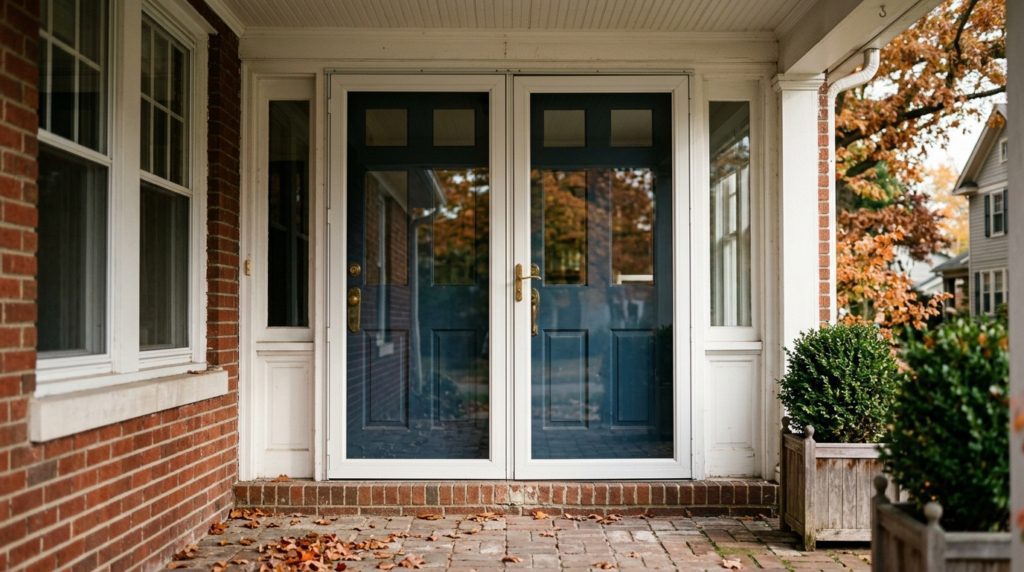
Most storm doors cover a single opening, but a double front entry or a set of French doors needs two panels working as a pair. That is what a double storm door is: two storm panels that meet in the middle of a wide opening, with one side you use every day and one that stays put until you want the whole entry open. They protect the doors behind them from Ohio weather while still letting you swing both leaves wide for furniture or a crowd.
This guide explains how the active and passive panels work, the styles and glass to choose from, the materials that survive a freeze-thaw winter, and the one weak spot installers watch most. If you are weighing a wider entry overall, our doors page covers the matching options. By the end you will know whether a double unit fits your entry or whether a single storm door is the smarter call.
Quick answer: Double storm doors are two storm panels fitted over a wide double-door or French-door entry. One panel is the active door for daily use; the other is held shut by flush bolts and opens only when you need the full width. They add weather protection, light, and ventilation without losing the wide opening.
What Makes a Storm Door "Double"
A standard storm door is a single panel hung on one side of an opening. A double storm door is built for an entry that is too wide for one leaf, where two panels meet in the center instead. The key difference is that there is no permanent post dividing the opening. When both panels swing back, the entire width is clear, which is the whole point of a double entry in the first place.
That clear opening is why people install them over double front doors, French doors, and wide rear or patio entries. A grill, a sofa, or a refrigerator goes straight through without anyone wrestling it around a fixed mullion. The rest of the time, only one side does the work, the same as any ordinary storm door.
It helps to picture the pair as one system rather than two separate doors. The two panels are sized and hung together so they close against each other in a straight, sealed line down the middle. Get that center line right and the pair behaves like a single weathertight barrier; get it wrong and you feel every gap.
Active and Passive Panels: How the Pair Works
In every double setup, one panel is the active door and the other is passive. The active door carries the handle, the latch, and usually the lock, and it is the one you push open to come and go. It does almost all the daily work, so you pick the active side based on how you naturally walk up to the entry and which way feels right to swing.
The passive door stays shut most of the time. It is held in place by flush bolts, slim rods recessed into the top and bottom edges of the panel that slide up into the head jamb and down into the threshold. Throw those bolts and the passive panel becomes a fixed jamb for the active door to latch against. Release them, and the second leaf swings free for that full-width opening.
Where the two panels meet, a piece called an astragal seals the joint. It is the vertical strip that the active door closes against, and it carries the weatherstripping that keeps wind and rain out of the seam. The astragal, the flush bolts, and the latch all have to line up within a small margin, which is exactly why a double install is fussier than a single one.
When a Double Storm Door Makes Sense
The clearest reason to choose a double unit is the opening itself. If your home has a true double front door, a French-door entry to a patio, or a wide rear door, a single storm door simply will not span it. A matched pair keeps the symmetry of the entry, so the storm doors look intentional rather than tacked on, which matters a great deal on a formal or older facade.
Beyond looks, the practical wins line up fast. You get weather protection on both leaves, more daylight through the glass, and real airflow in spring and fall when you swap to screens. Here is where a double earns its keep over a single storm door:
- Moving large items. Both panels open for furniture, appliances, and holiday deliveries with nothing in the middle to dodge.
- Hosting and traffic. A wide, clear entry handles a crowd coming and going without a bottleneck.
- Protecting the doors behind. The storm panels take the wind-driven rain and sun so the entry doors last longer.
- Ventilation and light. Screen and glass inserts let you open the house to a breeze while keeping bugs and weather out.
If your entry is a single standard door, none of this applies, and a regular storm door is the right tool. The double exists specifically to serve wide and paired openings.
Styles and Glass Options
Double storm doors come in the same core styles as single ones, just mirrored into a pair. The choice mostly comes down to how much glass you want and how you plan to ventilate. Each style changes the look of the entry as much as its function, so it is worth matching the glass-to-panel ratio to the doors behind it.
The common configurations break down like this, and most of them are covered in more depth in our guide to storm door types:
- Full-view. Glass from top to bottom on both panels for maximum light and a clear view of the entry doors. The most popular look on double fronts.
- Mid-view or partial-view. A solid lower panel under the glass adds durability and hides kicks and paw marks.
- Ventilating. Sliding glass and screen panels let you adjust airflow without swapping inserts by hand.
- Self-storing screens. Glass and screen both ride in the frame, so you change between them in seconds each season.
The glass itself is a real decision in this climate. Tempered glass resists impact and breaks safely, laminated glass adds security, and an insulated low-E pane cuts heat loss in winter and glare in summer. On a south or west entry that bakes in afternoon sun, a low-E or ventilating option keeps the trapped air between the storm and the entry door from cooking the finish on the door behind it.
Materials That Hold Up in Ohio
Frame material decides how the pair ages through Columbus winters and humid summers. Aluminum is the most common choice: it is light, will not rot, and resists corrosion, which is why most stock storm doors are built from it. A baked enamel finish holds color for years with almost no upkeep, and the low weight keeps the hinges and closers from sagging over time.
Vinyl and composite frames add an insulated core, so they hold a bit more heat and stay quiet in wind. Wood-core doors clad in aluminum give the warm look some older homes call for, but they ask for more careful sealing, because any moisture that works into the wood through a finish gap will freeze, expand, and start the slow rot that ruins a frame from the inside.
Steel is the pick when security is the priority. A steel double storm door with reinforced corners and a heavy-duty lock turns the entry into a real second barrier. Whatever the material, the hardware matters as much as the frame in this climate: ball-bearing hinges and a quality closer keep both panels swinging true after thousands of freeze-thaw cycles have worked at every joint.
The Center Seal and the Freeze-Thaw Problem
The single biggest difference between a double storm door and a single one is that vertical line down the middle where the two panels meet. That seam is the weak point, and in inland Ohio it is the part that fails first. Wind drives rain and snow straight at the joint, and the daily swing from a freezing morning to a milder afternoon works the weatherstripping on the astragal loose a little more each cycle.
On double-door jobs around Columbus, the draft a homeowner feels almost never comes from the glass. It is the passive panel sitting a hair proud of the threshold, or the astragal weatherstrip flattened after a few winters. Reseat the flush bolts and refresh that center strip and the cold seam usually closes right up.
The passive door makes this trickier because it is easy to forget. If its flush bolts are not driven fully into the head jamb and threshold, the panel rocks under wind load, the center seal opens, and that small gap is the draft you feel all season. It is also the easier panel to force, so a passive door that is not properly bolted is a security gap as much as a comfort one. Checking those bolts twice a year is the cheapest maintenance a double unit asks for.
Measuring and Installing the Pair
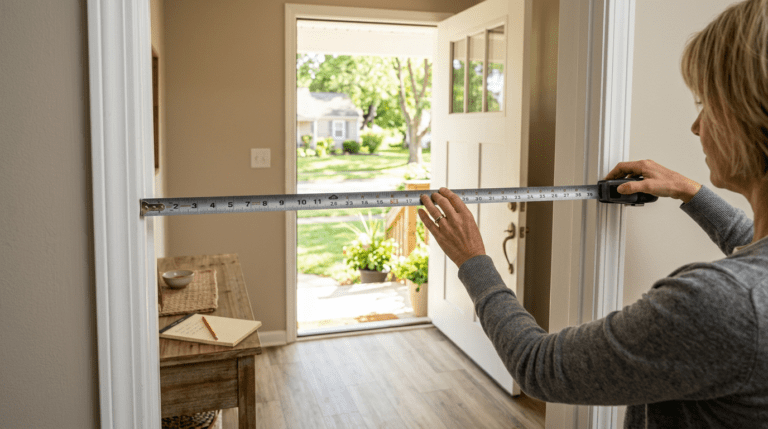
A double storm door lives or dies by its fit, and the measuring is less forgiving than on a single door. You measure the opening width at the top, middle, and bottom, then the height at the left, center, and right, and you build to the smallest number in each direction. Older Columbus homes make this matter: decades of settling often leave the bottom of a wide opening reading wider than the top, and a pair built to the easy middle number will bind or leave a gap. The same careful approach we cover for a single unit in measuring for a storm door applies here, doubled.
The opening also has to be square and plumb, with a solid, flat mounting surface on both jambs for the hinges and Z-bar. If the frame is out of square, the astragal will not meet cleanly and the flush bolts will fight their strikes. Many double openings on older or custom entries are not a stock size, so the pair is built to fit rather than pulled off a shelf.
Installation is where most homeowners hand it off. Hanging two panels so they meet in a straight, sealed line, with the flush bolts and latch all aligned, takes more patience and a second set of hands than a single door. The mechanics are similar to a single storm door installation, but every alignment step happens twice and has to agree in the middle. A small error that a single door shrugs off will leave a double pair drafty or hard to latch.
When a Single Storm Door Is the Better Call
A double unit is not automatically the right answer just because the entry has two doors. The honest question is how you actually use the opening. If you almost never swing both leaves, and the second door is decorative or rarely touched, a single oversized storm door on the active side can cover the working leaf for far less complexity and a tighter, simpler seal.
Site conditions can decide it too. A narrow stoop with no room to stand both storm panels open, a porch post that blocks one swing, or jambs with no flat mounting surface all push toward a single solution. There is no sense fitting a pair that cannot fully open or seal where it counts.
The trade-off is symmetry and the full-width opening. If you value the matched look of two panels, or you genuinely move large items through the entry, the double earns its extra cost and care. If you do not, a single storm door gives you most of the weather protection with less to align and less to maintain. Weigh how the entry is used day to day before you commit to the pair.
Not Sure a Double Unit Fits Your Entry?
Wide and double-door entries rarely come in stock sizes, and the fit is what makes a double storm door seal tight or sit drafty. A quick look at your opening tells you whether a matched pair, a single oversized door, or a fresh entry setup is the right move for your home.
Book a free, no-pressure entry assessment with our Columbus and Cincinnati team and get a straight answer on what fits your opening and your weather.
FAQ: Double Storm Doors

Ready to fix your windows? Get a free quote in 30 seconds.
Family-owned, licensed & insured. Free, no-obligation quotes.