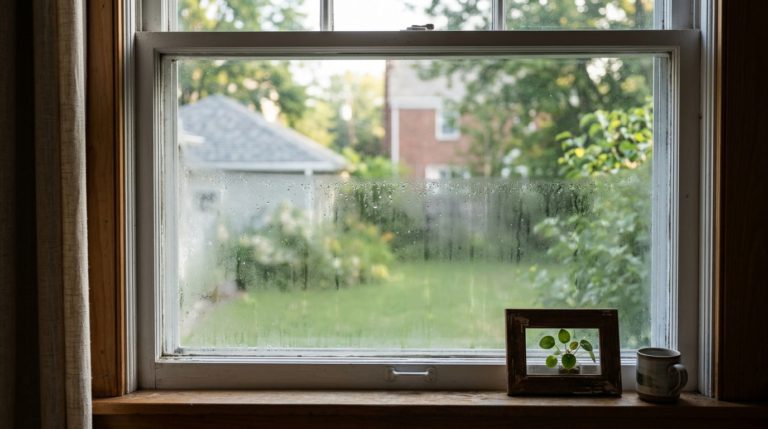
A crack appears in a window and the first thought is always the same: what hit it? But most cracked panes around Columbus were never struck by anything. Glass fails for a handful of predictable reasons, and once you know the pattern a crack leaves behind, you can usually read the cause off the glass itself and decide what to do next.
This guide covers the three main reasons windows crack, the less common ones that catch people off guard, how to tell a thermal break from an impact hit at a glance, and the steps that actually prevent the next one. If a pane is already gone, a clean read on why it cracked also tells you whether it is a quick glass swap or a sign you need a new window installed.
Quick answer: Windows crack for three main reasons: thermal stress from uneven heating and cooling of the glass, impact from an object striking it, and pressure changes inside a sealed double-pane unit. Less often, foundation settling, a too-tight frame, or a forced sash adds edge stress. The crack’s shape usually reveals which one it was.
The Three Main Reasons Windows Crack
Almost every cracked pane traces back to one of three forces, and they leave different fingerprints on the glass. Thermal stress comes from the glass heating and cooling unevenly, so one part expands while another stays put and the sheet tears itself along the line of tension. Impact is the obvious one: a ball, a stone thrown up by a mower, hail, or a bird hits the surface and the glass radiates outward from the hit. Pressure cracks form inside sealed insulated units when the trapped air or gas expands and contracts against a fixed pane.
The reason the cause matters is that it changes the fix and the odds it happens again. An impact crack is bad luck and a one-time event. A thermal stress crack means the glass, its exposure, or its installation set up a tension the pane could not survive, and the replacement can fail the same way if nothing changes. Pressure and seal problems point at the insulated unit itself.
Beyond the big three sit a few quieter causes worth knowing: a house settling on its foundation, a frame screwed in too tight to let the glass move, a manufacturing flaw in the glass edge, and the simple habit of forcing a stuck sash. Each one shows up differently, and the rest of this guide walks through reading them.
Thermal Stress Cracks: The Most Common Culprit
Thermal stress is the cause behind most of the mystery cracks we get called about, the ones with no chip, no point of impact, and no obvious story. Glass expands when it warms and contracts when it cools. When sunlight heats the center of a pane while the edges stay cool in the shadow of the frame, the hot middle pushes against cool, rigid edges until the tension finds the weakest point and releases as a crack.
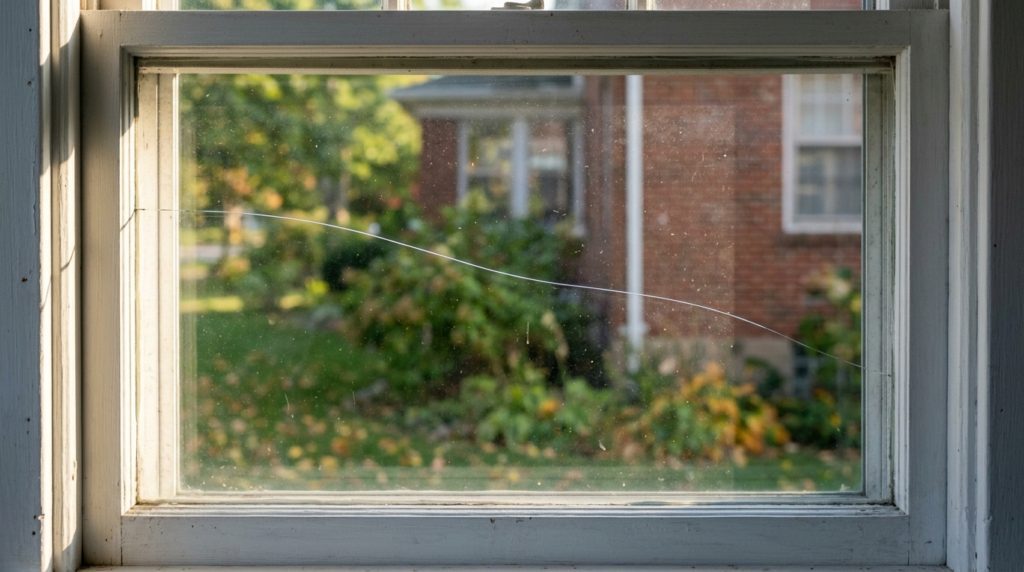
The signature is unmistakable once you have seen it. A thermal stress crack starts at the edge of the glass, runs in at a roughly 90-degree angle to the frame, then often curves or wanders gently across the pane. There is no starburst and no center, because nothing struck it. Large windows on partly shaded walls are the classic victims, since the half-sun, half-shadow split is exactly the uneven heating the glass cannot handle.
Standard annealed glass is the most vulnerable. Heat-treated glass, which is reheated and rapidly cooled at the factory, resists thermal stress several times better, which is why it goes into the spots most exposed to fast temperature swings. You can read more on how that strengthening works in our explainer on annealed versus tempered glass.
Impact Cracks: When Something Hits the Glass
Impact cracks are the easiest to diagnose because the glass tells the whole story. The break radiates out from a single point in a starburst or spiderweb pattern, and there is usually a visible mark, a small chip, or even a hole at the center where the object made contact. The harder and more direct the hit, the more the lines fan out and the closer the pane comes to shattering outright.
The culprits are familiar. A baseball or golf ball from the yard, a stone kicked up by a lawnmower, wind-driven debris during a storm, hail during Ohio’s spring and summer storm season, or a bird striking the reflection in the glass. On lower windows, kids and pets account for a fair share. None of these reflect a problem with the window itself; the glass simply met more force than it could absorb.
What matters with an impact crack is the glass type and location. Ordinary single-pane glass breaks into long, sharp shards, while safety glass breaks into blunt pebbles by design. Panes near doors, stairs, and floors are required to be safety glass for exactly this reason, a point we cover in our guide to tempered safety glass.
Pressure Cracks and Failed Seals in Double-Pane Glass
Modern windows are usually insulated units: two panes of glass with a sealed pocket of dry air or argon gas between them. That sealed pocket is what makes them efficient, but it also introduces a failure mode single-pane windows never had. When outdoor air pressure shifts sharply, the trapped gas expands or contracts and pushes against the panes, and the result can be a pressure crack with a distinctive curved, hourglass shape and no point of impact.
Pressure cracks are uncommon in flat central Ohio, since they are tied to big elevation changes or extreme weather swings, but seal trouble is not. A more frequent issue is the edge seal between the panes giving out under years of freeze-thaw flexing. That does not always crack the glass; more often it lets humid air seep in and fog the unit from the inside, a milky haze you cannot wipe away.
It is worth telling the two apart before you call it a crack. A true crack is a sharp line you can feel; a foggy, cloudy pane is a failed seal. If yours is hazing rather than cracking, our walkthrough on fixing foggy double-pane windows covers it, and a sealed-unit problem usually routes to insulated glass repair rather than a full replacement.
Edge Cracks, Settling, and Forced Sashes
A smaller set of cracks comes from stress the glass should never have carried in the first place. Edge cracks begin at the perimeter and work inward, and they usually trace back to installation: a frame set out of square, glazing screwed in too tight, or shims that leave no room for the glass to expand. When a rigid frame fights the glass instead of cradling it, the corners take the load and eventually split.
Older Columbus homes add their own twist. As a foundation settles over decades, the rough opening can rack slightly out of square and transfer that movement straight into the sash and glass. The same goes for the common habit of muscling a painted-shut or swollen window open: the sudden flex finds a weak edge and starts a crack that grows with every season.
These are the cases where a crack is a symptom of something larger. A single edge crack on one window is usually just that window, but matching cracks on several units, or a sash that has visibly dropped out of square, can point to frame rot or structural movement that a new pane alone will not solve.
Why Cracks Spike in Ohio's Spring and Fall
If you tally service calls about mystery cracks, they cluster in spring and fall rather than the dead of winter or the peak of summer. The reason is the size of the daily swing. In the shoulder seasons a central Ohio day can start at a hard frost, climb into warm afternoon sun, and drop back below freezing overnight. That whole arc plays out on a single pane, and the faster the glass goes from cold to hot, the sharper the tension across it.
South- and west-facing windows take the worst of it, especially any pane that sits half in the sun and half in the shadow of a tree, an eave, or a neighboring wall. The lit half expands hard while the shaded half stays frozen, and an annealed pane can only take so much of that split before it lets go. Add a winter habit that quietly makes it worse: blasting a heat register or a space heater straight onto cold glass warms the center while the framed edges stay icy.
On jobs around Columbus, a window that cracks in March or October with no chip and no story is almost always thermal stress, not vandalism. The crack starts at the edge and curves in, and nine times out of ten it is a big, half-shaded pane on the sunny side of the house.
How to Tell What Kind of Crack You Have
You can usually identify the cause yourself in under a minute by reading the line the crack draws and checking for a point of contact. That read matters because it decides your next step: a one-off impact is simple, while a thermal or seal pattern is a hint about exposure or the unit itself. Step back, look at where the crack starts, and follow where it goes.
Use the quick field below the way our technicians do on a first walkthrough, then confirm by feeling the glass: a true crack is a sharp ridge, while a failed seal is a haze trapped where you cannot touch it.
- Starts at the edge, runs in at 90 degrees, then curves with no chip or center: thermal stress.
- Radiates from one point in a starburst with a mark or hole: an impact.
- A clean, curved, hourglass line with no contact point on a sealed unit: pressure.
- Begins in a corner or along the perimeter and creeps inward: an edge or installation stress crack.
- Milky haze you cannot wipe off, not a sharp line: a failed seal, not a crack at all.
Can You Prevent Window Cracks?
You cannot stop a stray baseball, but most of the cracks that are not pure bad luck are preventable, and prevention starts before the glass ever goes in. The single biggest lever is the glass itself. Heat-treated or tempered glass shrugs off the temperature swings that snap annealed panes, which is why it belongs in big, sun-exposed, or partly shaded openings where thermal stress is most likely.
Exposure is the next lever. A pane that is fully sunlit or fully shaded handles heat far better than one split down the middle, so trimming a branch or rethinking a heavy awning that throws a hard shadow line can take the load off the glass. Keep heat sources off cold windows too, and route registers and space heaters so they are not aimed at the panes through an Ohio winter.
The rest is craftsmanship and upkeep. Run through the checklist below, and remember that a square, properly shimmed frame that lets the glass move is the quiet difference between a window that lasts and one that cracks at the corner.
- Choose heat-treated glass for large, south- or west-facing, and partly shaded windows.
- Even out sun exposure by trimming branches that cast a hard half-shadow on the glass.
- Keep heat off the glass by aiming vents and space heaters away from cold panes.
- Insist on a square, properly shimmed install so the frame never pinches the glass.
- Close gently and never force a stuck sash until you find what is binding it.
Should You Repair or Replace a Cracked Window?
Whether a crack is a quick fix or a replacement comes down to the glass type and how far the damage reaches. A small crack in a single pane of ordinary glass can sometimes be stabilized, but on any window that matters for comfort or efficiency the glass gets swapped rather than patched, because a crack only spreads with the next temperature swing.
Double-pane units change the math. Once one pane of an insulated unit cracks, the sealed pocket is compromised, the insulating gas escapes, and the unit loses the efficiency it was built for. In most cases the right move is to replace the glass unit while keeping the existing frame, which is faster and tidier than tearing out the whole window. Our overview of glass repair and replacement walks through what that involves.
The replacement decision tips toward a whole new window when the frame is rotted, racked out of square, or when several units are failing at once. A crack from foundation movement or a frame past its service life is a signal to look at the opening, not just the pane. When you are unsure, a quick look at the crack pattern and the frame condition gives a clear answer.
Cracked Window You Want Looked At?
If a pane has cracked and you cannot tell whether it was a one-time impact or a sign of a deeper problem, a few minutes of diagnosis settles it. Reading the crack, checking the frame, and confirming whether the seal is intact tells you fast whether it is a simple glass swap or something the whole opening needs.
Book a free, no-pressure window assessment with our Columbus and Cincinnati team and get a straight answer on what cracked, why, and what it takes to fix it for good.
FAQ: Cracked Windows

Ready to fix your windows? Get a free quote in 30 seconds.
Family-owned, licensed & insured. Free, no-obligation quotes.